Curiosity and the Brain: 7 Powerful Ways It Boosts Learning and Memory

Curiosity is more than a feeling of interest it is a biological process that activates specific systems in the brain. When curiosity is triggered, the brain prepares itself to learn, remember, and explore. This article explores curiosity and the brain, explaining how curiosity activates neural systems, dopamine, and learning processes.

Understanding what happens in the brain during curiosity helps explain why curiosity improves learning, motivation, and memory.

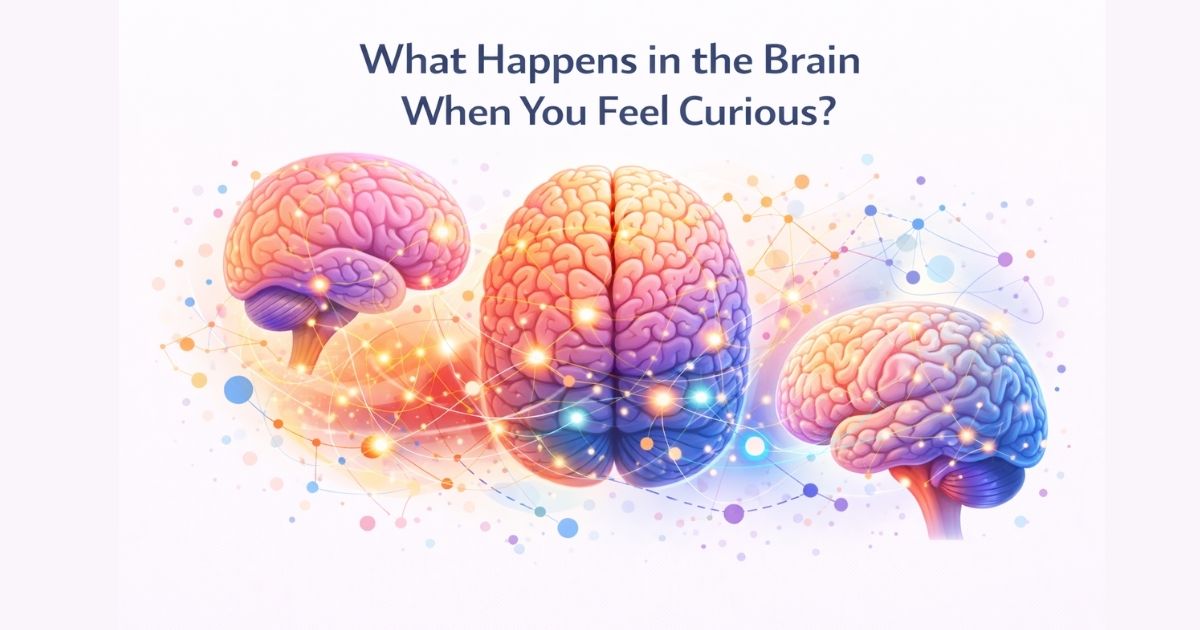
curiosity and the brain showing dopamine activation and memory enhancement

Table of Contents

7 Powerful Brain Mechanisms Behind the Neuroscience of Curiosity

Understanding the neuroscience of curiosity reveals that curiosity is not just an emotional impulse but a coordinated brain response involving motivation, reward, memory, and executive control systems. Modern cognitive curiosity studies show that curiosity activates structured neural pathways that prepare the brain for learning and adaptive behavior.

Below are seven core brain mechanisms that explain the neurological basis of curiosity and its powerful impact on learning and memory.

1. Information Gap Detection System

Curiosity begins when the brain detects a mismatch between existing knowledge and new information. This cognitive tension activates exploratory circuits and signals that learning is required.

Research in the psychology of curiosity and motivation shows that this gap-detection process drives question-asking and investigative behavior. Without this initial trigger, deeper learning rarely begins.

2. Dopamine-Based Reward Activation

One of the most studied brain functions related to curiosity involves dopamine release. When uncertainty appears, dopamine increases in anticipation of gaining knowledge.

This mechanism links curiosity and learning directly. Dopamine enhances focus and strengthens motivation, making the process of discovery feel intrinsically rewarding.

Curiosity, therefore, is reinforced biologically — not just psychologically.

3. Activation of the Brain’s Reward Circuitry

Beyond dopamine release, curiosity stimulates broader reward networks in the brain. These systems signal that resolving uncertainty has value.

The neurological basis of curiosity shows that the brain treats information acquisition similarly to tangible rewards. This explains why satisfying curiosity often produces a feeling of completion or relief.

4. Hippocampus Engagement and Memory Encoding

Curiosity significantly increases activity in the hippocampus — a key structure involved in memory formation.

Studies on curiosity and memory formation indicate that information learned during states of curiosity is encoded more deeply and retained longer. The hippocampus becomes more receptive to incoming information when curiosity is active.

This mechanism explains why curiosity improves long-term retention.

5. Enhanced Attention and Cognitive Control

Curiosity activates regions of the prefrontal cortex responsible for attention regulation and executive function.

This strengthens selective focus and reduces cognitive resistance. In applied settings, this mechanism explains why curiosity and learning are strongly correlated — the brain becomes more attentive and less distracted.

Curiosity essentially primes the mind for disciplined engagement.

6. Increased Cognitive Flexibility

Research in cognitive curiosity studies shows that curiosity enhances mental flexibility. Curious individuals are more likely to explore alternative solutions, consider multiple perspectives, and adapt to new information.

This flexibility supports creative thinking and innovation.

It also connects directly to curiosity and decision making in the brain, where exploratory processing allows for better evaluation of options.

7. Decision-Making Optimization Through Exploration

Curiosity influences how the brain evaluates choices. When curious, individuals gather more information before making decisions.

Neuroscientific findings on curiosity and decision making in the brain suggest that curiosity improves adaptive decision-making by encouraging evidence-based exploration rather than impulsive reactions.

This final mechanism shows that curiosity is not only about learning — it is about intelligent behavior.

How Curiosity and the Brain Work Together
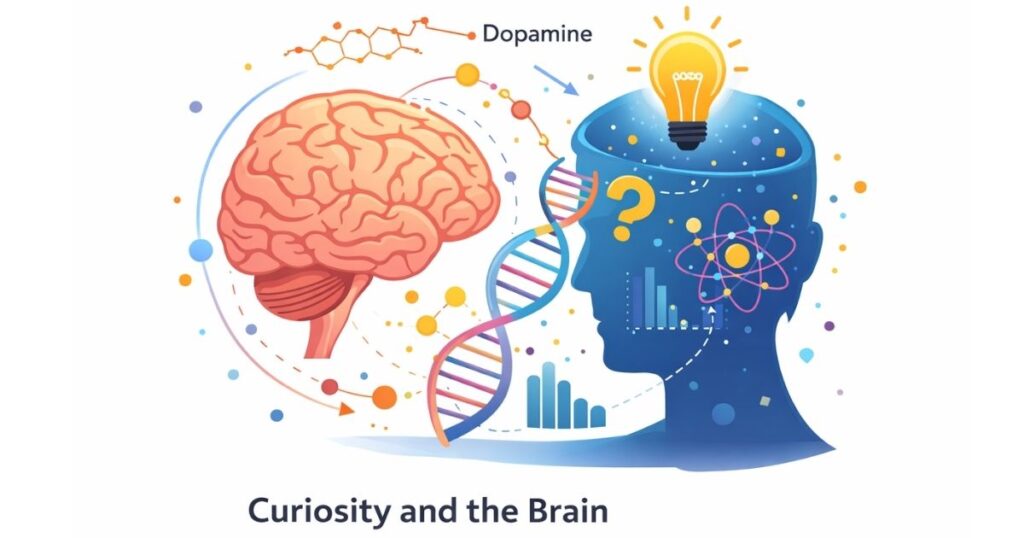
When you encounter a question, mystery, or information gap, the brain immediately responds.

Neuroscientific studies show that curiosity activates:

  • The dopamine reward system
  • Brain regions responsible for learning and memory
  • Areas linked to motivation and attention

This activation encourages the brain to seek answers and remain engaged until the gap is closed.

How Curiosity and the Brain Work Together in Everyday Life

Curiosity and the brain interact constantly in everyday situations, even when we are not consciously aware of it. When we encounter something unfamiliar such as a new idea, problem, or question the brain detects an information gap. This triggers neural systems related to attention, motivation, and reward.

Research shows that curiosity increases activity in the hippocampus, a brain region involved in learning and memory. At the same time, dopamine is released, making the process of learning feel rewarding. This is why people tend to remember information better when they are genuinely curious about it.

In daily life, this brain response explains why curiosity improves problem-solving, creativity, and decision-making. Curious individuals are more likely to explore multiple perspectives, ask better questions, and adapt to new situations. Over time, this strengthens cognitive flexibility and supports lifelong learning.

Understanding how curiosity and the brain work together allows us to use curiosity intentionally as a tool for personal growth, education, and mental resilience.

The Role of Dopamine in Curiosity

Dopamine is a neurotransmitter commonly associated with pleasure and motivation. When curiosity is sparked, dopamine levels increase, similar to what happens when we anticipate a reward.

This dopamine response:

  • Increases motivation to explore
  • Enhances focus and attention
  • Makes learning feel enjoyable

Because of this, the brain treats information gained through curiosity as valuable and rewarding.

Neuroscientific findings on curiosity and memory consolidation are supported by research published by the National Institutes of Health.

Curiosity and Memory Formation

One of the most important effects of curiosity is its impact on memory.

When curiosity is active:

  • The hippocampus (memory center) becomes more engaged
  • New information is encoded more effectively
  • Long-term retention improves

This is why people often remember information better when they were genuinely curious about it rather than forced to learn it.

Why Curiosity Improves Learning

Curiosity primes the brain for learning by:

  • Increasing attention span
  • Reducing mental resistance
  • Encouraging deeper information processing

This explains why curiosity-driven learning is often more effective than passive memorization.

To understand this process in a broader psychological context, this curiosity explained guide explores how curiosity shapes learning, behavior, and motivation across the human lifespan.

Curiosity, the Brain, and Human Behavior

Curiosity does not only affect learning it also influences behavior.

When the brain is curious:

  • People are more open to new experiences
  • Problem-solving becomes more flexible
  • Creativity increases
  • Adaptation to change improves

This brain-based response explains why curiosity is closely linked to innovation and personal growth.

Curiosity vs. Distraction in the Brain

Not all information-seeking behavior is healthy curiosity.

True curiosity:

  • Involves focused attention
  • Leads to understanding
  • Has a clear learning outcome

Distraction-driven behavior:

  • Is impulsive
  • Short-lived
  • Often lacks meaningful retention

Understanding this difference helps individuals use curiosity more intentionally and avoid information overload.

How Curiosity Improves Learning and Memory

Curiosity and the brain work together to enhance learning by increasing attention and engagement. When we feel curious, the brain prioritizes incoming information, making it easier to understand and remember new concepts. Studies show that curiosity activates the hippocampus, a region critical for memory formation, allowing information learned during curious states to be retained longer.

This is why curiosity plays such an important role in education, creativity, and problem-solving. When learners are genuinely curious, they are more motivated, focused, and open to new ideas. Understanding how curiosity affects the brain helps explain why curiosity-driven learning is more effective than passive information consumption.

Frequently Asked Questions About Curiosity and the Brain

  1. What happens in the brain when we feel curious?

    When curiosity is triggered, the brain activates the dopamine reward system and increases activity in the hippocampus, which supports learning and memory. This creates a learning-ready state where attention improves and information is encoded more effectively. Curiosity signals that knowledge is valuable, encouraging exploration and engagement.

  2. How does dopamine influence curiosity?

    Dopamine increases when we anticipate discovering new information. This neurotransmitter enhances motivation, focus, and attention. During curiosity, dopamine does not simply create pleasure — it strengthens learning pathways by signaling that resolving uncertainty is rewarding.

  3. Why does curiosity improve memory?

    Curiosity improves memory because it activates the hippocampus, a brain region responsible for encoding and consolidating new information. When the brain is curious, it prioritizes incoming data, making it easier to retain and recall later. Information learned in a curious state is often remembered longer.

  4. Is curiosity linked to intelligence?

    Curiosity is strongly associated with learning and cognitive flexibility, but it is not the same as intelligence. Curious individuals tend to explore more, ask deeper questions, and seek understanding, which can support intellectual growth over time.

  5. Can curiosity change the brain?

    Yes. Repeated curiosity-driven learning strengthens neural pathways through neuroplasticity. When individuals frequently explore new ideas, the brain adapts by forming stronger and more efficient connections, improving cognitive flexibility and long-term learning capacity.

  6. What brain regions are involved in curiosity?

    Curiosity primarily activates:
    The hippocampus (learning and memory)
    The prefrontal cortex (decision-making and attention)
    Dopamine-related reward pathways
    Together, these regions coordinate exploration, motivation, and information processing.

  7. How is curiosity different from distraction in the brain?

    Curiosity involves focused attention and purposeful exploration aimed at understanding. Distraction-driven behavior is impulsive, short-lived, and often lacks meaningful retention. True curiosity enhances learning, while distraction fragments attention and reduces memory consolidation.

  8. Why does curiosity make learning feel enjoyable?

    Curiosity increases dopamine levels, which enhance motivation and anticipation of reward. This makes the process of discovering new information feel satisfying, reinforcing further learning behavior.

  9. Does curiosity help with problem-solving?

    Yes. When the brain is curious, it becomes more open to exploring multiple solutions. Curiosity increases cognitive flexibility, improves attention to detail, and encourages deeper processing — all of which strengthen problem-solving ability.

  10. Can curiosity be strengthened?

    Curiosity can be strengthened by regularly exposing yourself to new ideas, asking open-ended questions, and actively seeking understanding rather than passive information. Engaging with meaningful challenges stimulates neural systems involved in exploration and learning.

Final Thoughts

When curiosity is activated, the brain enters a learning-ready state. Dopamine release, increased attention, and enhanced memory formation work together to make curiosity one of the most powerful drivers of human intelligence.

Curiosity is not just a trait it is a neural advantage that supports lifelong learning and adaptability.

Leave a Comment

Scroll to Top