
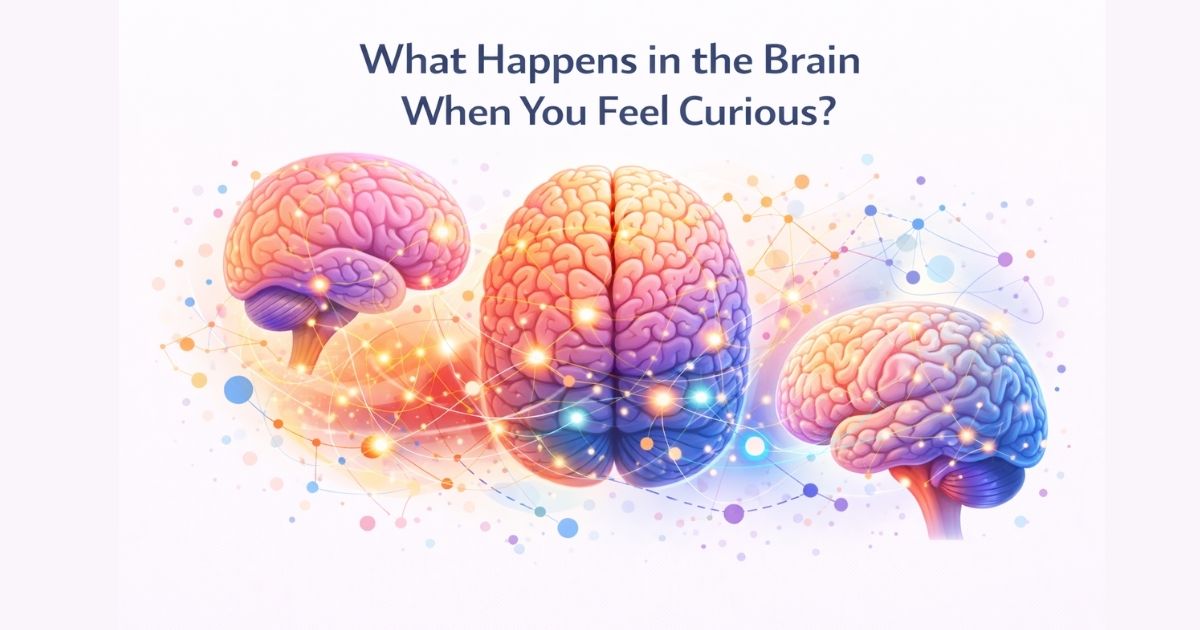
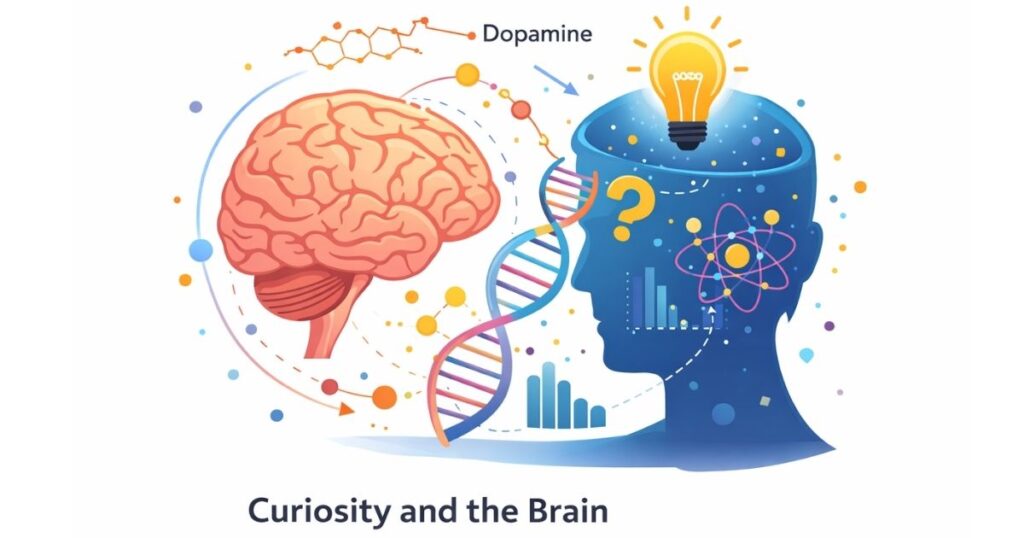
Quick answer: Curiosity and the brain are closely linked: when you feel curious, your brain treats information like a reward. The dopamine reward circuit (the midbrain and the striatum, including the caudate and nucleus accumbens) becomes more active, much as it does when you anticipate food or money. Dopamine also boosts the hippocampus, which helps store memories, so you remember things you were curious about better. The uncomfortable “need to know” feeling involves areas such as the anterior insula and anterior cingulate cortex.
Curiosity feels like a simple urge, but neuroscience shows it is a carefully organized process involving reward, memory, attention and even discomfort. Over the last two decades, brain-scanning studies have revealed what happens inside your head from the moment a question grabs you to the moment you learn the answer.
Which parts of the brain control curiosity?
There is no single “curiosity center”. Instead, several brain networks work together:
| Brain area | Role in curiosity |
|---|---|
| Ventral tegmental area and substantia nigra (midbrain) | Release dopamine, signaling that information is valuable |
| Striatum (caudate and nucleus accumbens) | Reward anticipation; “wanting” to know the answer |
| Hippocampus | Forms new memories; works harder during curious states |
| Anterior insula and anterior cingulate cortex | Register the uncomfortable gap or conflict that triggers curiosity |
| Prefrontal cortex | Evaluates what is worth exploring and plans how to find out |
Curiosity and dopamine: information as a reward
Dopamine is often called the “pleasure chemical”, but a better description is the brain’s “this is worth pursuing” signal. It rises when we expect something valuable.
Several studies show that information triggers this same system:
- Kang and colleagues (2009) found that curiosity about trivia answers activated the caudate, a reward region. People also paid scarce tokens and waited longer to see answers they were curious about.
- Bromberg-Martin and Hikosaka (2009) found that dopamine neurons in monkeys responded to advance information about upcoming rewards, as if the information were a reward itself.
- Lau and colleagues (2020) showed that people would accept the risk of a mild electric shock to satisfy curiosity, and that the decision used the same striatal activity as accepting a shock for food when hungry.
In other words, the brain values knowing in a similar way to how it values eating. That helps explain why humans are so curious.
How curiosity improves memory
In a landmark 2014 study, Matthias Gruber, Bernard Gelman and Charan Ranganath at the University of California, Davis asked volunteers to rate their curiosity about trivia questions while their brains were scanned.
- When curiosity was high, activity rose in the midbrain dopamine areas and the nucleus accumbens.
- Connections between the midbrain and the hippocampus also strengthened.
- People remembered the answers to high-curiosity questions better.
- Surprisingly, they also remembered unrelated faces shown while they were waiting for answers, even when tested a day later.
The takeaway: curiosity puts the brain into a state that makes learning easier for anything that comes along. This is why curiosity is so powerful for students (see curiosity and learning).
Why curiosity can feel uncomfortable
Not all curiosity feels pleasant. The tip-of-the-tongue feeling or an unsolved puzzle can be frustrating. A 2012 study by Marieke Jepma and colleagues showed people blurry pictures of objects. Not knowing what they were looking at activated the anterior insula and anterior cingulate cortex, areas linked to unpleasant states such as conflict. When the clear image appeared and curiosity was relieved, reward areas in the striatum became active.
So curiosity has two faces: the pleasant urge to explore, and the itch of a gap you need to close. Psychologists call these interest-type and deprivation-type curiosity.
How curiosity and the brain work together, step by step
- Noticing a gap. You meet something surprising or incomplete. Conflict-monitoring areas flag it.
- Valuing the answer. The prefrontal cortex and dopamine system judge whether the information is worth getting.
- Anticipation. The striatum ramps up, creating the “I want to know” feeling.
- Exploring. Attention narrows on finding the answer.
- Resolution. Learning the answer produces a reward response, and the hippocampus stores it more strongly.
Curiosity vs distraction
Curiosity and distraction both pull attention toward something new, but they work differently. Curiosity is goal-directed: it keeps you focused on closing a specific gap. Distraction is usually triggered by flashy stimuli, such as notifications, and jumps from one thing to the next without building knowledge. Endless scrolling can mimic curiosity because it provides constant novelty, but it rarely creates the deep “need to know” that strengthens memory.
Does curiosity change with age?
Young children show intense curiosity, and asking questions is one of their main ways of learning. Research suggests that general curiosity tends to decline somewhat with age, but specific interests can grow stronger. Staying curious may also be good for the brain: older adults who keep learning new, challenging skills show cognitive benefits in several studies, though more research is needed on curiosity itself.
Curiosity and the brain: key takeaways
- Curiosity uses the brain’s dopamine reward system, the same system that responds to food and money.
- Curious states strengthen the hippocampus and improve memory.
- The frustrating side of curiosity involves the anterior insula and anterior cingulate cortex.
- Learning the answer produces a reward response, which keeps us exploring.
Frequently asked questions
What part of the brain is responsible for curiosity?
Curiosity involves several areas: the midbrain dopamine regions and striatum for reward, the hippocampus for memory, the anterior insula and anterior cingulate cortex for detecting gaps, and the prefrontal cortex for deciding what to explore.
Does curiosity release dopamine?
Yes. Studies show curiosity activates dopamine-rich reward areas, and dopamine neurons respond to information about upcoming rewards as if it were a reward.
Why does curiosity help memory?
Dopamine released during curiosity strengthens activity in the hippocampus, the brain’s memory hub, so information learned during curious states is stored better.
Is curiosity good for your brain?
Curiosity supports learning, memory and motivation. Keeping the brain engaged with new challenges is also linked to healthier cognitive aging.
Related articles
- What is curiosity?
- Curiosity and learning
- Curiosity and motivation
- Why do we dream?
- Curiosity vs interest
Sources
- Gruber, M. J., Gelman, B. D. & Ranganath, C. (2014). “States of curiosity modulate hippocampus-dependent learning via the dopaminergic circuit.” Neuron. doi:10.1016/j.neuron.2014.08.060
- Kidd, C. & Hayden, B. Y. (2015). “The psychology and neuroscience of curiosity.” Neuron. doi:10.1016/j.neuron.2015.09.010
- Kang, M. J. et al. (2009). “The wick in the candle of learning.” Psychological Science. doi:10.1111/j.1467-9280.2009.02402.x
- Bromberg-Martin, E. S. & Hikosaka, O. (2009). “Midbrain dopamine neurons signal preference for advance information about upcoming rewards.” Neuron.
- Jepma, M. et al. (2012). “Neural mechanisms underlying the induction and relief of perceptual curiosity.” Frontiers in Behavioral Neuroscience.
- Lau, J. K. L. et al. (2020). “Shared striatal activity in decisions to satisfy curiosity and hunger at the risk of electric shocks.” Nature Human Behaviour.