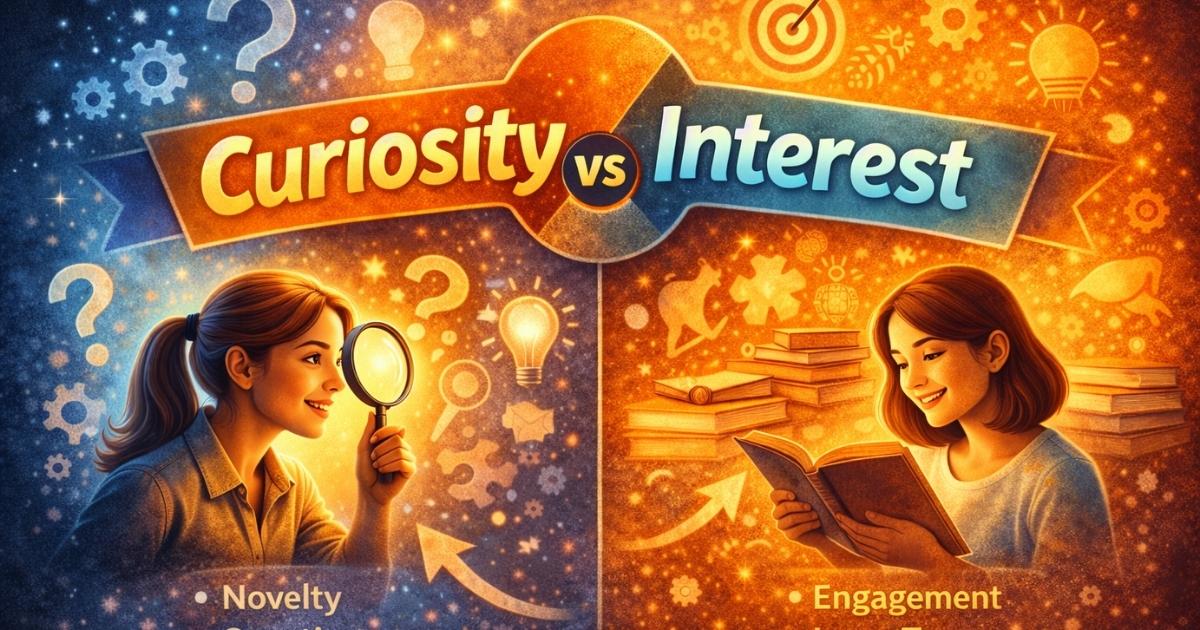
Curiosity vs interest is a common topic in psychology, especially when discussing learning, motivation, and human behavior. While curiosity and interest are closely related, they are not the same. Understanding the difference between curiosity and interest helps explain how people explore new ideas, develop long-term passions, and stay motivated.
Curiosity vs Interest in Psychology
In psychology, curiosity and interest represent two different motivational states. Curiosity is typically triggered by a lack of knowledge or an information gap, while interest develops when someone already has familiarity or enjoyment with a subject.
Curiosity pushes individuals to ask questions and seek answers. Interest, on the other hand, encourages deeper engagement over time.
What Is Curiosity?
Curiosity is the desire to know something new. It often arises suddenly when a person encounters uncertainty, novelty, or a question they cannot immediately answer.
Key characteristics of curiosity:
- Triggered by the unknown
- Short-term but intense
- Focused on exploration
- Motivated by information gaps
Curiosity plays a critical role in learning by initiating exploration and discovery.
What Is Interest?
Interest develops when someone repeatedly engages with a topic and finds it meaningful or enjoyable. Unlike curiosity, interest tends to be more stable and long-lasting.
Key characteristics of interest:
- Builds over time
- Sustained engagement
- Emotional connection to a topic
- Supports long-term learning
Interest often grows after curiosity is satisfied, making it essential for mastery and lifelong learning.
Curiosity vs Interest: Understanding the Key Psychological Differences
Curiosity vs interest is a common comparison in psychology because both concepts influence attention, learning, and motivation, yet they operate in fundamentally different ways. Curiosity is the psychological drive that emerges when a person becomes aware of a gap in knowledge and feels compelled to resolve it. Interest, on the other hand, develops when an individual already finds a topic enjoyable, meaningful, or personally relevant. Understanding the difference between curiosity vs interest helps explain why humans sometimes explore unfamiliar topics while, at other times, remain deeply engaged with subjects they already know well.
From a psychological perspective, curiosity vs interest represents two distinct stages of mental engagement. Curiosity is often the starting point. It arises in response to uncertainty, novelty, or missing information. When people encounter something they do not understand, curiosity creates a sense of mental tension that motivates exploration. Interest usually follows curiosity. Once basic understanding is achieved, interest can develop into a sustained emotional and cognitive attachment to a topic. This sequence explains why curiosity often leads to learning, while interest supports long-term focus and commitment.
Curiosity vs interest also differs in how each affects attention. Curiosity tends to be short-term but intense. It pulls attention toward new questions, unfamiliar ideas, or surprising information. Interest, by contrast, is more stable and enduring. When someone is interested in a subject, attention remains focused over longer periods, even without novelty. In psychology, this distinction is important because curiosity helps initiate learning, while interest helps maintain it. Both are essential, but they serve different roles in cognitive development.
Another key difference between curiosity vs interest lies in emotional experience. Curiosity is often accompanied by anticipation and uncertainty. The mind seeks resolution, and satisfaction comes from finding answers. Interest is associated with enjoyment, familiarity, and personal relevance. People engage with interests because they find them rewarding, not necessarily because they lack understanding. This emotional distinction explains why curiosity can fade once a question is answered, while interest can deepen over time as knowledge expands.
Curiosity vs interest also plays different roles in motivation. Curiosity is an intrinsic motivator driven by the desire to reduce uncertainty. It pushes individuals to explore new ideas even when there is no external reward. Interest, however, motivates continued engagement and mastery. When people are interested in a subject, they are more willing to invest time, effort, and persistence. In psychological research, curiosity is often linked to exploration, while interest is linked to sustained learning and skill development.
In educational psychology, understanding curiosity vs interest is especially important. Curiosity helps students engage with new material by triggering questions and encouraging exploration. Interest helps students remain engaged over time, supporting deeper understanding and long-term retention. Effective learning environments often aim to spark curiosity first and then cultivate interest through relevance, meaning, and personal connection. This progression highlights why curiosity and interest should not be treated as interchangeable concepts.
To fully understand curiosity vs interest, it is helpful to first understand the broader definition of curiosity itself. You can explore this foundational concept in the What Is Curiosity authority article, which explains how curiosity functions as a core psychological process that drives exploration, learning, and human development. This broader understanding provides context for how curiosity differs from interest and why both are essential components of motivation and cognition.
In summary, curiosity vs interest represents two complementary psychological forces rather than opposing ones. Curiosity initiates exploration by drawing attention to what is unknown, while interest sustains engagement by deepening connection to what is known. Together, they shape how humans learn, grow, and interact with the world. Recognizing the distinction between curiosity vs interest allows for a clearer understanding of human behavior, learning patterns, and the psychological mechanisms that support lifelong development.
How Curiosity vs Interest Affects Learning
Curiosity vs interest impacts learning in different but complementary ways. Curiosity helps learners start the learning process, while interest helps them continue.
Curiosity:
- Sparks initial exploration
- Encourages question-asking
- Helps overcome boredom
Interest:
- Supports deeper understanding
- Encourages long-term study
- Improves persistence
Together, curiosity and interest create a powerful learning cycle.
Curiosity vs Interest and Motivation
Motivation is influenced differently by curiosity and interest. Curiosity-driven motivation is often short-lived but powerful, while interest-driven motivation is more stable and enduring.
Curiosity motivates people to:
- Seek answers
- Explore unfamiliar topics
- Resolve uncertainty
Interest motivates people to:
- Practice skills
- Invest time and effort
- Develop expertise
Understanding this difference explains why curiosity often leads to interest over time.
How Curiosity Turns into Interest
In many cases, curiosity is the starting point that leads to interest. When curiosity is repeatedly satisfied, the brain begins to associate enjoyment and meaning with the topic.
This process explains why people often develop interests after:
- Exploring a new subject
- Asking repeated questions
- Experiencing rewarding learning moments
To understand how this process fits into the bigger picture of human behavior, explore our what is curiosity guide, which covers how curiosity shapes learning, motivation, and psychology.
Final Thoughts
Curiosity vs interest is not a competition—both are essential. Curiosity sparks exploration, while interest sustains engagement. Together, they drive learning, creativity, and long-term personal growth.
Recognizing the difference between curiosity and interest helps learners, educators, and professionals use both more effectively.