
Many people use curiosity and interest as if they mean the same thing. In everyday language, the two words overlap. In psychology, however, the difference between curiosity and interest is not semantic — it is structural.
Curiosity emerges when the mind detects an information gap. Interest develops when the mind finds meaning and sustained value in a topic. One pulls attention toward the unknown. The other anchors attention to the meaningful. Confusing these two motivational states makes it harder to understand why some ideas fascinate us briefly while others shape our identity over the years.
In curiosity vs interest psychology, curiosity functions as an exploratory drive triggered by uncertainty. Interest functions as a stabilizing force that deepens engagement. Together, they shape how humans learn, persist, and grow — but they do so through different psychological mechanisms.
To properly understand the difference between curiosity and interest, we must go beyond surface definitions and examine how each operates in the brain, how each influences motivation, and how one often transforms into the other. This distinction is foundational to understanding learning, behavior, and long-term development.
Defining Curiosity and Interest in Psychology
Understanding the difference between curiosity and interest begins with a precise definition. In psychology, these are not interchangeable labels for liking something. They represent distinct motivational systems that operate at different stages of cognitive engagement.
To properly conduct a curiosity and interest comparison, we must examine how each state is triggered, how it functions mentally, and what outcome it produces.
Defining Curiosity as an Information-Gap Drive
Curiosity is a motivational state triggered when the brain detects a gap between what is known and what needs to be known. This idea is formalized in the information gap theory, which explains that curiosity arises when awareness of missing knowledge creates cognitive tension.
This tension is not random. It is measurable. When uncertainty appears, the brain activates reward prediction circuits, especially those involving dopamine. This is why curiosity feels energizing rather than passive. It pulls attention forward.
In curiosity vs interest psychology, curiosity is:
- Stimulus-driven
- Triggered by novelty or uncertainty
- Short-term but intense
- Focused on resolving unknowns
Curiosity is often categorized as epistemic curiosity, meaning the desire for knowledge itself. When someone encounters a surprising fact or an unanswered question, curiosity compels investigation.
This foundational mechanism is explored in greater depth in What Is Curiosity? A Complete Guide to the Human Drive for Discovery, where curiosity is described as a core exploratory system that drives human development.
Curiosity is therefore not simple liking. It is a cognitive alert system that detects gaps and demands closure.
Defining Interest as Sustained Cognitive Engagement
Interest operates differently. If curiosity is activated by uncertainty, interest is activated by value and meaning.
Interest develops when a person repeatedly engages with a subject and finds it emotionally or intellectually rewarding. It is not driven by tension, but by connection. In the process of defining curiosity and interest, this is the critical divergence.
Interest in psychological research is characterized by:
- Long-term stability
- Emotional relevance
- Personal significance
- Sustained attention
Curiosity asks, “What is this?”
Interest asks, “How deeply can I go?”
Interest strengthens through competence, familiarity, and autonomy. According to motivation frameworks such as self-determination theory, sustained engagement depends on feeling capable and internally motivated.
Unlike curiosity, which fades after resolution, interest often deepens after understanding increases. This is why curiosity can lead to interest, but interest does not require novelty to survive.
This distinction becomes clearer when examined through neural mechanisms, which are explored in Curiosity and the Brain: What Happens When You Feel Curious?, where reward circuits are shown to initiate exploration but not necessarily maintain long-term engagement.
The Psychological Mechanism Behind Curiosity vs Interest
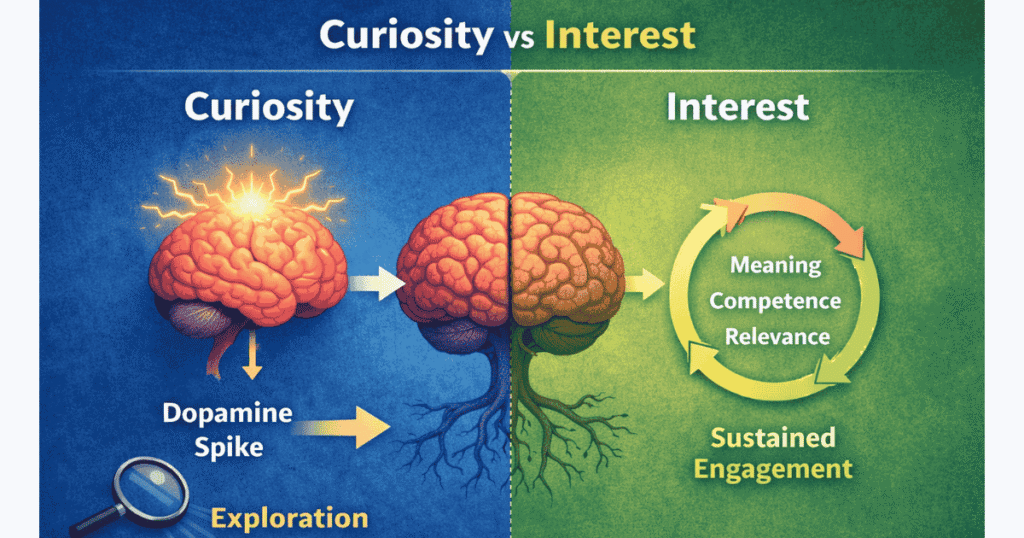
Understanding the difference between curiosity and interest requires moving beyond definitions into underlying psychological and neural mechanisms. While both states influence motivation and learning, they activate distinct cognitive systems.
In any serious curiosity and interest comparison, the mechanism is the dividing line. What triggers each state? What sustains it? And why does one fade while the other endures?
Dopamine, Reward Prediction, and Curiosity
Curiosity operates through what neuroscientists describe as the brain’s reward prediction system. When an information gap is detected, the brain anticipates the reward of resolving uncertainty. This anticipation increases dopamine activity, particularly in regions associated with exploration and learning.
Dopamine does not merely produce pleasure. It enhances attention and memory encoding. This explains why information learned while curious is retained more effectively.
In curiosity versus interest, curiosity:
- Activates short-term reward anticipation
- Increases exploratory behavior
- Heightens focus temporarily
- Encourages rapid information-seeking
This mechanism is detailed in Curiosity and the Brain: What Happens When You Feel Curious?, where the neurological basis of exploratory motivation is examined.
Curiosity, therefore, is neurologically urgent. It is activated by novelty, surprise, or contradiction. Once the uncertainty is resolved, dopamine activity decreases — and so does the intensity of curiosity.
This explains why curiosity can feel powerful but fleeting.
Emotional Attachment and the Formation of Interest
Interest develops through a different pathway. It is not primarily triggered by uncertainty but by repeated engagement combined with emotional relevance.
In distinguishing curiosity from interest, the key factor is reinforcement over time. When a person interacts repeatedly with a subject and experiences:
- Competence
- Meaning
- Personal relevance
The brain begins forming stable motivational patterns. Interest becomes integrated into identity.
Where curiosity relies heavily on novelty, interest relies on emotional attachment and sustained cognitive engagement.
Interest is associated with:
- Long-term attention stability
- Reduced dependency on novelty
- Deeper processing of information
- Persistent motivation
This is why someone may lose curiosity after an answer is found, but continue developing interest in the broader subject.
In practical terms:
Curiosity opens the door.
Interest builds the house.
Understanding this distinction is foundational in curiosity vs interest psychology, especially in educational settings where sparking curiosity is only the first step — sustaining interest is the real challenge.
7 Powerful Psychological Distinctions Between Curiosity and Interest
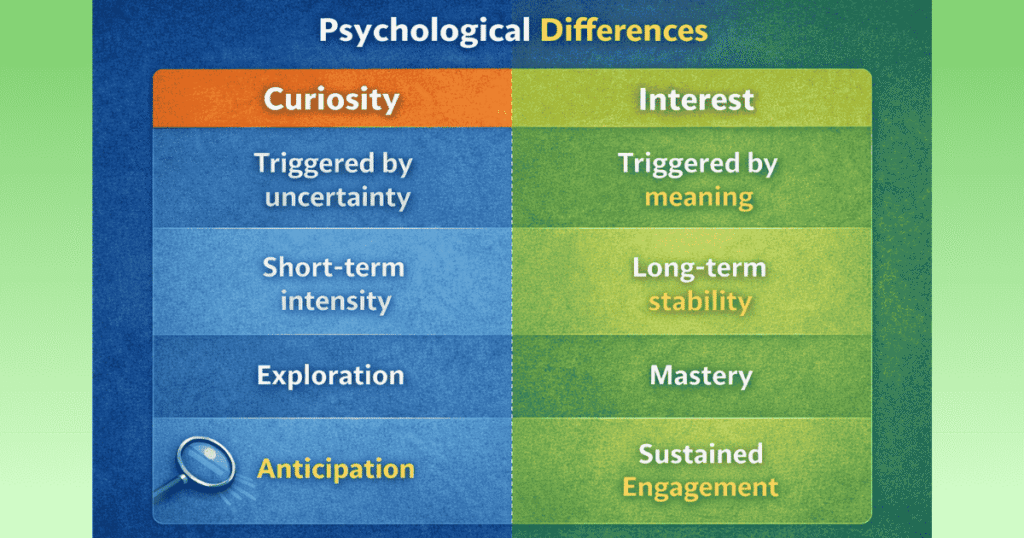
Understanding the difference between curiosity and interest becomes clearer when the two are examined side by side across core psychological dimensions. These seven distinctions reveal how curiosity and interest operate as complementary — but fundamentally different — motivational systems.
1. Trigger — Uncertainty vs Familiarity
The first distinction in any serious curiosity and interest comparison lies in what activates each state.
Curiosity is triggered by uncertainty. When the brain detects missing information, contradiction, or novelty, it generates cognitive tension. This tension demands resolution.
Interest, by contrast, is triggered by familiarity combined with meaning. It develops after exposure, not before it.
Mechanism:
Curiosity relies on the information gap detection system. Interest relies on value reinforcement and emotional relevance.
Why it matters:
If learning environments only provide novelty without meaning, curiosity may appear — but it will not evolve into interest.
Example:
A surprising science fact sparks curiosity. Repeated engagement with scientific ideas builds interest in science as a discipline.
2. Duration — Short-Term Intensity vs Long-Term Stability
Curiosity is intense but temporary. It peaks quickly and declines once the knowledge gap is resolved.
Interest is stable and enduring. It persists even when no new mystery is present.
Mechanism:
Curiosity depends on dopamine spikes tied to anticipation. Interest depends on stable motivational circuits reinforced by competence and identity integration.
Why it matters:
In curiosity vs interest psychology, duration determines whether engagement turns into mastery.
Example:
Someone may be curious about how a magic trick works. Once revealed, curiosity disappears. But an interest in illusion or psychology may persist for years.
3. Emotional State — Anticipation vs Enjoyment
Curiosity carries anticipation. It is forward-looking and slightly restless. There is psychological tension involved.
Interest carries enjoyment and immersion. It is emotionally comfortable and absorbing.
Mechanism:
Curiosity activates predictive reward systems. Interest activates satisfaction and sustained engagement pathways.
Why it matters:
This explains why curiosity often feels urgent, while interest feels fulfilling.
Application:
Educators often spark anticipation first — then cultivate enjoyment to stabilize attention.
4. Cognitive Focus — Exploration vs Deep Engagement
Curiosity promotes exploration across possibilities. It encourages scanning, questioning, and branching out.
Interest promotes depth. It narrows attention and strengthens conceptual integration.
In distinguishing curiosity from interest, this cognitive difference is critical.
Mechanism:
Curiosity broadens attentional scope. Interest increases sustained cognitive investment.
Example:
A person curious about philosophy may explore multiple schools of thought. A person interested in philosophy may specialize in ethics or metaphysics.
This distinction also aligns with principles discussed in What Is Curiosity in Psychology? Definition, Types, and Real-Life Examples, where exploratory behavior is examined in depth.
5. Motivation Type — Information-Seeking vs Mastery-Oriented
Curiosity is driven by the desire to reduce uncertainty. It is information-seeking.
Interest is mastery-oriented. It motivates practice, repetition, and skill refinement.
Mechanism:
Curiosity resolves gaps. Interest builds competence.
Why it matters:
Without curiosity, exploration never begins.
Without interest, expertise never develops.
This is one of the most important curiosity and interest distinctions in long-term learning.
6. Learning Impact — Initiation vs Persistence
Curiosity initiates learning. Interest sustains it.
Research in educational psychology consistently shows that curiosity increases initial engagement, while interest predicts persistence and long-term retention.
Mechanism:
Curiosity enhances memory encoding during discovery. Interest strengthens long-term consolidation through repeated engagement.
This learning cycle connects directly to the broader evolutionary role explained in Why Are Humans Curious? The Psychology, Brain, and Evolution Behind Curiosity, where curiosity is framed as an adaptive exploratory force.
7. Developmental Role — Discovery vs Identity Formation
Curiosity supports discovery. Interest supports identity.
Curiosity helps individuals explore possible paths. Interest shapes which paths become part of who they are.
Mechanism:
Curiosity expands options. Interest integrates commitment.
Example:
A child curious about music experiments with instruments. An adolescent interested in music begins identifying as a musician.
In long-term development, interest often becomes tied to self-concept, values, and life direction.
How Curiosity Turns Into Interest (The Psychological Transition Model)
Understanding the difference between curiosity and interest is only part of the equation. The more powerful insight lies in understanding how curiosity transforms into interest.
Curiosity is often the entry point. Interest is the outcome — but only under specific psychological conditions.
In a refined curiosity and interest comparison, this transition is not automatic. Many curiosities never become interests. The transformation depends on reinforcement, meaning, and repeated engagement.
Stage 1 — Repeated Exposure Reduces Uncertainty
Curiosity begins with uncertainty. When a question is answered, the initial tension dissolves. But if the answer reveals deeper layers, the brain encounters new structured complexity rather than simple closure.
This is critical.
If exposure remains shallow, curiosity fades.
If exposure deepens, curiosity evolves.
Mechanism:
Repeated exposure strengthens neural pathways associated with the topic. Instead of a one-time dopamine spike, the brain begins forming stable reward associations.
Example:
Someone curious about how memory works may initially search for a simple explanation. But if they continue exploring neural mechanisms, cognitive biases, and learning theory, structured engagement begins forming.
This progression mirrors patterns described in Curiosity and the Brain: What Happens When You Feel Curious?, where exploratory activation precedes deeper cognitive integration.
Stage 2 — Meaning and Personal Relevance Formation
Curiosity becomes interest when information connects to identity or personal goals.
Interest requires meaning. Without relevance, curiosity remains episodic.
In distinguishing curiosity from interest, this is a defining moment:
Curiosity asks, “What is this?”
Interest asks, “Why does this matter to me?”
Mechanism:
Psychological models such as self-determination theory suggest sustained motivation requires autonomy, competence, and relevance. When individuals feel capable and see value in a subject, interest consolidates.
Application:
A student curious about psychology after one lecture may lose engagement quickly. But if they recognize its relevance to understanding human behavior, relationships, or career aspirations, interest strengthens.
This is why in educational systems, sparking curiosity is insufficient without building relevance.
Stage 3 — Reinforcement Through Competence and Mastery
Interest solidifies when competence increases.
Curiosity does not require skill. Interest does.
As individuals gain skill, mastery reinforces motivation. The brain shifts from seeking novelty to seeking refinement.
Mechanism:
Repeated successful engagement activates reward circuits differently than novelty-driven curiosity. Instead of chasing the unknown, the brain begins valuing depth.
Example:
A person curious about coding experiments briefly. A person interested in coding practices daily, solves increasingly complex problems, and integrates the skill into identity.
This distinction explains why curiosity or interest cannot be treated as identical motivational forces.
Why Some Curiosities Never Become Interests
Not all curiosity evolves. Three common barriers prevent transition:
- Lack of repeated exposure
- Absence of personal meaning
- Insufficient perceived competence
When these elements are missing, curiosity remains temporary.
Understanding this transition model clarifies the deeper curiosity and interest contrast — curiosity expands awareness, but interest builds structure.
Why Distinguishing Curiosity from Interest Matters in Learning and Motivation
In educational psychology and behavioral science, confusing curiosity with interest leads to ineffective learning strategies. While both influence attention and engagement, they operate at different stages of the motivational cycle.
Understanding the curiosity vs interest psychology framework allows educators, professionals, and learners to design environments that initiate engagement and sustain it.
Curiosity as the Initiator of Learning
Curiosity functions as the ignition system of learning. It pulls attention toward novelty and unresolved questions. When learners encounter surprising information or uncertainty, curiosity activates exploratory behavior.
This is why questions are powerful teaching tools. A well-framed problem stimulates the brain’s predictive systems and increases attentional focus.
Mechanism:
Curiosity enhances encoding of new information. When individuals are curious, memory formation improves because the brain prioritizes information that resolves uncertainty.
This principle is supported by cognitive research summarized by institutions such as the National Institutes of Health (NIH), which examines curiosity and memory and demonstrates that curiosity enhances learning efficiency.
Implication:
Without curiosity, learning often feels forced. With curiosity, learning becomes self-driven.
However, curiosity alone is unstable.
Interest as the Sustainer of Long-Term Engagement
Interest determines whether learning continues after initial exploration.
In a structured curiosity and interest comparison, curiosity explains initial attention, while interest explains persistence. Long-term academic success, career development, and expertise depend more heavily on interest than curiosity.
Mechanism:
Interest strengthens through repetition and mastery. As competence increases, intrinsic motivation stabilizes. The learner shifts from resolving uncertainty to deepening skill.
Example:
A student may feel curious about neuroscience after hearing an intriguing fact about memory. But only sustained interest will motivate the years of study required to become a neuroscientist.
This distinction also connects to the broader motivational themes explored in Why Are Humans Curious? The Psychology, Brain, and Evolution Behind Curiosity, where curiosity is framed as an adaptive exploration system rather than a persistence system.
The Learning Cycle — From Exploration to Mastery
When properly aligned, curiosity and interest operate sequentially:
- Curiosity sparks engagement
- Exploration provides initial understanding
- Relevance creates emotional connection
- Interest stabilizes attention
- Mastery develops through repetition
In distinguishing curiosity from interest, the critical shift occurs between step two and three — when information becomes personally meaningful.
Educational systems that focus only on novelty risk produce surface-level engagement. Systems that cultivate interest foster expertise.
Motivation Stability — Short Bursts vs Enduring Commitment
Curiosity-driven motivation is intense but short-lived. Interest-driven motivation is steady and resilient.
This explains common experiences:
- Sudden fascination with a topic that disappears quickly
- Long-term dedication to a hobby or discipline
In analyzing curiosity compared to interest, stability is the defining metric. Curiosity fuels exploration. Interest fuels commitment.
Understanding this difference helps explain burnout, distraction patterns, and inconsistent learning habits. Many people chase curiosity spikes without cultivating sustained interest — resulting in fragmented knowledge.
Common Misconceptions About Curiosity vs Interest
Many discussions blur the difference between curiosity and interest, treating the two as interchangeable. This confusion weakens both psychological understanding and practical application. Clarifying misconceptions sharpens the entire curiosity and interest comparison.
Misconception 1 — Curiosity and Interest Are Synonyms
One of the most persistent errors in the curiosity versus interest debate is assuming they describe the same motivational state.
They do not.
Curiosity is triggered by uncertainty. Interest is sustained by meaning. Curiosity pushes toward the unknown. Interest deepens engagement with the known.
When people say, “I’m curious about history,” they often mean they are momentarily intrigued. When they say, “I’m interested in history,” they imply sustained engagement.
Failing to distinguish these states leads to shallow analysis in both psychology and education.
Misconception 2 — Curiosity Always Leads to Interest
Another common assumption in the curiosity and interest contrast is that curiosity naturally evolves into interest.
In reality, most curiosities fade.
If exposure is brief, relevance is low, or competence does not increase, curiosity dissolves once the initial question is answered. Only when repeated engagement produces meaning does interest form.
This explains why people frequently jump from topic to topic — experiencing curiosity without developing commitment.
Misconception 3 — Interest Requires Constant Novelty
Some assume interest survives only through continuous stimulation.
This confuses interest with curiosity.
Curiosity requires novelty. Interest does not.
Interest often strengthens through repetition and familiarity. A musician practicing scales daily is not driven by novelty, but by depth. An athlete’s training routine drills are motivated by mastery, not surprise.
In distinguishing curiosity from interest, this stability is fundamental.
Misconception 4 — Curiosity Is More “Intellectual” Than Interest
Another misunderstanding in curiosity vs interest psychology is that curiosity is purely cognitive, while interest is emotional.
Both contain cognitive and emotional components.
Curiosity involves anticipation and cognitive tension.
Interest involves enjoyment and cognitive immersion.
Neither is purely rational nor purely emotional. They are integrated motivational states.
Misconception 5 — Losing Curiosity Means Losing Passion
Curiosity fluctuates. Interest can persist.
It is normal for curiosity to decline after foundational knowledge is acquired. This does not mean the subject has lost value. Often, the mind has simply transitioned from exploration to consolidation.
Recognizing this distinction prevents misinterpreting normal motivational shifts as a loss of purpose.
Practical Applications of the Difference Between Curiosity and Interest
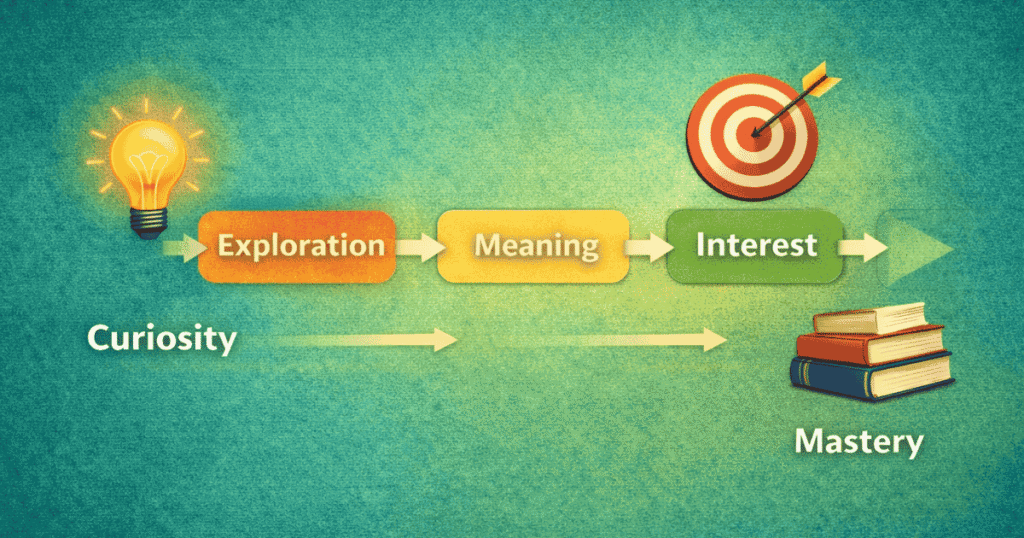
The distinction between curiosity and interest is not abstract psychology. It directly influences how people learn, build skills, choose careers, and sustain motivation over time.
A refined curiosity and interest comparison provides a practical framework for improving performance and long-term engagement.
Application in Education — Designing for Exploration and Depth
Effective learning environments do not rely on curiosity alone.
Teachers who only present surprising facts may spark short bursts of engagement. But without structured reinforcement and relevance, curiosity fades. To build expertise, educational systems must convert curiosity into interest.
Strategic approach:
- Introduce uncertainty to spark curiosity
- Provide a structured understanding
- Connect content to personal goals
- Encourage repeated application
This sequence mirrors the psychological transition model discussed earlier. When learners feel competence increasing, interest stabilizes.
The foundational mechanisms behind exploratory behavior are examined in What Is Curiosity in Psychology? Definition, Types, and Real-Life Examples, where curiosity is framed as the initial driver of cognitive engagement.
Application in Career Development — Testing vs Committing
In career exploration, curiosity helps individuals test new paths. Interest determines long-term commitment.
Many people mistake temporary curiosity for sustainable interest. They pursue opportunities based on novelty rather than alignment.
To properly distinguish curiosity from interest:
- Curiosity asks: “Is this field intriguing?”
- Interest asks: “Can I see myself growing here for years?”
A short internship may satisfy curiosity. Long-term professional identity requires interest.
Understanding this difference prevents impulsive career shifts driven by novelty spikes.
Application in Skill Acquisition — From Sampling to Mastery
Curiosity promotes sampling. Interest promotes mastery.
This explains why people often start hobbies enthusiastically but abandon them quickly. Curiosity creates the spark. Without reinforcement and competence-building, the spark extinguishes.
In a structured curiosity versus interest framework:
- Curiosity fuels experimentation
- Interest fuels disciplined practice
Athletes, musicians, programmers, and researchers rely on sustained interest rather than repeated curiosity spikes.
Mastery is not built on novelty — it is built on depth.
Application in Personal Growth — Identity Formation
One of the most profound curiosity and interest distinctions lies in identity development.
Curiosity expands horizons. It exposes individuals to possibilities. Interest integrates chosen possibilities into identity.
For example:
- A person curious about psychology may read several articles.
- A person interested in psychology begins thinking like a psychologist.
Interest becomes part of self-concept.
This deeper developmental theme connects to broader human motivation patterns explored in Why Are Humans Curious? The Psychology, Brain, and Evolution Behind Curiosity, where curiosity is framed as adaptive exploration, but not necessarily identity formation.
Application in Managing Motivation Fluctuations
Understanding curiosity or interest dynamics helps manage motivation cycles.
When engagement drops, ask:
- Has curiosity been satisfied?
- Has interest been cultivated?
If curiosity has faded but interest was never built, disengagement is predictable. Rebuilding meaning and competence restores interest more effectively than introducing random novelty.
This insight is particularly valuable for long-term projects requiring persistence.
Frequently Asked Questions About the Difference Between Curiosity and Interest
What is the main difference between curiosity and interest?
The main difference between curiosity and interest is that curiosity is triggered by uncertainty, while interest is sustained by meaning and personal relevance. Curiosity pushes a person to explore unknown information, whereas interest keeps them engaged over time. In a structured curiosity vs interest psychology framework, curiosity initiates learning and interest maintains it.
Is curiosity the same as interest in psychology?
No. In psychology, curiosity and interest are distinct motivational states. Curiosity arises from an information gap and creates a desire to resolve uncertainty. Interest develops after engagement becomes personally meaningful. Understanding the difference between curiosity and interest helps explain why some topics fascinate us briefly while others shape long-term commitment.
Does curiosity always turn into interest?
No. Curiosity does not automatically become interest. For curiosity to transform into interest, repeated exposure, personal relevance, and increasing competence must be present. Without reinforcement, curiosity fades once the question is answered. This distinction is central in distinguishing curiosity from interest in motivational psychology.
Which is more important for learning, curiosity or interest?
Both are important but serve different roles. Curiosity sparks initial exploration and improves memory encoding during discovery. Interest supports persistence, depth, and mastery. In a complete curiosity and interest comparison, curiosity explains engagement at the beginning, while interest explains long-term achievement.
Can someone be curious without being interested?
Yes. A person can feel momentary curiosity about a topic without developing sustained interest. Curiosity is often short-term and driven by novelty. Interest requires ongoing value and emotional investment. This explains why many curiosities remain temporary.
Can someone be interested without feeling curious?
Yes. Interest does not always depend on novelty. Once knowledge is established, a person may continue engaging deeply without experiencing strong curiosity spikes. Interest often becomes tied to identity, competence, and long-term goals.
How do curiosity and interest work together?
Curiosity and interest work sequentially. Curiosity introduces new possibilities by drawing attention to the unknown. If exploration leads to meaning and competence, interest develops and stabilizes engagement. Together, they form a motivational cycle that supports learning and development.