
Most people believe they struggle with learning because they are “not smart enough.” In reality, the problem is rarely intelligence. The real issue is the method. Without using effective learning strategies, even highly capable individuals waste hours rereading notes, highlighting textbooks, or passively watching lectures with little improvement in memory retention or understanding.
Learning is not random. It follows structured cognitive processes rooted in how the brain handles information. When you understand how the learning process works — from attention and encoding to storage and retrieval — you can dramatically increase information retention while reducing time spent studying.
At its core, learning is a biological and psychological event. It begins with information processing, where incoming data is filtered through attention and working memory. Only a fraction of what you encounter becomes stable knowledge. The difference between temporary exposure and long-term mastery lies in strategy.
Research in educational psychology and educational neuroscience consistently shows that certain methods outperform others. Passive review creates familiarity but not mastery. In contrast, structured memory retention strategies, retrieval-based techniques, and well-designed study habits actively strengthen neural pathways. The brain does not reward repetition alone; it rewards effortful recall and meaningful engagement.
This is why many traditional study techniques fail. They feel productive, but do not align with how knowledge is actually consolidated into long-term memory. Effective learning is not about working harder; it is about working in alignment with the brain’s natural mechanisms.
Another important distinction is between exposure and knowledge acquisition. Exposure means seeing information. Acquisition means integrating it into long-term understanding so it can be recalled, applied, and adapted in new situations. True learning reshapes internal mental models through structured reinforcement and reflection.
In this guide, you will learn nine science-backed effective learning strategies that improve focus, increase memory retention techniques, and strengthen the entire learning cycle. These methods are grounded in learning theories, validated by research in cognitive science, and applicable to academic study, professional skill development, and lifelong growth.
We will examine:
- How the learning process actually works
- Why common effective studying methods often fail
- The role of cognitive load theory in attention and retention
- How retrieval practice, spacing, and reflection build durable knowledge
- Why adult learning theory changes how strategies should be applied
- How to design structured online learning strategies without cognitive overload
By the end, you will not just know what works — you will understand why it works. That distinction is critical. When you understand the mechanisms behind effective learning, you gain control over your own intellectual development.
Before we explore the nine strategies, we must first understand the scientific foundation behind them. Because once you understand how learning truly functions at a cognitive level, the strategies stop feeling like tricks — and start functioning like tools.
The Science Behind Effective Learning Strategies
To apply effective learning strategies correctly, you must first understand what happens inside the mind when learning occurs. Without this foundation, even powerful techniques become mechanical routines rather than strategic tools.
Learning is a structured biological process. It begins with attention, moves through encoding, and culminates in long-term storage and retrieval. This sequence is known as the learning process, and it is governed by specific cognitive processes that determine whether information fades quickly or becomes durable knowledge.
How the Learning Process Really Works
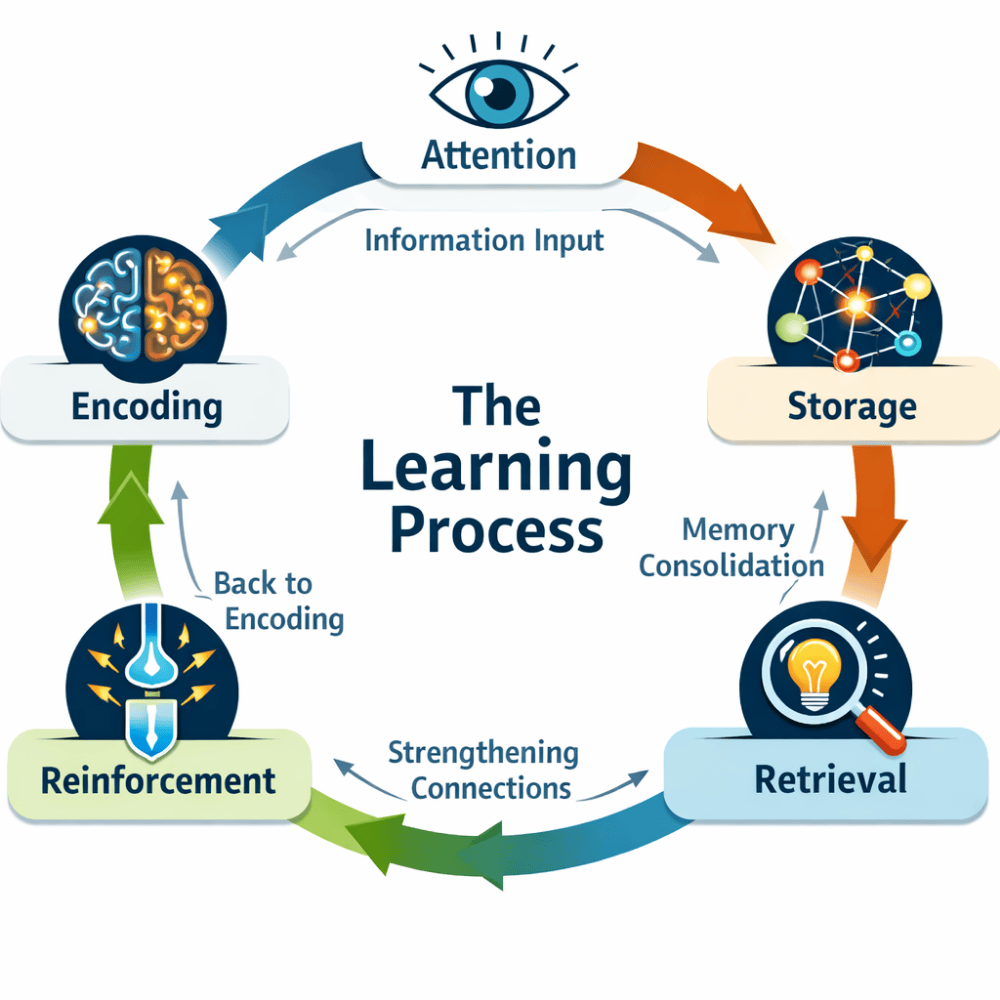
At its most basic level, learning follows three stages:
- Encoding – transforming information into a mental representation
- Storage – stabilizing that representation in memory
- Retrieval – accessing it when needed
These stages are part of broader information processing mechanisms. When you encounter new material, your brain does not automatically store it. Instead, it filters the input through attention. If attention is weak — due to distraction, multitasking, or overload — encoding suffers.
This explains why passive rereading often fails. Recognition is mistaken for retention. The brain feels familiar with material, but familiarity does not equal durable knowledge acquisition.
Working memory plays a central role here. It acts as a temporary processing space. However, it is limited. You can only hold a small number of elements at once. When overloaded, the system collapses. This is where cognitive load theory becomes critical. It explains that learning efficiency depends on managing the mental load placed on working memory.
There are three types of cognitive load:
- Intrinsic load (complexity of the material)
- Extraneous load (distractions or poor presentation)
- Germane load (effort devoted to understanding)
Effective strategies reduce extraneous load and optimize germane load. That is why structured learning methods outperform chaotic study sessions.
If encoding is successful, the information moves toward consolidation. During consolidation, neural connections strengthen through repetition and meaningful engagement. This process supports memory retention strategies that extend beyond short-term familiarity.
Understanding this mechanism changes how you approach studying. Instead of focusing on time spent, you focus on the quality of processing.
For a deeper exploration of how these stages shape understanding, see our detailed guide on how people learn scientifically.
Cognitive Processes That Strengthen Memory Retention
The reason some effective learning techniques work better than others lies in how they activate core cognitive learning processes.
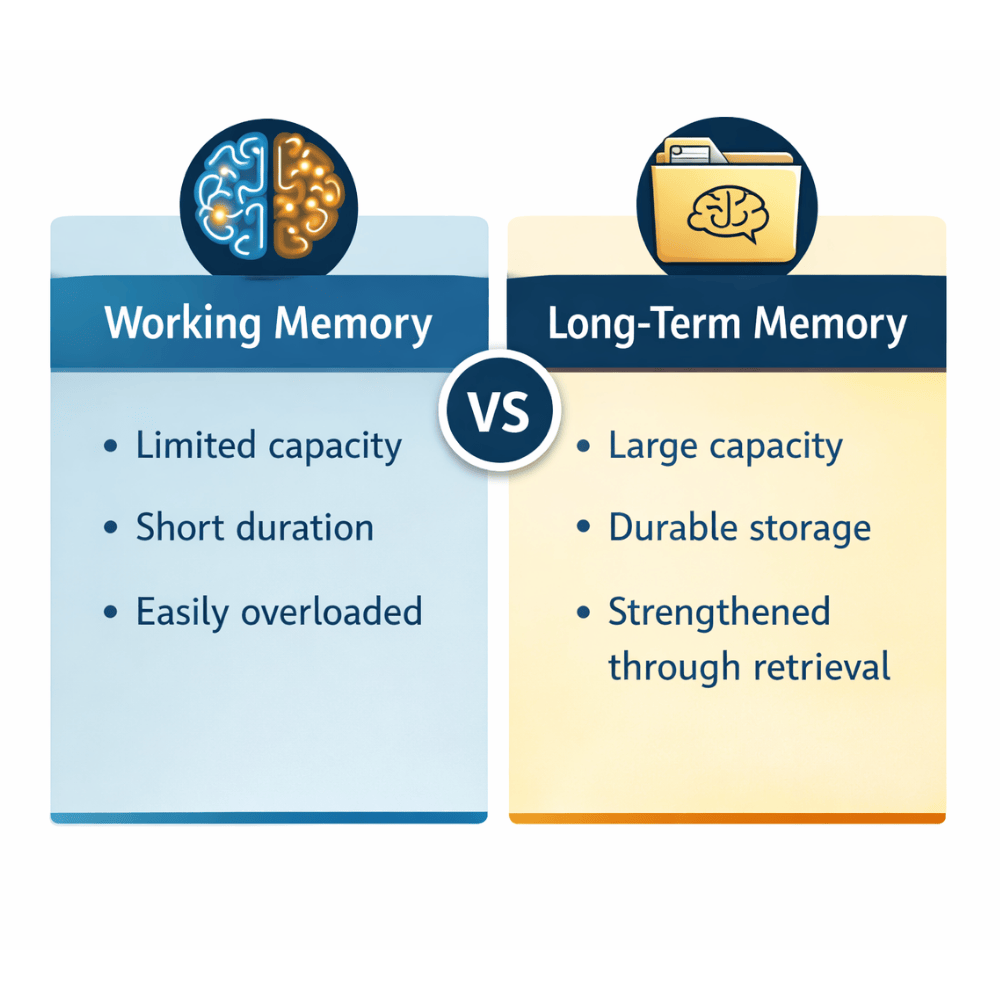
Two memory systems are especially important:
- Working memory – temporary and limited
- Long-term memory – expansive and stable
To move information from working memory to long-term storage, effortful engagement is required. This is why memory retention techniques such as retrieval practice are powerful. They force reconstruction rather than passive exposure.
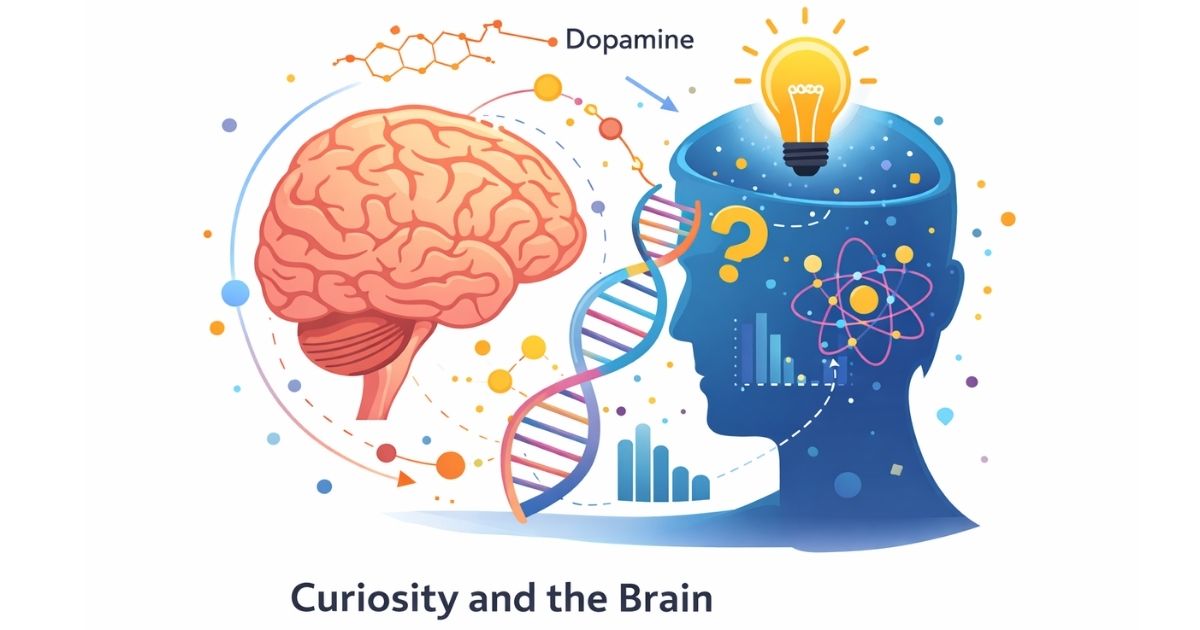
Research supported by the American Psychological Association and supported by findings discussed in Curiosity and the Brain shows that active retrieval strengthens neural pathways far more effectively than passive rereading. Retrieval creates desirable difficulty — a level of challenge that enhances consolidation rather than hindering it.
Sleep also plays a role in memory stabilization, a phenomenon further explored in Why Do We Dream, where the relationship between sleep cycles and memory processing is examined.
Another essential factor is spacing. When information is reviewed over time rather than crammed in one session, neural connections are repeatedly reactivated. This strengthens stability and improves long-term recall.
Attention also plays a major role. Divided attention reduces encoding strength. This is why poor study habits, especially multitasking, severely weaken retention. Cognitive resources are finite. When split, consolidation declines.
Furthermore, reflection — a metacognitive activity — improves durability. When learners evaluate what they understand and what they do not, they engage in metacognition, which strengthens structured learning control.
In practical terms, this means effective strategies must:
- Engage active recall
- Manage cognitive load
- Encourage spacing
- Promote reflection
- Reduce distraction
If a method does not activate these mechanisms, it is unlikely to produce meaningful results.
Before we explore the nine core strategies, we must address one more critical issue: why so many commonly used effective studying methods feel productive but fail in practice.
Why Most Study Methods Fail (And What Blocks Effective Learning)
If there are so many effective learning strategies backed by cognitive science, why do most people still struggle to retain information?
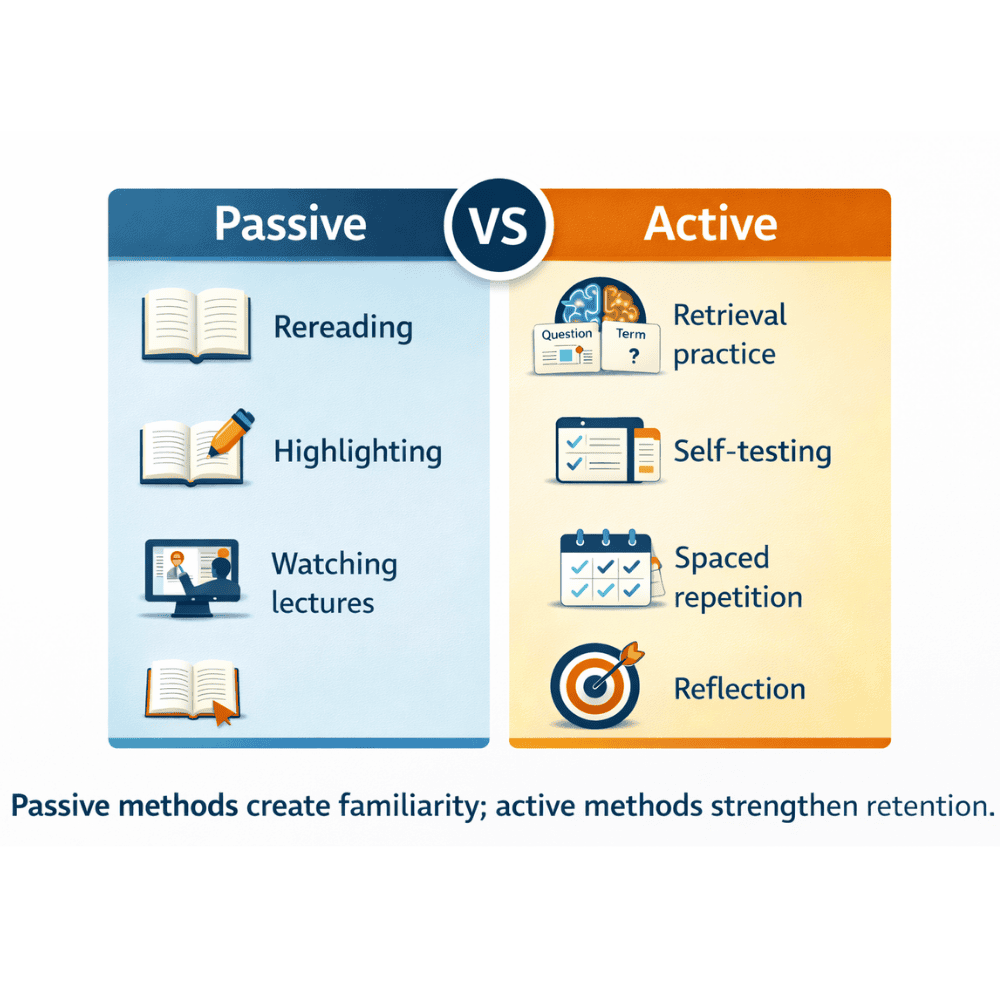
The answer is simple: most commonly used study techniques feel productive but do not align with how the brain actually stores and retrieves information.
Understanding what fails is just as important as knowing what works.
The Illusion of Learning
One of the biggest barriers to true knowledge acquisition is the illusion of learning.
When you reread notes, highlight textbooks, or watch lectures repeatedly, the material becomes familiar. Familiarity creates a false sense of mastery. But recognition is not the same as recall.
This happens because passive review strengthens short-term recognition circuits but does not sufficiently activate the cognitive processes required for long-term consolidation.
The brain responds differently to effort. When information is simply re-exposed, encoding remains shallow. When information must be reconstructed from memory, the learning trace strengthens.
This is why passive methods fail to build durable memory retention strategies.
Passive Study Habits That Undermine Retention
Let’s examine common ineffective study habits:
1. Rereading Without Testing
Rereading improves familiarity but does not enhance information retention. Without retrieval, the neural pathways remain weak.
2. Highlighting Excessively
Highlighting often creates an illusion of structure without real processing. It rarely engages in deep information processing.
3. Multitasking During Study
Divided attention overloads working memory, reducing encoding efficiency. Cognitive resources are limited. When split, learning declines significantly.
For a detailed breakdown of attention limitations, see our guide on multitasking vs deep focus in learning.
4. Cramming Before Exams
Cramming increases short-term performance but does not support long-term retention. Without spacing, consolidation remains incomplete.
These behaviors conflict directly with cognitive load theory. They increase extraneous load and reduce effective consolidation.
Cognitive Overload and Its Hidden Cost
Another reason learning fails is unmanaged mental load.
When learners attempt to absorb too much information at once, cognitive development does not accelerate — it stalls. The brain cannot efficiently encode complex material if working memory capacity is exceeded.
Effective learners reduce complexity by:
- Breaking information into structured units
- Connecting new knowledge to existing schemas
- Using repetition strategically
Without structure, overload disrupts learning strategies entirely.
Lack of Reflection and Metacognitive Awareness
One overlooked barrier is the absence of self-monitoring.
Most learners do not pause to evaluate:
- What do I truly understand?
- What can I explain without notes?
- Where are my knowledge gaps?
This reflective process is called metacognition, and it plays a central role in strengthening long-term retention.
Without reflection, learners repeat ineffective behaviors. With reflection, they adjust and refine their approach.
For a deeper exploration of reflective learning, refer to our guide on metacognitive learning strategies.
Motivation Without Structure
Even high motivation does not guarantee effective learning.
Without structured, effective learning techniques, motivation often leads to overexertion rather than improvement. Effort alone cannot override poor strategy.
Interestingly, structured strategies enhance motivation because visible progress reinforces engagement. This aligns with principles of behavior modification, where measurable improvement strengthens commitment.
Our detailed article on curiosity and motivation explains how internal drive interacts with structured practice.
Transition to Core Strategies
Now that we understand:
- Why passive methods fail
- How cognitive overload blocks retention
- Why reflection is critical
- Why structure matters more than effort
We can move to the core of this guide:
The nine science-backed effective learning strategies that align directly with the brain’s natural mechanisms.
These strategies activate:
- Retrieval pathways
- Consolidation cycles
- Attention control
- Metacognitive awareness
- Long-term information retention
9 Powerful Science-Backed Effective Learning Strategies That Actually Work
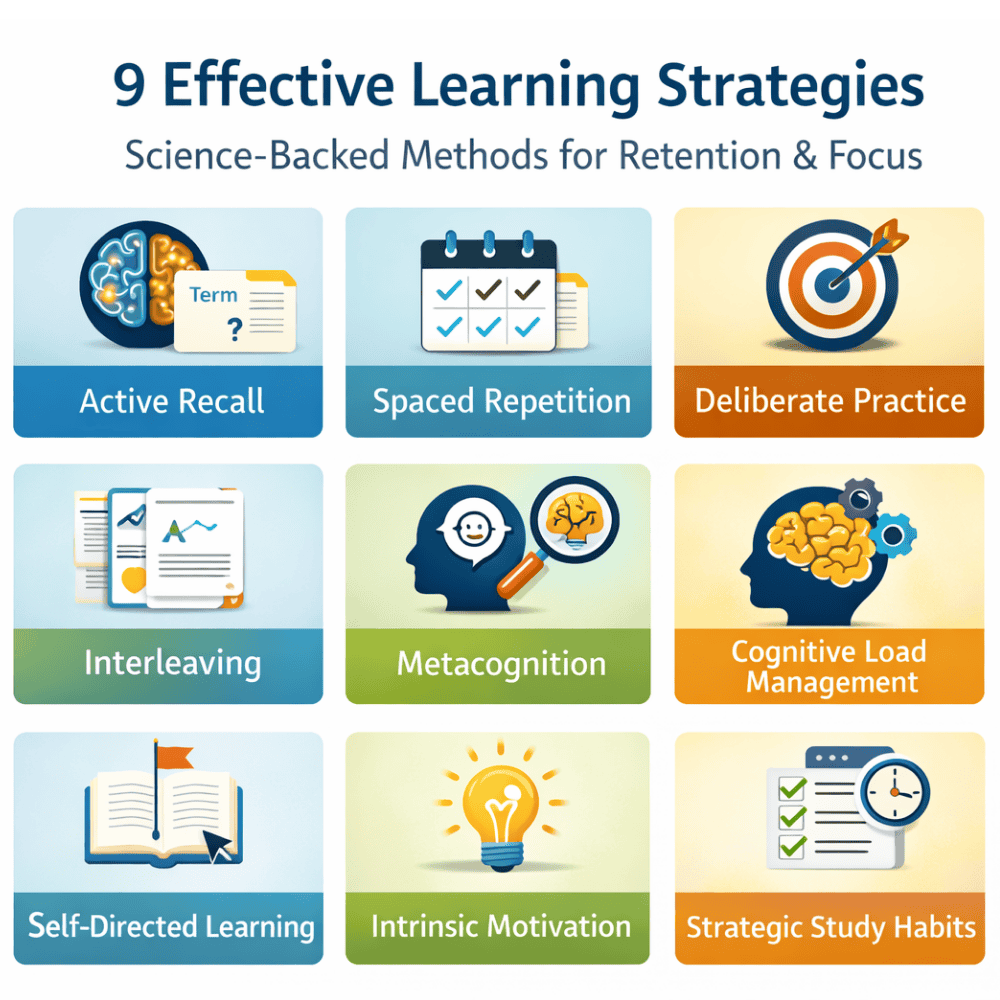
Now we move to the core of this guide.
These nine effective learning strategies are not motivational tips. They are grounded in research from educational psychology, educational neuroscience, and established learning theories. Each method directly aligns with the cognitive processes that strengthen long-term knowledge acquisition.
Each strategy below includes:
- The mechanism
- Why it works
- How to apply it
1. Active Recall (Retrieval Practice)
Active recall, frequently examined in discussions comparing active recall vs passive review in cognitive research, is significantly more effective for strengthening long-term retention. Also known as retrieval practice, it is one of the most powerful memory retention techniques available.
Why It Works
When you retrieve information from memory without looking at notes, you force the brain to reconstruct neural pathways. This strengthens connections between concepts and improves information retention.
Unlike passive review, retrieval increases long-term storage because it engages effortful information processing.
How to Apply It
- Close your notes and write what you remember.
- Use flashcards.
- Teach the concept out loud without referencing material.
For a deeper breakdown, see our guide on active recall vs passive review.
2. Spaced Repetition
Spaced repetition is a structured memory retention strategy that involves reviewing material over increasing intervals of time.
Why It Works
The brain strengthens memory when retrieval happens, just as forgetting begins. This reinforces consolidation and stabilizes knowledge in long-term memory.
Spacing reduces cognitive overload and aligns with how the learning process naturally consolidates information.
How to Apply It
- Review material 1 day later, then 3 days, then 1 week.
- Use spaced flashcard systems.
- Schedule review sessions intentionally.
For practical implementation, refer to spaced repetition technique.
3. Deliberate Practice
Deliberate practice differs from simple repetition. It involves focused improvement on weaknesses with structured feedback.
Why It Works
It activates deep cognitive learning processes and pushes the learner beyond comfort zones, increasing adaptability and retention.
How to Apply It
- Identify specific weaknesses.
- Practice at the edge of your ability.
- Seek feedback and adjust.
More details available in deliberate practice explained.
4. Interleaving Practice
Interleaving practice means mixing related topics rather than studying one concept repeatedly in isolation.
Why It Works
Switching between related subjects strengthens discrimination skills and improves flexible retrieval. This enhances deeper information processing.
How to Apply It
- Study multiple related topics in one session.
- Rotate problem types instead of blocking them.
5. Metacognitive Reflection
Metacognition is awareness of your own understanding.
Why It Works
Reflecting on what you know versus what you don’t strengthens regulation of the learning process. It improves strategic adjustment and reduces wasted effort.
How to Apply It
- After studying, ask: What can I explain without notes?
- Identify confusion areas immediately.
- Adjust strategy accordingly.
Explore this further in metacognitive learning strategies.
6. Managing Cognitive Load
Applying cognitive load theory improves learning efficiency.
Why It Works
When working memory is overloaded, encoding weakens. Reducing extraneous load improves retention.
How to Apply It
- Study in distraction-free environments.
- Break complex material into chunks.
- Avoid multitasking.
Learn more about attention limits in multitasking vs deep focus in learning.
7. Self-Directed Learning
Self-directed learning empowers learners to control pace and strategy.
Why It Works
Autonomy increases intrinsic engagement and improves structured learning strategies. It aligns well with adult learning theory, which emphasizes independence.
How to Apply It
- Set personal learning goals.
- Choose resources strategically.
- Track progress independently.
See detailed explanation in adult learning theory explained.
8. Intrinsic Motivation and Curiosity
Internal drive dramatically enhances effectiveness.
Why It Works
Intrinsic motivation activates reward circuits that reinforce learning behaviors. This supports structured behavior modification and sustained engagement.
To understand the deeper psychological foundation behind intrinsic drive, refer to What Is Curiosity, which explains how curiosity fuels cognitive engagement and exploration.
Curiosity amplifies encoding strength, making information more memorable.
Curiosity increases encoding strength by activating attention networks, a mechanism explored in depth in Curiosity and Learning, where curiosity is shown to directly improve memory retention and understanding.
This relationship between internal drive and sustained effort aligns closely with principles explained in Curiosity and Motivation, where wanting to know becomes a powerful driver of long-term knowledge acquisition.
9. Strategic Study Habits
Strong study habits amplify all other strategies.
Why It Works
Consistency strengthens neural pathways. Structured routines improve long-term information retention.
How to Apply It
- Schedule regular review cycles.
- Use retrieval-based sessions.
- Track improvement over time.
Build these habits using the framework in building a daily learning habit.
Summary of Core Mechanisms
All nine strategies share common principles:
- They activate retrieval
- They manage cognitive load
- They promote reflection
- They strengthen consolidation
- They enhance structured knowledge acquisition
Unlike passive methods, these techniques align with how people actually learn at a cognitive level.
Applying Effective Learning Strategies in Real-World Contexts
Understanding effective learning strategies is only half the equation. The real advantage comes from adapting them to your environment. Learning does not occur in isolation. It happens in classrooms, workplaces, digital platforms, and self-directed study routines. Each context shapes the learning process differently.
To maximize knowledge acquisition, strategies must be flexible and context-aware.
Effective Learning Strategies for Adults
Adults do not learn the same way children do. This is where adult learning theory becomes essential.
Unlike younger learners, adults:
- Prefer autonomy
- Need relevance and immediate application
- Bring prior knowledge into new learning
- Are motivated by problem-solving
This makes self-directed learning particularly powerful.
Why It Matters
According to foundational work in educational psychology, adult learners integrate new knowledge by connecting it to existing mental frameworks. If new material lacks relevance, retention drops.
Adults also benefit from structured reflection and application-based methods rather than passive lecture consumption.
How to Apply Strategies as an Adult
- Use deliberate practice to refine professional skills.
- Apply retrieval practice to real-life scenarios.
- Integrate effective study techniques into daily routines.
- Reflect using metacognitive prompts: “How can I apply this tomorrow?”
For a deeper understanding of adult learning dynamics, refer to the adult learning theory explained.
Effective Learning in Digital and Online Environments
Modern learners increasingly rely on digital platforms. While convenient, these environments introduce distractions that disrupt information processing.
The Challenge of Online Learning
Digital study environments often increase extraneous cognitive load:
- Notifications
- Multitasking
- Fragmented attention
- Overexposure to content
Without structured online learning strategies, retention suffers.
How to Apply Effective Learning Strategies Online
1. Limit distractions to reduce extraneous load.
2. Use active recall instead of passive video consumption.
3. Schedule spaced reviews after digital sessions.
4. Chunk content into manageable units to protect working memory.
The shift to digital education makes cognitive load theory even more relevant. Managing attention becomes a skill in itself.
For broader discussion, explore learning in the digital age.
Teaching Methods and Their Influence on Learning
While this guide focuses on learners, instructional design also shapes outcomes.
Strong teaching methods support effective strategies by:
- Encouraging retrieval rather than repetition
- Structuring content to reduce overload
- Promoting reflection and discussion
- Integrating spaced practice
When teaching aligns with the brain’s natural cognitive learning processes, retention improves significantly.
This connection between strategy and instruction bridges the gap between learner effort and structured educational systems.
Language Acquisition as a Learning Model
One practical example of strategy adaptation is language acquisition.
Language learning highlights:
- The importance of spaced repetition
- The power of active recall
- The role of immersion
- The necessity of consistent exposure
Language learners who rely only on passive exposure struggle. Those who combine retrieval, structured repetition, and reflection progress faster.
This example demonstrates how effective learning strategies apply across disciplines.
Study Habits Across Academic and Professional Settings
Whether preparing for exams or developing workplace skills, structured study habits amplify outcomes.
Key principles:
- Regular review cycles
- Clear goal setting
- Reduced multitasking
- Measured feedback loops
Strong routines reduce reliance on motivation alone. They transform learning from sporadic effort into sustainable progress.
For a practical habit-building structure, refer to building a daily learning habit.
Transition to Final Integration
We have now explored:
- The science behind learning
- Why passive methods fail
- The 9 core strategies
- Context-based adaptation
The final step is integration.
Effective learners do not apply strategies randomly. They build a structured system that reinforces retention, focus, and long-term growth.
Building a Personal Learning System That Sustains Growth
Knowing effective learning strategies is valuable. Applying them consistently is transformative. The difference between short bursts of improvement and long-term intellectual growth lies in system design.
A learning system integrates:
- Structured review
- Retrieval cycles
- Reflection
- Feedback
- Adaptation
Without structure, even powerful learning methods become inconsistent habits. With structure, they compound.
Designing a Repeatable Learning Framework
A strong system aligns with the natural learning process and supports durable knowledge acquisition.
Step 1: Define Clear Learning Objectives
Effective learning begins with clarity. Before engaging any material, define:
- What skill or knowledge am I building?
- What does mastery look like?
- How will I measure retention?
Clear objectives reduce cognitive overload and improve focus.
Step 2: Structure Information Processing
Once objectives are clear, optimize information processing:
- Break material into manageable units.
- Connect new ideas to existing knowledge.
- Avoid multitasking to protect working memory.
This reduces extraneous load and strengthens encoding.
Step 3: Implement Retrieval Cycles
Retrieval strengthens memory more than exposure.
A structured cycle may look like:
- Day 1: Learn new material.
- Day 2: Practice active recall.
- Day 4: Retrieve without notes.
- Day 7: Apply concept in new context.
This reinforces memory retention techniques and solidifies long-term storage.
For a deeper framework, explore spaced repetition technique.
Step 4: Integrate Reflection and Metacognition
Learning systems fail when reflection is absent.
After each session, ask:
- What did I truly understand?
- What required effort to recall?
- Where are my knowledge gaps?
This strengthens metacognition and enhances adaptive strategy selection.
Refer to metacognitive learning strategies for structured reflection models.
Step 5: Track Progress and Adjust
Progress tracking activates positive reinforcement and supports structured behavior modification.
You can track:
- Recall accuracy
- Speed of retrieval
- Application ability
- Error frequency
Adjustment ensures strategies remain aligned with evolving goals.
Creating Strong Study Habits That Support Retention
Systems become powerful when reinforced by consistent study habits.
Key habits include:
- Fixed study time blocks
- Distraction-free environments
- Pre-planned retrieval sessions
- Weekly review cycles
Consistency strengthens neural pathways and supports durable information retention.
To implement habit-based reinforcement, review building a daily learning habit.
Motivation Within a Structured System
Many learners rely solely on motivation. However, motivation fluctuates.
Structured systems reduce reliance on emotional momentum. When routines are predefined, action requires less cognitive effort.
Intrinsic drive, supported by curiosity, amplifies effectiveness. As discussed in curiosity and learning, interest enhances encoding strength and attention stability.
This combination of structure + motivation creates sustainable growth.
Long-Term Cognitive Development Through Compounding Learning
Effective learning compounds over time.
When strategies are consistently applied:
- Retrieval becomes easier.
- Pattern recognition improves.
- Transfer between domains increases.
- Cognitive flexibility strengthens.
This leads to accelerated cognitive development, not through intelligence alone, but through optimized process design.
A Simple Weekly Learning Blueprint
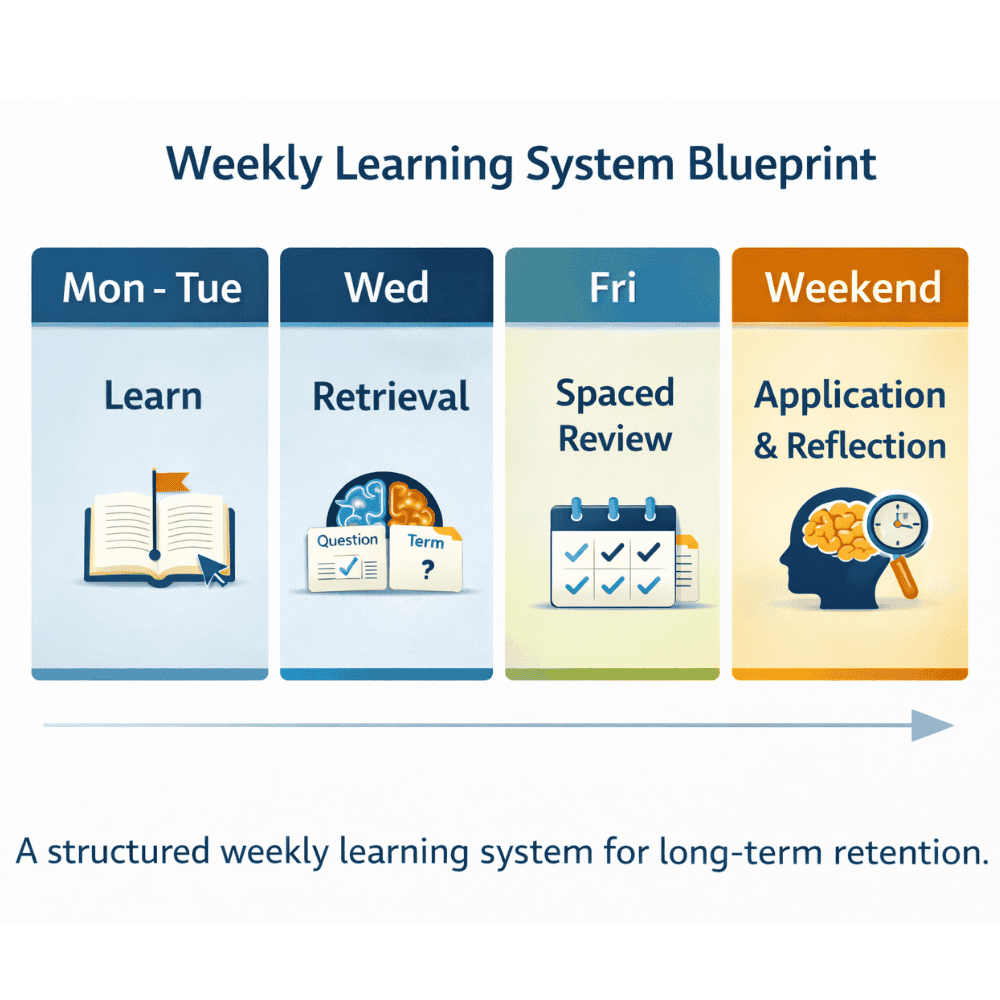
Here is a practical weekly framework:
Monday–Tuesday:
Learn new material using structured, effective learning techniques.
Wednesday:
Active recall session.
Friday:
Spaced review.
Weekend:
Application + reflection.
This structure supports:
- Reduced cognitive load
- Improved consolidation
- Sustained memory retention strategies
Frequently Asked Questions About Effective Learning Strategies
What are the most effective learning strategies?
The most effective learning strategies include active recall, spaced repetition, deliberate practice, interleaving, and metacognitive reflection. These methods strengthen long-term memory retention, improve information processing, and align with core cognitive processes that support durable knowledge acquisition.
How can I improve memory retention quickly?
To improve memory retention quickly, use retrieval-based practice instead of passive rereading. Apply spaced repetition, reduce distractions to manage cognitive load theory, and actively test yourself. Effortful recall strengthens neural pathways more effectively than repeated exposure.
Why do traditional study methods fail?
Traditional study techniques like highlighting and rereading fail because they create familiarity without strengthening retrieval pathways. They do not engage deep information retention mechanisms required for long-term storage.
Does cognitive load affect learning performance?
Yes. According to cognitive load theory, working memory has a limited capacity. When overloaded by distractions or excessive information, encoding weakens. Reducing extraneous load improves learning efficiency and retention.
What is the difference between working memory and long-term memory?
Working memory temporarily holds information for processing, while long-term memory stores knowledge over extended periods. Effective learning strategies focus on transferring information from working memory into long-term storage through structured retrieval and repetition.
Are effective learning strategies different for adults?
Yes. Adult learning theory emphasizes autonomy, relevance, and self-direction. Adults benefit from self-directed learning, application-based methods, and structured reflection more than passive instruction.
For deeper understanding, see adult learning theory explained.
How do online learning strategies improve retention?
Effective online learning strategies involve minimizing distractions, scheduling spaced reviews, and applying active recall. Digital environments increase cognitive load, so structured practice is essential to maintain focus and retention.
Is motivation necessary for effective learning?
Motivation enhances engagement, but structure matters more. When learners apply structured effective learning strategies, progress becomes consistent even when motivation fluctuates. Curiosity strengthens encoding and attention stability.
Explore this dynamic in curiosity and motivation.
Final Thoughts
Effective learning is not a talent. It is a structured process guided by cognitive science. When you align your habits with proven effective learning strategies, you gain control over retention, focus, and long-term growth.
The difference between average and exceptional learners is not intelligence — it is strategy.