
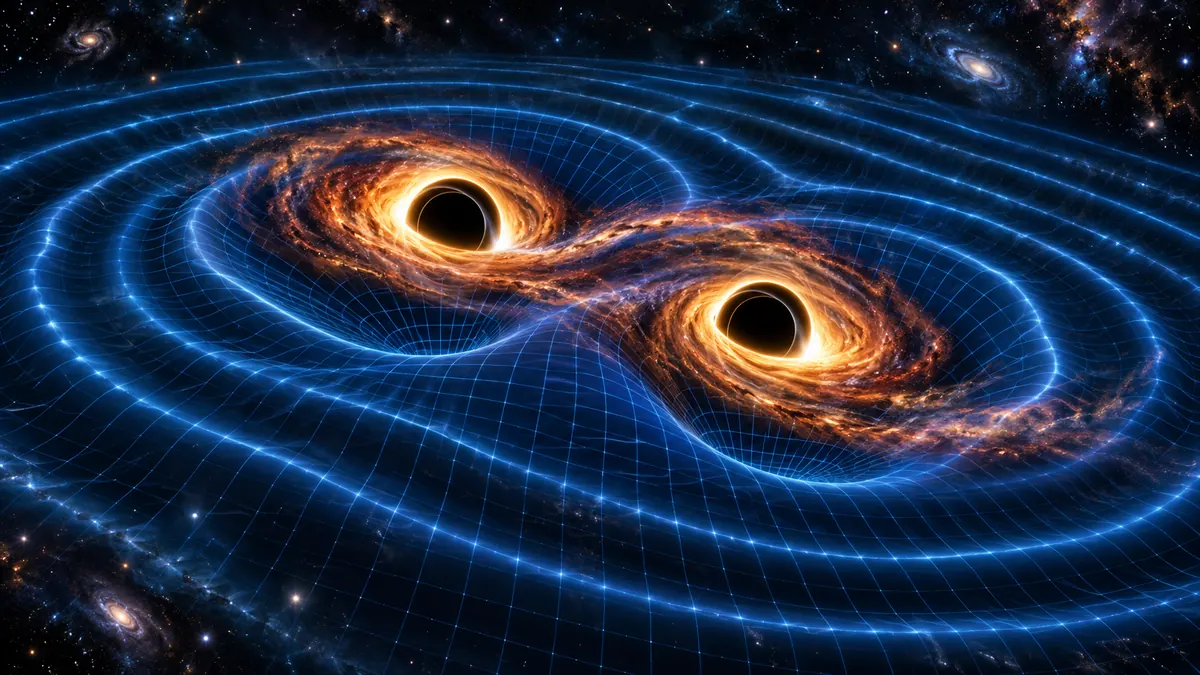
Quick answer: What happens if two black holes collide? They spiral toward each other, merge into a single, larger black hole, and release an enormous burst of energy as gravitational waves, ripples in spacetime itself. In the first detected merger in 2015, black holes of about 36 and 29 times the Sun’s mass became one of about 62; the missing 3 Suns’ worth of mass was turned into gravitational-wave energy in a fraction of a second.
Black hole collisions are among the most violent events in the universe, yet they produce no explosion of light. For decades they existed only in equations and computer simulations. Then, on 14 September 2015, the LIGO detectors in the United States picked up the faint signal of two black holes merging 1.3 billion light-years away. Since then, astronomers have recorded hundreds of candidate mergers. New to black holes? Start with what is a black hole.
The 3 stages of a black hole collision
| Stage | What happens | Gravitational-wave signal |
|---|---|---|
| 1. Inspiral | The two black holes orbit each other, getting closer as they lose energy | A “chirp” that rises in pitch and strength |
| 2. Merger | The event horizons touch and join into one | The peak: the strongest burst of waves |
| 3. Ringdown | The new black hole wobbles, then settles into a smooth, spinning shape | Fading waves, like a bell after it’s struck |
The inspiral can last millions of years, but the last orbits happen extremely fast. In GW150914, the final stage, from orbits hundreds of times per second to a single black hole, took only about 0.2 seconds.
How much energy does a black hole collision release?
An astonishing amount. In the 2015 event, about 3 times the mass of the Sun was converted into gravitational-wave energy, following Einstein’s E = mc². For a brief moment, the power released was greater than the combined light output of all the stars in the observable universe.
Yet because black holes give off no light of their own, a merger in empty space is completely dark. The energy travels as ripples in space and time, not as light.
What are gravitational waves?
Einstein’s general theory of relativity predicted in 1916 that massive objects moving quickly would make ripples in spacetime. These waves stretch and squeeze space as they pass. By the time the 2015 signal reached Earth, it changed the length of LIGO’s 4 km arms by less than a thousandth of the width of a proton. Three LIGO pioneers, Rainer Weiss, Barry Barish and Kip Thorne, won the 2017 Nobel Prize in Physics for the detection.
Famous black hole collisions
| Event | Masses (Sun = 1) | Why it matters |
|---|---|---|
| GW150914 (2015) | 36 + 29, final 62 | First gravitational waves ever detected |
| GW170814 (2017) | 31 + 25, final 53 | First detected by three detectors, including Virgo in Italy |
| GW190521 (2019) | 85 + 66, final about 142 | Created an “intermediate-mass” black hole |
| GW190814 (2019) | 23 + 2.6 | The smaller object is a mystery: either a very light black hole or a very heavy neutron star |
| GW231123 (2023) | Total about 225 | The most massive merger reported so far, announced in 2025 |
See more in our list of famous black holes.
What does the new black hole look like?
- Bigger, but not by the full sum. The final mass is less than the two added together, because some mass became gravitational-wave energy.
- Spinning fast. The orbital motion turns into spin, so merged black holes usually rotate rapidly.
- Sometimes kicked. If the waves are emitted unevenly, the new black hole can recoil at hundreds or even thousands of kilometers per second, fast enough to escape some star clusters, or even galaxies. That’s one way rogue black holes could form.
Do supermassive black holes collide too?
Yes, probably. When galaxies merge, their central supermassive black holes should sink toward the middle and eventually merge too. In 2023, pulsar timing arrays, including NANOGrav, reported evidence of a gravitational-wave “background hum”, likely produced by many pairs of supermassive black holes orbiting each other across the universe. The planned space observatory LISA is designed to detect these giant mergers directly in the 2030s.
Could a black hole collision affect Earth?
No. Gravitational waves from mergers are extremely weak by the time they reach us; detecting them takes some of the most sensitive instruments ever built. A merger would only be dangerous if it happened very close to Earth, and no black hole pair is known nearby.
Frequently asked questions
Can two black holes destroy each other?
No. They merge into one larger black hole. Nothing is destroyed; some mass is converted into gravitational waves.
How often do black holes collide?
Across the observable universe, very often. Current detectors pick up a candidate merger every few days when they are running.
Is there light when black holes collide?
Usually not, because black holes emit no light and pairs in empty space have no surrounding gas. Astronomers are searching for rare cases where gas around a merger might glow.
How fast do black holes move before they merge?
In the final orbits, they can move at a substantial fraction of the speed of light, roughly half of it in GW150914.
What would happen if a black hole hit a neutron star?
The black hole would swallow the neutron star, sometimes tearing it apart first. Such events have been detected by gravitational waves since 2020.
Related articles
- What is a black hole?
- Names of famous black holes
- Rogue black holes
- Do black holes die?
- The biggest space discoveries
Sources
- Abbott, B. P. et al. (2016). “Observation of gravitational waves from a binary black hole merger.” Physical Review Letters. doi:10.1103/PhysRevLett.116.061102
- Abbott, R. et al. (2020). “GW190521: a binary black hole merger with a total mass of 150 solar masses.” Physical Review Letters.
- Abbott, R. et al. (2020). “GW190814: gravitational waves from the coalescence of a 23 solar mass black hole with a 2.6 solar mass compact object.” The Astrophysical Journal Letters.
- Agazie, G. et al. (NANOGrav) (2023). “The NANOGrav 15 yr data set: evidence for a gravitational-wave background.” The Astrophysical Journal Letters.
- LIGO Caltech: “Gravitational waves detected 100 years after Einstein’s prediction”. ligo.caltech.edu