
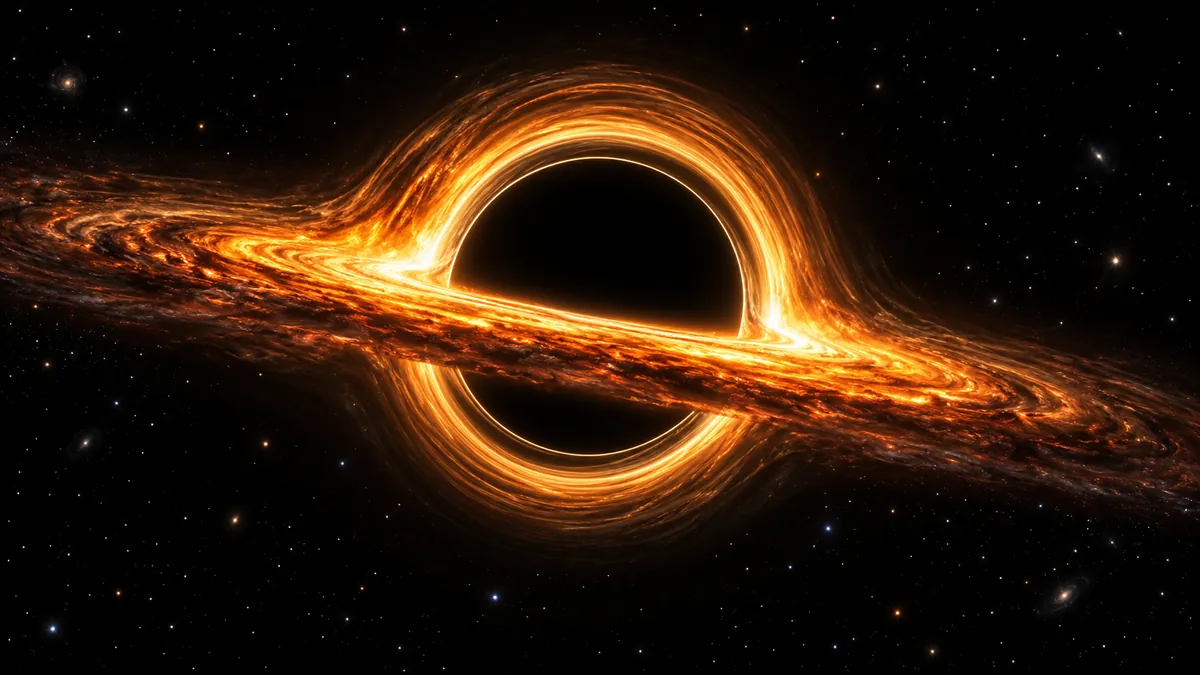
Quick answer: What is a black hole? It is a region of space where gravity is so strong that nothing, not even light, can escape. Its boundary is called the event horizon. Most black holes form when a massive star (roughly 20 or more times the Sun’s mass) runs out of fuel and its core collapses. Supermassive black holes, millions to billions of times the Sun’s mass, sit at the centers of most large galaxies, including our own Milky Way.
Black holes were once a strange prediction of Albert Einstein’s general theory of relativity that many physicists doubted were real. Today astronomers have detected their gravitational waves, photographed their shadows and won Nobel Prizes for studying them. Here is a clear guide to what black holes are, how they form and what we have learned about them.
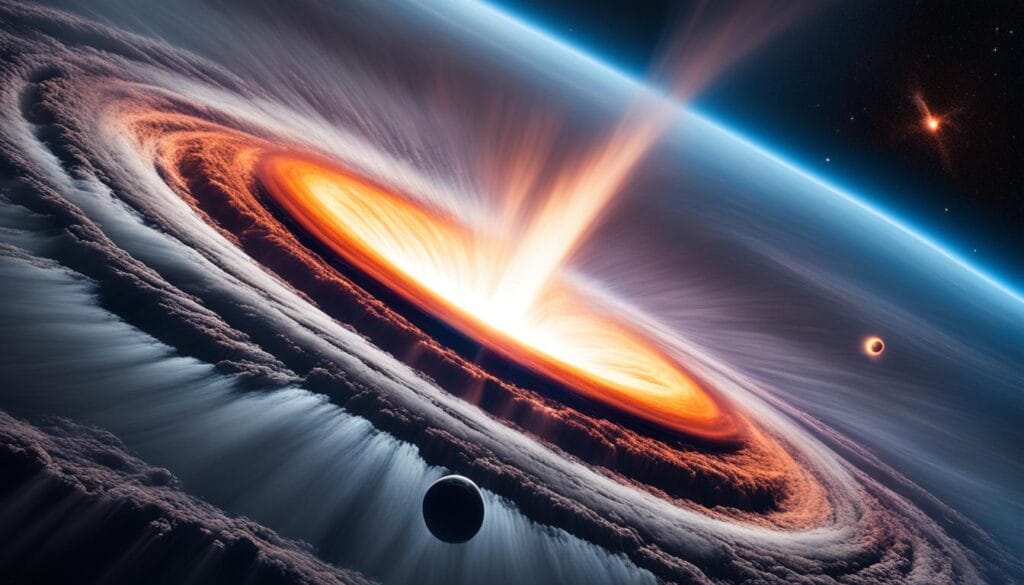
What is a black hole and how does it work?
Gravity depends on how much mass is packed into a space. If you squeeze enough mass into a small enough region, the speed needed to escape it becomes greater than the speed of light. Since nothing can travel faster than light, nothing can get out.
The size of that point-of-no-return is called the Schwarzschild radius. To become a black hole, the Sun would have to be compressed to a ball about 6 km across (a radius of about 3 km). Earth would have to be squeezed to about the size of a marble, under 2 cm wide.
The parts of a black hole
| Part | What it is |
|---|---|
| Event horizon | The boundary beyond which nothing can escape |
| Singularity | The predicted center where density becomes infinite and current physics breaks down |
| Accretion disk | A swirling disk of gas heated to millions of degrees as it falls in; it glows brightly |
| Photon sphere | A zone where light can orbit the black hole, forming the bright ring seen in black hole images |
| Jets | Beams of particles shot out at near light speed from some black holes’ poles |
How do black holes form?
- A massive star burns its fuel. Stars balance gravity pulling in against the pressure of nuclear fusion pushing out.
- Fusion stops. When the core runs out of fuel, there is nothing left to hold it up.
- The core collapses. In a fraction of a second, the core falls in on itself, often triggering a supernova explosion that blasts away the outer layers.
- A black hole is left behind. If the remaining core is heavy enough, roughly more than about 3 times the Sun’s mass, no known force can stop the collapse.
Smaller stars like the Sun will never become black holes. They end as white dwarfs.
The 4 types of black holes
| Type | Mass (Sun = 1) | How they form | Example |
|---|---|---|---|
| Stellar-mass | About 3 to over 100 | Collapse of massive stars | Cygnus X-1 |
| Intermediate-mass | About 100 to 100,000 | Uncertain; possibly mergers in dense star clusters | Few confirmed candidates |
| Supermassive | Millions to billions | Uncertain; growth from early “seeds” and mergers | Sagittarius A*, M87* |
| Primordial | Could be tiny | Hypothetical; formed just after the Big Bang | None confirmed |
How do scientists find black holes if they’re invisible?
- Orbiting stars. Stars whipping around an invisible object reveal its mass. Andrea Ghez and Reinhard Genzel shared the 2020 Nobel Prize in Physics for tracking stars around the Milky Way’s central black hole. Roger Penrose shared it for showing black holes follow from general relativity.
- X-rays. Gas falling into a black hole heats up and glows in X-rays. Cygnus X-1 became the first widely accepted black hole this way in the 1970s.
- Gravitational waves. On 14 September 2015, the LIGO detectors recorded ripples in spacetime from two black holes, about 36 and 29 times the Sun’s mass, merging around 1.3 billion light-years away.
- Direct images. The Event Horizon Telescope, a network of radio telescopes across Earth, released the first image of a black hole’s shadow (M87*) in 2019 and of our galaxy’s Sagittarius A* in 2022.
Black holes and the singularity
At the center of every black hole, Einstein’s general relativity predicts a singularity: a point (or, for a spinning black hole, a thin ring) where matter is crushed to infinite density and the curvature of spacetime becomes infinite. In 1965, Roger Penrose proved that once an event horizon forms, a singularity is unavoidable according to general relativity, work that earned him a share of the 2020 Nobel Prize.
Most physicists don’t think nature really contains infinities. A singularity is more likely a sign that general relativity breaks down and that a theory of quantum gravity is needed to describe what truly happens there. Because the event horizon hides it, no observation can reach a singularity. What happens to the information that falls in is a related puzzle (see the black hole information paradox).
Black holes at the centers of galaxies
Almost every large galaxy has a supermassive black hole at its center, millions to billions of times the Sun’s mass. The Milky Way’s is Sagittarius A*, about 4 million Suns; the Andromeda Galaxy’s is roughly 100 million; and the giant galaxy M87 hosts one of about 6.5 billion.
- They grow with their galaxies. A black hole’s mass is closely linked to the mass of its galaxy’s central bulge, suggesting the two evolve together.
- They can shine as quasars. When gas pours in, the disk around the black hole can outshine all the galaxy’s stars combined.
- They can stop star formation. Powerful jets and winds can heat or blow away the gas a galaxy needs to make new stars.
- They merge when galaxies merge. Pairs of supermassive black holes are thought to produce a gravitational-wave “background hum” (see what happens when two black holes collide).
Besides its central giant, our galaxy holds an estimated 100 million smaller black holes. Read how many black holes are in our galaxy and our list of famous black holes.
12 facts about black holes
- The Milky Way’s black hole is about 4 million times the Sun’s mass. Sagittarius A* lies roughly 26,000 light-years from Earth.
- M87* is far bigger. The first black hole ever imaged has about 6.5 billion solar masses and lies about 55 million light-years away.
- The nearest known black hole is about 1,560 light-years away. Gaia BH1 was identified in 2022 from the wobble of its companion star.
- Black holes don’t “suck” everything in. If the Sun were replaced by a black hole of the same mass, Earth’s orbit would not change. It would just get very cold and dark.
- Time slows near a black hole. Strong gravity slows time relative to distant observers, an effect predicted by general relativity.
- Falling in would stretch you. Near a small black hole, the pull on your feet would be much stronger than on your head, a process physicists call “spaghettification”.
- Black holes may slowly evaporate. In 1974, Stephen Hawking predicted they leak tiny amounts of energy, now called Hawking radiation. It has not been observed directly (see do black holes die?).
- Some black holes spin incredibly fast. Many are measured spinning at a large fraction of the maximum speed allowed.
- Black hole jets can be longer than galaxies. Some jets stretch for hundreds of thousands of light-years.
- Black holes merge. Gravitational-wave observatories have now recorded many black hole collisions.
- Giant black holes appeared surprisingly early. The James Webb Space Telescope has found active supermassive black holes less than a billion years after the Big Bang, challenging ideas about how quickly they grew.
- Nothing has ever been seen inside. What happens at the singularity is one of the biggest open questions in physics (see unsolved mysteries of the universe).
Can a black hole destroy Earth?
No. There is no known black hole close enough to threaten Earth, and the Sun is far too small to ever become one. The nearest known black hole is more than 1,500 light-years away.
Frequently asked questions
What is inside a black hole?
No one knows. General relativity predicts a singularity of infinite density at the center, but most physicists think a theory combining gravity and quantum mechanics will describe it differently.
What happens if you fall into a black hole?
For a small black hole, tidal forces would stretch you apart before you reached the event horizon. For a supermassive one, you could cross the horizon intact, but you could never escape or send a signal back out.
How big is a black hole?
It depends on its mass. A black hole with 10 times the Sun’s mass has an event horizon about 60 km across. Sagittarius A* is about 24 million km across, smaller than Mercury’s orbit.
Who discovered black holes?
Karl Schwarzschild found the first black hole solution to Einstein’s equations in 1916. John Wheeler popularized the name “black hole” in 1967, and Cygnus X-1 was the first strong observational candidate.
Can black holes die?
In theory yes, by slowly losing energy through Hawking radiation, but for a stellar black hole this would take far longer than the current age of the universe.
Related articles
- Primordial black holes
- Names of famous black holes
- Do black holes die?
- What happens if two black holes collide?
- How many black holes are in our galaxy?
- Rogue black holes
- The black hole information paradox
- What is dark matter?
- Unsolved mysteries of the universe
- The biggest space discoveries
- 15 mind-blowing facts about space
- All Space & Universe articles
Sources
- Abbott, B. P. et al. (LIGO and Virgo Collaborations) (2016). “Observation of gravitational waves from a binary black hole merger.” Physical Review Letters. doi:10.1103/PhysRevLett.116.061102
- Event Horizon Telescope Collaboration (2019). “First M87 Event Horizon Telescope results. I.” The Astrophysical Journal Letters. doi:10.3847/2041-8213/ab0ec7
- Event Horizon Telescope Collaboration (2022). “First Sagittarius A* Event Horizon Telescope results.” The Astrophysical Journal Letters.
- El-Badry, K. et al. (2023). “A Sun-like star orbiting a black hole.” Monthly Notices of the Royal Astronomical Society.
- The Nobel Prize in Physics 2020, NobelPrize.org.
- NASA Science: “Black Holes”. science.nasa.gov