
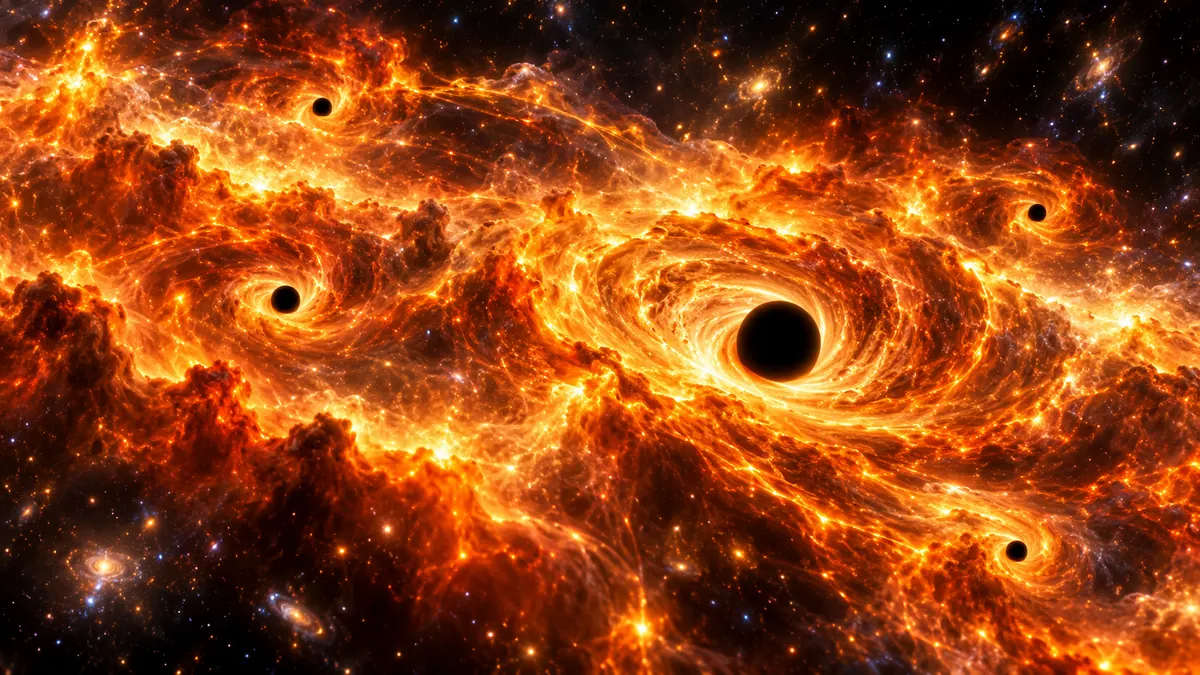
Quick answer: Primordial black holes are hypothetical black holes that may have formed in the first second after the Big Bang, not from collapsing stars. They could range from smaller than an atom (with the mass of a mountain) to thousands of times the Sun’s mass. None has been confirmed yet, but scientists study them because they could explain part of dark matter, the seeds of giant early black holes, and even some gravitational-wave signals.
Almost every black hole we know of formed when a massive star died. Primordial black holes would be different: they would be as old as the universe itself. The idea was first suggested by Yakov Zeldovich and Igor Novikov in 1966 and developed by Stephen Hawking in 1971. More than 50 years later, they remain one of the most intriguing “maybe” objects in cosmology. For the basics, start with our guide to what a black hole is.
How would primordial black holes form?
In the first fraction of a second after the Big Bang, the universe was filled with extremely hot, dense matter and radiation. It was almost perfectly smooth, but not quite. If some small regions were denser than average by enough, gravity could have made them collapse straight into black holes, without ever forming stars.
- Density ripples: Tiny variations in density, possibly created during cosmic inflation, spread through the early universe.
- Runaway collapse: Where a region was dense enough, its own gravity overwhelmed the outward pressure.
- A black hole is born: The region collapsed into a black hole roughly as massive as all the matter inside its “horizon” at that moment.
The earlier a primordial black hole formed, the smaller it would be. One forming about a trillionth of a second after the Big Bang might weigh about as much as an asteroid; one forming around one second after could be about 100,000 times the Sun’s mass.
Primordial vs stellar black holes
| Primordial black holes | Stellar black holes | |
|---|---|---|
| When they formed | Within the first second after the Big Bang | Throughout cosmic history, when big stars die |
| How they formed | Direct collapse of dense regions | Core collapse of a massive star |
| Possible masses | From tiny (asteroid mass) to thousands of Suns | About 3 to over 100 Suns |
| Confirmed? | No | Yes, many |
Could primordial black holes be dark matter?
This is the biggest reason scientists care. Dark matter makes up about 85% of all matter, and no particle explanation has been confirmed. Primordial black holes would be invisible, heavy and would have been created early enough to behave like dark matter.
Researchers have tested this idea in many ways, and most mass ranges are now ruled out as making up all of dark matter:
| Mass range | How it’s tested | Result |
|---|---|---|
| Very small (under about a billion tonnes) | They would have evaporated by now, releasing gamma rays | Ruled out as dark matter |
| Asteroid mass | Hard to detect; few strong tests | Still possible |
| Planet to star mass | Microlensing surveys look for stars briefly brightening | Can only be a small fraction |
| Tens of Suns | Gravitational-wave merger rates, cosmic background | Can only be a small fraction |
So primordial black holes could still be all of dark matter only in a narrow “asteroid-mass window”, or they could make up a small part of it.
Do primordial black holes evaporate?
Yes, in theory. Stephen Hawking showed that black holes slowly lose energy through Hawking radiation, and smaller ones lose it faster. Primordial black holes lighter than roughly a billion tonnes would have evaporated completely by now. Ones of about that mass would be finishing right about now, ending in a burst of gamma rays. Telescopes such as NASA’s Fermi have searched for these final flashes but haven’t found one. Read more in do black holes die?
Other reasons scientists are interested
- Early supermassive black holes. The James Webb Space Telescope has found huge black holes surprisingly soon after the Big Bang. Primordial black holes could have been their “seeds”.
- Gravitational waves. Some black hole mergers detected by LIGO and Virgo have unusual masses, and a few researchers suggest some could be primordial (see what happens when two black holes collide).
- Planet Nine. One speculative idea suggests the hypothetical Planet Nine could actually be a primordial black hole of several Earth masses, only a few centimeters across.
Key facts about primordial black holes
- First proposed in 1966 by Zeldovich and Novikov; developed by Hawking in 1971.
- Would have formed in the first second after the Big Bang.
- Could range from tiny to thousands of solar masses.
- Have never been directly detected.
- Remain a candidate for some or all dark matter in a narrow mass range.
Frequently asked questions
Do primordial black holes exist?
We don’t know. They are allowed by physics and predicted by some models of the early universe, but none has been confirmed.
How big is a primordial black hole?
It depends on its mass. One with the mass of a large asteroid would be smaller than a virus. One with the mass of Earth would be about the size of a marble.
Could a primordial black hole pass through Earth?
In theory, a tiny one could pass through without much effect, but the chance of this happening is extremely small, and none has ever been detected doing so.
Are primordial black holes dangerous?
No. Even if they exist, they would be spread thinly across space, and the chance of one coming close enough to affect Earth is negligible.
Who discovered primordial black holes?
No one has discovered one yet. Yakov Zeldovich and Igor Novikov first proposed them in 1966, and Stephen Hawking developed the idea in 1971.
Related articles
- What is a black hole?
- Do black holes die?
- Rogue black holes
- What is dark matter?
- Names of famous black holes
Sources
- Hawking, S. (1971). “Gravitationally collapsed objects of very low mass.” Monthly Notices of the Royal Astronomical Society.
- Carr, B. & Kühnel, F. (2020). “Primordial black holes as dark matter: recent developments.” Annual Review of Nuclear and Particle Science.
- Green, A. M. & Kavanagh, B. J. (2021). “Primordial black holes as a dark matter candidate.” Journal of Physics G.
- Scholtz, J. & Unwin, J. (2020). “What if Planet 9 is a primordial black hole?” Physical Review Letters.
- NASA Science: “Black Holes”. science.nasa.gov