
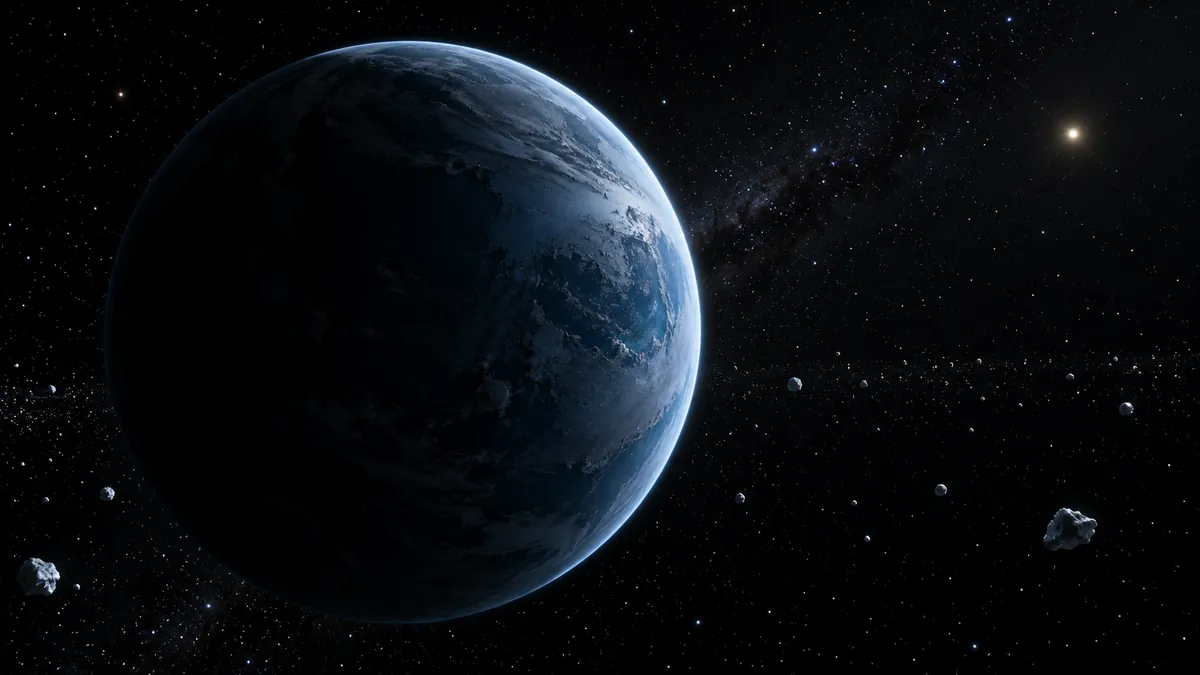
Quick answer: Planet Nine is a hypothetical planet that may orbit the Sun far beyond Neptune. In 2016, Caltech astronomers Konstantin Batygin and Michael Brown proposed it to explain why several distant icy objects have strangely clustered orbits. Their models suggest a planet of roughly 5 to 10 Earth masses, hundreds of times farther from the Sun than Earth, taking 10,000 to 20,000 years to complete one orbit. It has not been seen, and some scientists think the clustering is an illusion caused by how surveys search the sky.
For most of history, the solar system’s edge seemed settled: eight planets (nine, until Pluto was reclassified in 2006) and a belt of icy debris. But in the last decade, strange patterns in the outer solar system have convinced some astronomers that a large planet may still be hiding out there in the dark.
Why do astronomers think Planet Nine exists?
Beyond Neptune lies the Kuiper Belt, a zone of icy bodies including Pluto. Farther still are a few “extreme” trans-Neptunian objects (TNOs) whose orbits never bring them close to Neptune. In 2014, Chad Trujillo and Scott Sheppard noticed that several of these distant objects had oddly similar orbital orientations.
In 2016, Batygin and Brown showed that the clustering could be explained by the gravity of an unseen massive planet steering their orbits. Their models also explained other puzzles:
- Some distant objects have orbits tilted steeply compared to the planets.
- A few objects orbit almost perpendicular to the rest of the solar system.
- Objects such as Sedna never come close enough to Neptune to be pushed by it, so something else must have shaped their orbits.
What would Planet Nine be like?
| Property | Estimate | Compared with Earth |
|---|---|---|
| Mass | About 5 to 10 Earth masses | Likely a “super-Earth” or small ice giant |
| Average distance from Sun | Roughly 400 to 800 AU | Earth is 1 AU; Neptune is about 30 AU |
| Orbital period | About 10,000 to 20,000 years | Earth: 1 year |
| Brightness | Very faint, reflecting little sunlight | Far too dim to see without large telescopes |
Planets of this size, between Earth and Neptune, are among the most common types found around other stars, yet our solar system appears to have none. If Planet Nine exists, it might fill that gap (see facts about exoplanets).
The case against Planet Nine
Not everyone is convinced. The main doubts are:
- Observational bias. Telescopes can only search certain parts of the sky at certain times of year, and distant objects are easiest to spot near their closest point to the Sun. Studies using data from surveys such as OSSOS and the Dark Energy Survey found the apparent clustering could be produced by these search patterns.
- Small numbers. The argument relies on a fairly small group of extreme objects. More discoveries are needed.
- Other explanations. The combined gravity of a large disk of small icy bodies could shape the orbits instead. A more exotic idea suggests a small primordial black hole about the size of a grapefruit with several Earth masses.
Planet Nine vs “Planet X”
The hunt for an unknown planet has a long history. In 1846, Neptune was found because Urbain Le Verrier predicted its position from the way it tugged on Uranus. In the early 1900s, Percival Lowell searched for a “Planet X” to explain supposed oddities in Neptune’s orbit. Pluto was discovered in 1930 during that search, but it turned out to be far too small, and the oddities were later explained by better measurements of Neptune’s mass. Planet Nine is a new, separate prediction based on modern data.
How are scientists searching for it?
- Large survey telescopes. The Vera C. Rubin Observatory in Chile is repeatedly imaging the whole southern sky and is expected to either find Planet Nine or rule out much of the area where it could be.
- Old data. Astronomers are re-checking infrared survey data for a slowly moving faint dot.
- More distant objects. Each newly discovered extreme TNO tests whether the clustering is real.
Other mysteries at the edge of space
Planet Nine is only one of the open questions about the universe. Two of the biggest are explained in our guides to what a black hole is and what dark matter is. For a broader overview, see unsolved mysteries of the universe.
Frequently asked questions
Has Planet Nine been found?
No. As of now, Planet Nine has not been directly observed. Its existence is inferred from the orbits of distant objects, and the evidence is debated.
Is Planet Nine the same as Pluto?
No. Pluto was called the ninth planet until 2006, when it was reclassified as a dwarf planet. Planet Nine is a different, much larger hypothetical world far beyond Pluto.
Why hasn’t Planet Nine been seen?
It would be extremely far away and very faint, and it moves slowly across a large area of sky. Finding it is like searching for a dim, slowly drifting dot among millions of stars.
How big would Planet Nine be?
Models suggest about 5 to 10 times Earth’s mass, possibly two to four times Earth’s width.
Could Planet Nine hit Earth?
No. Even at its closest, its predicted orbit stays hundreds of times farther from the Sun than Earth.
Related articles
- Unsolved mysteries of the universe
- 10 amazing facts about exoplanets
- The biggest space discoveries
- Space facts for kids
Sources
- Batygin, K. & Brown, M. E. (2016). “Evidence for a distant giant planet in the solar system.” The Astronomical Journal. doi:10.3847/0004-6256/151/2/22
- Trujillo, C. A. & Sheppard, S. S. (2014). “A Sedna-like body with a perihelion of 80 astronomical units.” Nature.
- Batygin, K. et al. (2019). “The planet nine hypothesis.” Physics Reports.
- Napier, K. J. et al. (2021). “No evidence for orbital clustering in the extreme trans-Neptunian objects.” The Planetary Science Journal.
- NASA Science: “Hypothetical Planet X”. science.nasa.gov