
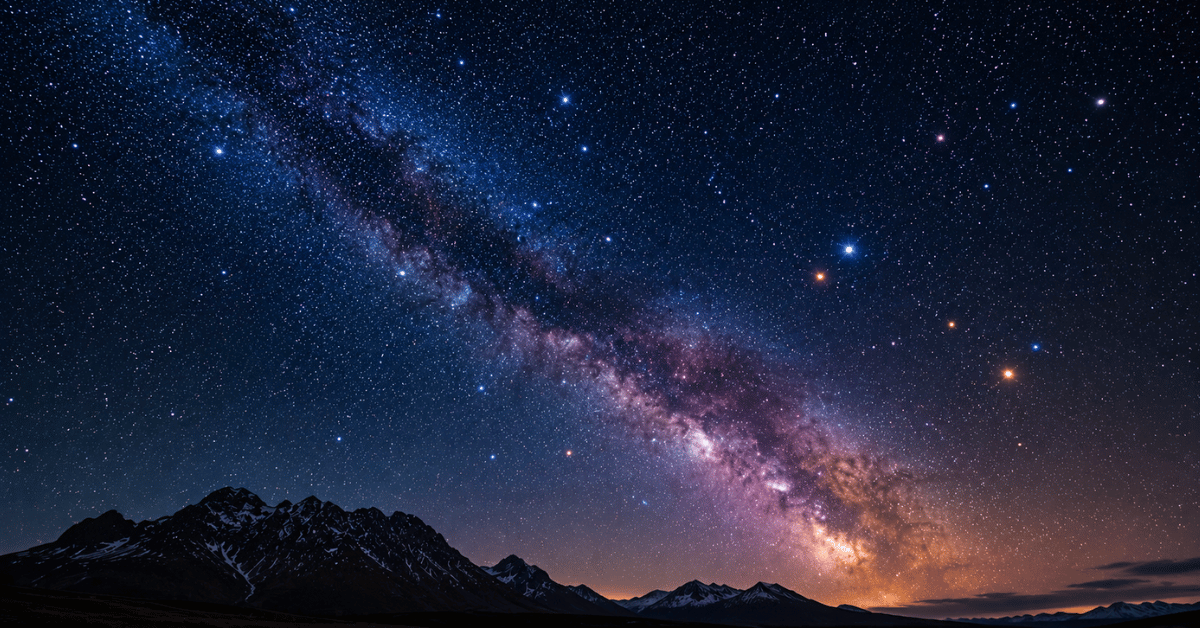
Quick answer: Stars twinkle because their light passes through Earth’s turbulent atmosphere. Pockets of air at different temperatures bend (refract) the light by slightly different amounts, and because stars are so far away they appear as single points of light, so these constant shifts make them flicker. Planets appear as tiny disks, so their light averages out and they shine more steadily.
Why do stars twinkle when you look up on a clear night? The sky above you fills with flickering points of light, some shimmering white, some flashing faint colors. It looks as though the stars themselves are pulsing.
They are not. Stars emit light in a perfectly steady stream. The twinkling you see has nothing to do with the star. It happens entirely inside the 100 kilometers of atmosphere that sit between your eyes and space.
Why do stars twinkle? Starlight travels billions of kilometers through space without distortion. The moment it enters Earth’s atmosphere, it passes through layers of air at different temperatures and densities that are constantly moving. Each time the light crosses from one air layer to another, it bends slightly. Those bends shift the star’s apparent position and brightness dozens of times every second. Your eye sees those rapid shifts as twinkling.
That same atmospheric bending also explains why the sky appears blue during the day, why sunsets turn red, and why objects near the horizon look distorted. The atmosphere is not a passive window. It is an active optical system that constantly reshapes the light passing through it.
Why Do Stars Twinkle: The One-Sentence Answer
Stars twinkle because Earth’s turbulent atmosphere bends starlight in constantly changing directions, making the star’s apparent position and brightness shift rapidly: an effect called astronomical scintillation.
That single sentence contains three ideas worth unpacking: why the atmosphere bends light, what turbulence does to that bending, and why the changes happen so fast. Each piece of the mechanism builds on the last.
Step One: Why Atmosphere Bends Light at All
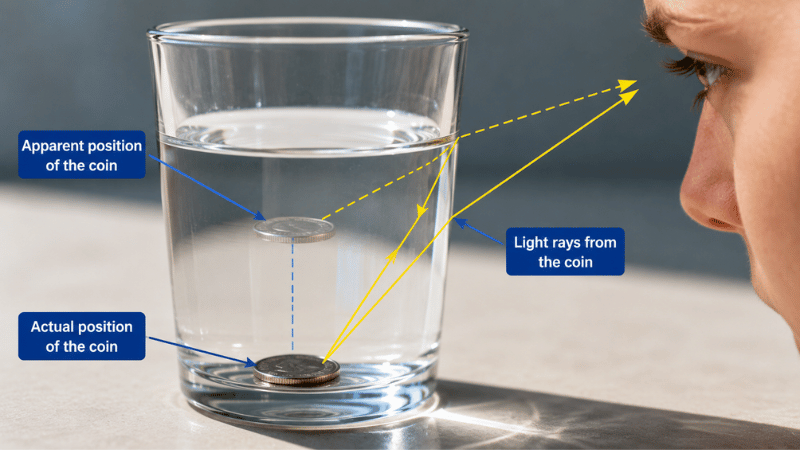
Drop a coin into a glass of water and look at it from the side. The coin appears to sit in a different position than it actually occupies. The water has bent the path of the light travelling from the coin to your eye, shifting the apparent position of the object.
Air does the same thing. Light travels at different speeds through materials of different densities. When a beam of light crosses from one material into a denser one, it slows down and bends. When it crosses into a less dense material, it speeds up and bends the other way. This is called refraction.
Earth’s atmosphere is not a uniform block of air. It is a layered, churning mixture of gases at varying temperatures, pressures, and densities. Warm air is less dense than cold air. Humid air has a slightly different density than dry air. Air at different altitudes has different pressures.
NOAA’s atmospheric science division confirms that the refractive index of air, which measures how strongly it bends light, changes continuously as temperature and density change. Starlight crossing through Earth’s atmosphere does not travel in a straight line. It bends dozens or hundreds of times as it passes through layer after layer of air with varying optical properties.
Step Two: Why the Bending Never Stays Still
If the atmosphere were perfectly still and uniform, that bending would happen in the same direction every time. The star would appear slightly displaced from its true position, but the displacement would be constant. You would never see a twinkle.
Atmosphere is never still. James Lattis, director of the University of Wisconsin-Madison Space Place, explains it precisely: ‘Each temperature zone is something like a bubble of warmer or cooler air, and they are usually rising and falling, which means the path of the starlight is constantly and randomly shifting. We see that unsteady shifting as twinkling.’
The Sun heats the ground during the day. That warm ground heats the air directly above it. Warm air is less dense than the surrounding cooler air, so it rises. Cool air sinks to replace it. Wind at different altitudes moves at different speeds and directions, creating shear turbulence where fast and slow air layers slide past each other. At night, the ground releases stored heat, driving convection that churns the lower layers of the atmosphere.
The result is that the atmosphere is in continuous, chaotic motion at every altitude. The air pockets bending starlight are always moving, always changing density, always altering the refractive index along the light’s path. The bending direction changes many times per second. That is why the star appears to jump, shift, dim, and brighten in rapid succession.
Why Stars Twinkle More Near the Horizon
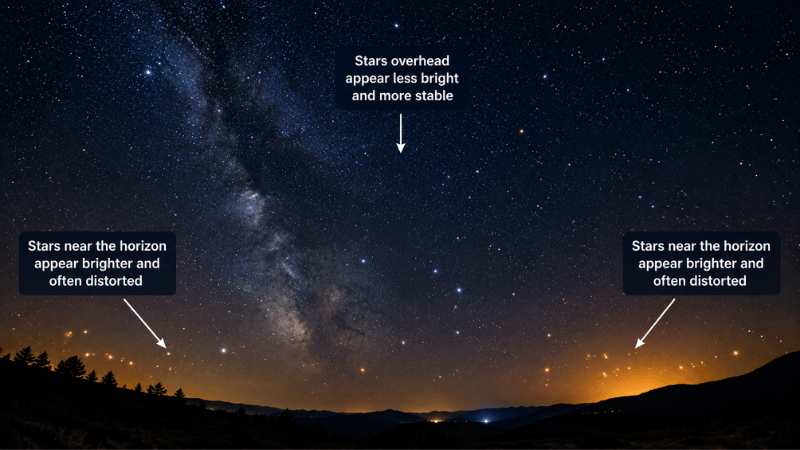
Look at a star directly overhead. Its light has traveled through about 100 kilometers of atmosphere on a straight vertical path to reach your eyes.
Now look at a star sitting just above the horizon. Its light has traveled through a long, diagonal slice of atmosphere, sometimes 10 to 40 times thicker than the vertical path. More air means more turbulent layers to cross. More turbulent layers mean more bending, more random shifts, more twinkling.
The Old Farmer’s Almanac notes that stars near the horizon can twinkle so violently that they appear to flash between separate colors. The atmospheric path is long enough that different wavelengths of light bend by slightly different amounts, separating the star’s light like a prism and causing rapid color shifts visible to the naked eye.
This is why serious stargazers wait for their target to climb higher in the sky before observing it. A star or planet near the horizon sits behind the thickest, most turbulent section of atmosphere and produces the worst image quality. Stars directly overhead, behind the thinnest atmospheric column, twinkle the least.
Why Stars Change Color When They Twinkle
On nights with strong atmospheric turbulence, bright stars near the horizon sometimes appear to flash rapidly between white, blue, red, and green. This color-changing twinkle catches people off guard because most stars look white overhead.
The mechanism is the same as a prism separating white light into a rainbow. White starlight contains every wavelength of the visible spectrum. When that light refracts through turbulent air, different wavelengths bend by different amounts. Blue light bends more than red light. Green bends more than yellow.
In turbulent air near the horizon, the bending is strong enough and variable enough that the different wavelengths arrive at your eye from slightly different directions at different moments. A moment of strong blue-bending makes the star flash blue. A shift in the air sends red to your eye instead. The star appears to change color rapidly, not because the star is doing anything, but because the atmosphere is scattering different parts of its spectrum in different directions from second to second.
Sirius, the brightest star in the night sky, is famous for this effect. Near the horizon in winter, Sirius can flash through several visible colors within seconds. It is so striking that people regularly report it as a UFO sighting. The effect is pure atmospheric optics.
Why Planets Do Not Twinkle But Stars Do
The most commonly asked follow-up question to why do stars twinkle is why planets appear so much steadier in comparison. An old observing rule says that if a bright object twinkles it is a star; if it holds steady it is a planet. The rule is broadly reliable, and the reason behind it reveals something important about distance.
Stars, despite being massive objects, are so far from Earth that they appear as single mathematical points of light. Even the most powerful ground-based telescopes cannot resolve a star as a disk. Every photon arriving from a distant star travels through a single, narrow beam of atmosphere.
When that narrow beam hits a turbulent air pocket, the pocket can redirect the entire beam away from your eye for a fraction of a second. The star winks out momentarily. Then the beam returns. Then it deflects again. The star twinkles because there is only one beam, and it has nowhere to average.
Planets are far closer to Earth. Even though they look like tiny points to the naked eye, they are close enough to present an actual disk with measurable angular width. Light from across the full surface of that disk arrives at your eye through many slightly different paths through the atmosphere.
When turbulence deflects the beam from one part of the planet’s disk, beams from other parts still arrive. The fluctuations from different paths cancel each other out across the disk. The overall brightness and position of the planet stays relatively stable. Astronomers at Cornell University’s Curious About Astronomy program describe it as averaging: the atmospheric distortions spread across many points rather than concentrating on one single beam.
The rule breaks down near the horizon. Even a planet, when sitting very low in the sky, passes its light through enough turbulent atmosphere to show visible twinkling. Jupiter and Venus near the horizon can appear to flicker noticeably on nights with strong atmospheric disturbance.
Why Sirius Twinkles Most Dramatically of All Stars
Sirius is the brightest star visible from Earth. On winter nights in the Northern Hemisphere, it sits relatively low in the southern sky for observers at mid-latitudes. That low position means its light travels through a long, turbulent atmospheric path.
Combined with its brightness, which makes even small fluctuations in intensity highly visible, Sirius twinkles more dramatically than almost any other star. Its light flashes through rapid color changes from white to blue to red and back. On nights with significant atmospheric turbulence, the effect is striking enough to confuse observers who do not expect it.
The same mechanism applies to any bright star observed at low altitude. Canopus, the second brightest star, creates the same effect for observers in the Southern Hemisphere. The rule is not specific to Sirius. It is a product of brightness combined with low altitude and turbulent air.
Can Twinkling Stars Predict the Weather
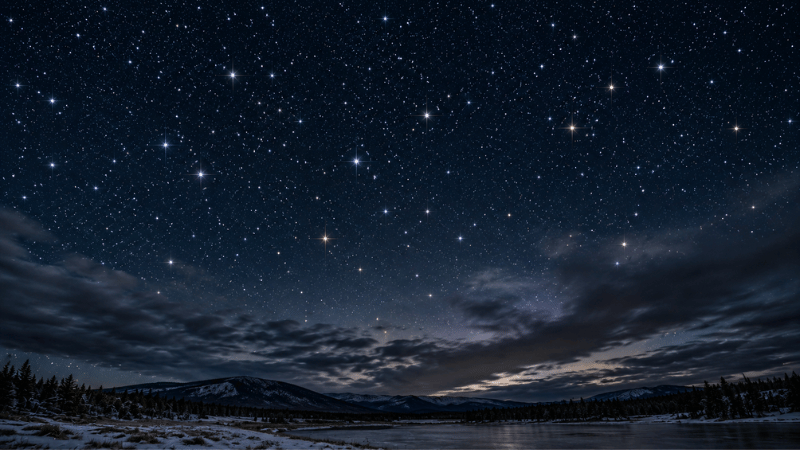
Folk wisdom has connected star twinkling to weather prediction for centuries. The saying ‘when stars twinkle strongly, a storm is coming’ has circulated in farming and sailing cultures across many countries. It turns out to have a genuine scientific basis.
Strong twinkling means high atmospheric turbulence. High atmospheric turbulence often accompanies rapidly changing weather systems: cold fronts moving in, warm air masses destabilizing, moisture levels changing. When stars twinkle unusually violently, particularly at high elevations in the sky where they would normally be steadier, it frequently signals atmospheric instability associated with incoming weather changes.
Conversely, stars that appear unusually steady and sharp, with minimal twinkling, often indicate stable, calm atmospheric conditions. The atmosphere is layered and still, temperature gradients are low, and the next 24 hours are likely to remain settled.
The relationship is not precise enough for weather forecasting, but it is real enough to be a useful informal indicator. The same atmospheric properties that affect starlight affect pressure systems, moisture transport, and temperature change at the surface.
How the Hubble Telescope Changed Everything by Leaving the Atmosphere
For most of astronomy’s history, the twinkling problem was simply accepted. Ground-based telescopes sat at the bottom of Earth’s atmosphere and produced blurred, shimmering images of stars. Astronomers built observatories on mountaintops partly to sit above the thickest, most turbulent low-altitude air, but the atmosphere remained an unavoidable limitation.
The Hubble Space Telescope, launched in 1990, solved the problem by removing it entirely. Hubble orbits above the atmosphere at an altitude of about 550 kilometers. With no atmosphere between its mirror and the stars, starlight arrives undistorted. Hubble sees stars as perfectly steady points of light, exactly as they are. Its images have a sharpness that no ground-based telescope can match in standard operation.
This is one reason the Hubble has produced some of the most striking images of deep space in history. It is not primarily because of the size of its mirror. Many ground-based telescopes have larger mirrors than Hubble. The advantage is the absence of atmospheric scintillation. The same principles that explain the extraordinary facts about space that are impossible to observe from Earth’s surface apply directly here. The atmosphere that gives us a blue sky and protects us from radiation also blurs every image we try to take of the universe beyond it.
How Ground-Based Telescopes Fight Twinkling with Adaptive Optics
Putting a telescope in space is expensive. The alternative, developed over the last three decades, is to fight the atmosphere from the ground using adaptive optics.
An adaptive optics system works by measuring atmospheric distortion in real time and cancelling it out faster than the atmosphere can change. A sensor measures how the shape of a nearby bright star’s wavefront is being distorted by the atmosphere at any given instant. A computer calculates the correction needed. A deformable mirror, controlled by hundreds of tiny actuators, bends its surface to apply the opposite distortion thousands of times per second. The atmospheric distortion and the mirror’s correction cancel out, producing a sharp image.
Scientific American’s explanation of adaptive optics notes that when no suitable bright star exists near the target, observatories use lasers to create artificial guide stars. The laser excites sodium atoms in a layer of the atmosphere about 90 kilometers up, creating a bright artificial point source whose distortion the system can measure and correct.
Major observatories using adaptive optics include the Keck Observatory in Hawaii, the Very Large Telescope in Chile, and the Gemini Observatories. The Extremely Large Telescope, currently under construction in Chile, will use a mirror that can adjust its shape up to 1,000 times per second to correct atmospheric blurring. When complete, it will produce images sharper than Hubble from the ground.
Does Star Twinkling Have Any Scientific Uses
Twinkling is a nuisance for astronomers trying to image distant objects, but it contains genuine scientific information about the atmosphere through which the light has passed.
By measuring the pattern of scintillation precisely, researchers can map turbulence layers in the atmosphere at different altitudes. They can determine wind speeds at high altitude, measure temperature gradients, and track how atmospheric structure changes over time. This information feeds into weather modeling, climate research, and the design of better adaptive optics systems.
Scintillation also occurs with radio waves from space, not just visible light. Pulsars are rapidly rotating neutron stars that emit intense beams of radio waves. Those radio waves scatter as they pass through interstellar plasma on their journey to Earth. Astronomers measure the scintillation patterns in pulsar signals to study the structure and density of the interstellar medium between stars. The same physical principle that causes visual twinkling applies to radio scintillation across interstellar distances. This connects to the broader science of extreme space objects and how their light reaches us through various distorting media.
Why Stars Do Not Twinkle in Space
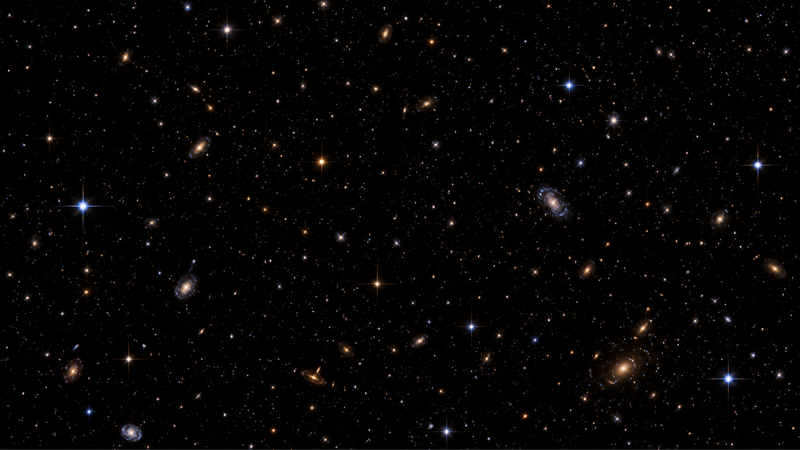
Astronauts aboard the International Space Station see stars as they truly are: perfectly steady, sharply defined points of light that do not flicker at all. The twinkling that earthbound observers see every night is entirely absent from space.
There is no atmospheric turbulence in space. No temperature gradients, no rising warm air, no wind shear. Light travels from a star to a space-based observer in a perfectly straight line through a near-perfect vacuum. Nothing bends it. Nothing redirects it. The star sits exactly where it appears to sit, emitting exactly as much light every instant.
The Moon demonstrates the same principle from a different angle. The Moon has essentially no atmosphere. Astronauts on the lunar surface see a black sky at noon with the sun blazing above. Stars are visible during the lunar day if you shield your eyes from the direct sunlight. None of them twinkle. The surface of the Moon offers a window into what the night sky would look like from Earth if our planet had no atmosphere. The same reasons that the Moon’s surface looks so dramatically different from Earth come down to the presence or absence of that thin layer of turbulent, refractive air.
Frequently Asked Questions
Why do stars twinkle but the sun does not?
The sun is so close to Earth that it appears as a disk rather than a point source of light. Light from every part of the sun’s visible surface arrives at your eye through slightly different atmospheric paths. Fluctuations in those paths cancel each other out across the disk, exactly as they do for planets. The sun’s apparent size is large enough to completely average out atmospheric distortion. You never see the sun twinkle.
Do stars twinkle during the day?
Stars are present in the daytime sky but invisible because sunlight scattered by the atmosphere is brighter than starlight. The atmospheric turbulence that causes twinkling operates continuously day and night. If you could somehow see stars during the day, they would twinkle just as they do at night, and often more intensely because daytime heating of the ground drives stronger convection and more atmospheric turbulence.
Why do some stars twinkle more than others?
Three factors determine how much a star twinkles. First, altitude in the sky: stars near the horizon twinkle far more than stars overhead because their light crosses more atmosphere. Second, atmospheric conditions on a given night: cold dry nights with rapid temperature changes produce more turbulence than warm humid nights. Third, wavelength sensitivity: blue stars are slightly more affected by atmospheric refraction than red stars, so they may appear to twinkle more intensely at equivalent altitudes.
Can you stop stars from twinkling?
From the ground, you can reduce twinkling by choosing high-altitude observing sites where you sit above the lowest and most turbulent atmospheric layers. Observing stars directly overhead minimizes the atmospheric path. Large telescopes with adaptive optics correct most of the remaining distortion in real time. To eliminate twinkling completely, you need to observe from above the atmosphere entirely, which is what space telescopes accomplish.
Why do stars twinkle faster on some nights?
The speed of twinkling reflects the speed of atmospheric turbulence above you. On nights with fast-moving wind shear at high altitude, the turbulent air pockets that bend starlight move quickly, causing rapid flickering. On calmer nights with slower atmospheric motion, twinkling is slower and more languid. Very fast twinkling, sometimes appearing almost stroboscopic, typically indicates significant high-altitude wind activity, which is why it often correlates with incoming weather changes.
Do stars twinkle on other planets?
It depends entirely on whether the planet has an atmosphere and what that atmosphere is made of. Mars has a thin atmosphere that causes minimal scintillation. Venus has a dense atmosphere of carbon dioxide and sulfuric acid clouds that would distort starlight significantly. Titan, Saturn’s moon, has a thick nitrogen and organic haze atmosphere that would cause strong twinkling. An airless body like the Moon or Mercury produces no twinkling at all. Twinkling is a property of the observing environment, not of the stars.
Do stars twinkle in space?
No. Twinkling is caused by Earth’s atmosphere. Astronauts and space telescopes above the atmosphere see stars as steady, non-twinkling points of light.
Why don’t planets twinkle?
Planets are much closer than stars, so they appear as tiny disks rather than single points. The atmosphere bends light from different parts of the disk in different ways, and those shifts average out, so planets shine more steadily.
The One Paragraph Answer
Stars do not actually twinkle. They emit light steadily across billions of kilometers of space. The twinkling you see happens in the last 100 kilometers of that journey, inside Earth’s atmosphere. Air at different temperatures and densities bends light by different amounts, a process called refraction. The atmosphere is never still: warm air rises, cold air sinks, wind creates turbulence at every altitude. Starlight crossing through those constantly moving air pockets bends in constantly changing directions, making the star’s apparent position and brightness shift dozens of times per second. Your eye perceives those rapid shifts as twinkling. Stars twinkle more near the horizon because the light crosses more atmosphere. Planets do not twinkle because their disks are wide enough to average out the distortion. In space, above the atmosphere, stars are perfectly still points of light. On Earth’s surface, every star you see twinkling is sending you a live readout of the state of the air above your head.
Related articles
- Why is the sky blue?
- 15 mind-blowing space facts
- Unsolved mysteries of the universe
- Space facts for kids
Sources
- James Lattis, director of the University of Wisconsin-Madison Space Place
- The Old Farmer's Almanac
- EarthSky: Astronomers at Cornell University's Curious About Astronomy program
- Scientific American's explanation of adaptive optics