
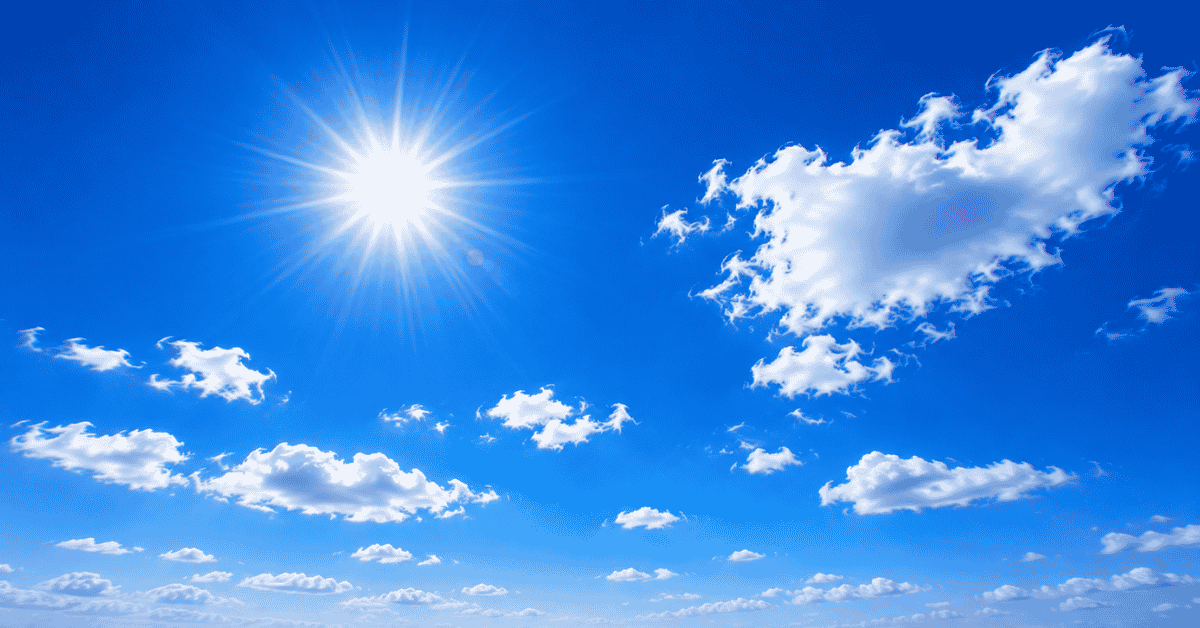
Quick answer: The sky is blue because molecules in the air scatter short-wavelength blue light from the Sun much more strongly than long-wavelength red light. This is called Rayleigh scattering. The scattered blue light reaches your eyes from every direction, so the whole sky looks blue. Violet light is scattered even more, but sunlight contains less violet and our eyes are more sensitive to blue.
Step outside on any clear afternoon. The sky above you is a deep, consistent blue. The same blue appears above deserts in Africa, snowfields in Antarctica, and cities in Asia. No ocean anywhere near those places.
That one observation rules out the most common misconception immediately. The sky is not blue because it reflects the sea.
Why is the sky blue? Sunlight carries every color of the visible spectrum. When it enters Earth’s atmosphere, the gas molecules scatter short-wavelength blue light in all directions across the sky. Blue scatters far more powerfully than any other color. Your eyes pick up that scattered blue from every direction you look. The result is a blue sky.
That process is called Rayleigh scattering. It also explains why natural light phenomena like rainbows and sundogs appear the way they do. The same physics, different geometry.
Sunlight Is Not White: It Contains Every Color
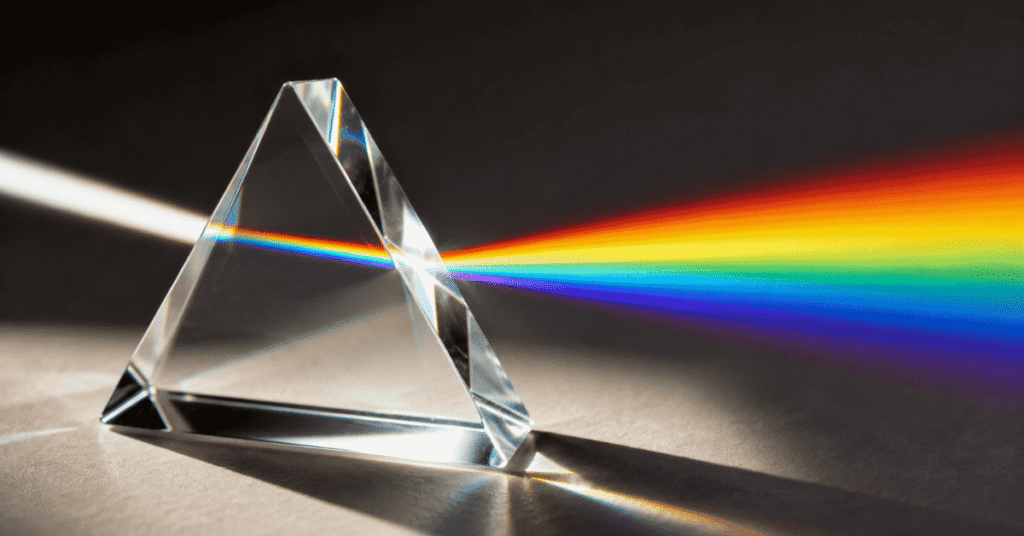
Sunlight looks white to the human eye. But white is not a single color. It is every color of the visible spectrum arriving at your eye simultaneously.
Pass sunlight through a glass prism. It separates into a rainbow: red, orange, yellow, green, blue, and violet. Each color travels at its own wavelength, measured in nanometers.
- Red light travels at around 700 nm, the longest visible wavelength
- Blue light travels at around 450 nm, near the short end of the spectrum
- Violet light travels at around 380 nm, the shortest visible wavelength
Those wavelength differences control exactly how each color behaves inside Earth’s atmosphere. Short wavelengths and long wavelengths do not behave the same way when they hit a gas molecule.
What the Atmosphere Is Made Of
Earth’s atmosphere is 78% nitrogen and 21% oxygen, with traces of argon, carbon dioxide, and water vapor. NOAA confirms that these gas molecules, not dust and not water, are what color the sky blue.
Nitrogen and oxygen molecules are extraordinarily small. Far smaller than the wavelengths of visible light. That size difference is what triggers scattering.
How Rayleigh Scattering Makes the Sky Blue
In 1871, British physicist Lord Rayleigh calculated how light behaves when it strikes particles far smaller than its own wavelength. His result, documented in detail by the University of California physics department, is that scattering intensity scales inversely with the fourth power of the wavelength.
Blue light has a wavelength roughly half that of red light. Plug those numbers into Rayleigh’s formula and blue light scatters approximately ten times more powerfully than red light through the same atmosphere.
When sunlight enters the atmosphere from above, the blue component collides with nitrogen and oxygen molecules and bounces in every direction. Sideways. Backward. Diagonally. It floods the entire sky.
Red and orange light, with their long wavelengths, pass through most of those same molecules almost undisturbed. They keep traveling in a straight line toward the ground.
When you look at any part of the sky that is not the sun itself, you are seeing blue light that has scattered toward your eyes from countless different angles at once. Blue fills the sky from edge to edge. That is Rayleigh scattering.
Why the Sky Is Blue and Not Violet
Violet light has a shorter wavelength than blue. It should scatter more than blue. So the sky should look violet. It does not. Most explanations skip over why.
Two things prevent a violet sky.
The sun emits less violet than blue. The solar spectrum peaks around yellow-green and contains considerably more blue light than violet. Less violet enters the atmosphere to scatter in the first place.
Human eyes respond weakly to violet. Your retina has cone cells tuned to red, green, and blue wavelengths. Violet simultaneously stimulates your blue and red cones, which your brain reads as a faint bluish-pink. Your eyes are measurably less sensitive to violet than to pure blue.
The Royal Observatory Greenwich explains this clearly: our eyes receive more blue than violet from the sun and are better at detecting it. Violet scatters more, but blue wins on both quantity and perception.
Why the Sky Gets Paler Near the Horizon
Look straight up: deep saturated blue. Look toward the horizon: pale washed-out blue or white. The same atmosphere produces both, and the difference is atmospheric path length.
Light arriving from directly overhead has traveled through roughly 100 kilometers of atmosphere. Light arriving from near the horizon has traveled through a far longer diagonal slice, sometimes five to ten times as thick.
Over that longer path, blue light scatters so many times it bounces back together with other colors. The recombined light looks pale blue or white rather than deep blue. The sky directly above keeps its rich color because the atmospheric path is shortest there.
Why the Sky Turns Red and Orange at Sunset
IMAGE NOTE: SECTION IMAGE 2: Vivid red-orange sunset photograph with the sun just above the horizon. Alt text: Red and orange sunset sky caused by blue light scattering away over a long atmospheric path at sunset, explaining why is the sky blue during the day. Source: Unsplash, search: vivid red orange sunset horizon.
Sunsets use the same Rayleigh scattering. The only thing that changes is the geometry of the light path.
At sunset, the sun sits at the horizon. Its light must travel through an extremely long diagonal slice of atmosphere before reaching your eyes. Atmospheric scientists at the University of Wisconsin explain that the extended path scatters all blue and violet light completely sideways out of your line of sight.
What survives the long journey is the long-wavelength light: red, orange, and yellow. That is what colors the sky and the sun itself at sunset.
Pollution, smoke, and dust add larger particles that scatter all wavelengths equally through a process called Mie scattering. Those particles strip away even more short-wavelength light, which is why sunsets near cities, or in the weeks following a large volcanic eruption, produce unusually deep reds and purples. This same Mie scattering is what turns the sky orange during wildfires, a phenomenon connected to the atmospheric weather events in the Science and Nature category on this site.
Why Space Is Black and the Moon Has No Blue Sky
Astronauts aboard the International Space Station see black in every direction that does not contain a bright object. No blue. Just black. This connects directly to the space facts about how the universe behaves differently outside Earth’s atmosphere, including why stars do not twinkle when viewed from space.
Space is black because Rayleigh scattering requires molecules. Space contains almost none. Without molecules to redirect sunlight in every direction, light travels in a straight line forever. If no photon from a light source travels directly into your eye, you see nothing.
The Moon demonstrates this perfectly. The Moon has virtually no atmosphere. Astronauts on the lunar surface see a black sky at noon with the sun blazing directly above them. No molecules. No scattering. No blue. Black sky, always.
What Color Is the Sky on Other Planets
Rayleigh scattering happens on every planet with an atmosphere. The sky color depends entirely on what the atmosphere contains.
Mars
Mars has a thin atmosphere of carbon dioxide loaded with fine iron-rich dust. That dust scatters red and orange wavelengths more than blue. The Martian sky appears butterscotch or pinkish-tan during the day. At sunrise and sunset, the sky near the sun turns blue, which is the exact opposite of Earth’s sunset. NASA’s planetary science documentation confirms this counterintuitive reversal.
Venus
Venus has a thick atmosphere of carbon dioxide blanketed in dense sulfuric acid cloud layers. Direct sunlight barely reaches the surface. The sky appears a dim, uniform yellowish-orange with no visible sun.
Uranus
Uranus has an atmosphere of hydrogen, helium, and methane. Methane absorbs red wavelengths and scatters blue and green. The sky appears vivid blue-green or cyan.
Titan
Saturn’s moon Titan has an atmosphere denser than Earth’s, filled with complex organic haze. Scattered light produces a thick orange-brown sky.
The Moon
No atmosphere means no scattering. The Moon’s sky is black at all times. This is one of the most striking facts about the difference between Earth and airless bodies in the solar system, and it illustrates exactly how dependent our familiar sky color is on having the right kind of atmosphere.
Who Figured This Out and When
The blue sky puzzled thinkers for over 2,000 years. Aristotle noticed it. Leonardo da Vinci observed that smoke and atmosphere both appeared blue and suspected a link. Isaac Newton separated white light into its spectrum but did not connect the discovery to the sky.
The first real breakthrough came from Irish physicist John Tyndall in 1859. He shone white light through a tank of water containing a small amount of milk. Viewed from the side, the beam appeared blue. Viewed from the end, the emerging light was reddish-orange. Tyndall had built an artificial blue sky and red sunset inside a glass tank. The University of California physics department notes that he incorrectly attributed the effect to dust rather than gas molecules.
Lord Rayleigh refined the mathematics in 1871 and proved that nitrogen and oxygen molecules alone were sufficient to explain the scattering. He worked out the inverse fourth-power relationship that now carries his name.
Albert Einstein provided the final piece in 1911. He calculated the precise formula for density fluctuations in the atmosphere that drive the scattering. His derivation matched observations exactly. The history of this discovery belongs alongside other unexplained puzzles that science eventually cracked, where obvious questions carried answers that required extraordinary mathematical minds.
Common Misconceptions
The sky is blue because it reflects the ocean
The sky is blue above the Sahara, above Antarctica, and above the Gobi desert. No ocean. Atmospheric scattering is the cause, not reflection.
Sunlight is yellow
Sunlight near the horizon looks yellow because some blue has already scattered away during its long atmospheric path. Overhead sunlight is white. All colors are present.
The sky would still be blue without an atmosphere
Remove the atmosphere and scattering stops. The sky becomes black, exactly as it is on the Moon and as astronauts see from space.
Dust and pollution create the blue sky
Tyndall originally thought so. He was wrong. Pure nitrogen and oxygen molecules are entirely sufficient. Pollution and dust actually introduce Mie scattering, which dilutes blue and shifts sky color toward gray, white, orange, and red.
Frequently Asked Questions
Why is the sky blue and not green?
Green light does scatter, but less than blue. The scattered color mix across the visible sky is dominated by blue strongly enough that your eye reads the sky as blue rather than green.
Why does the sky look gray-white on a hazy day?
Haze involves larger water vapor particles and aerosols. They scatter all wavelengths roughly equally through Mie scattering. That equal scattering mixes all colors back together and the sky appears white or gray.
Would the sky be the same color if Earth had more carbon dioxide?
Mostly yes. Carbon dioxide molecules are similar in size to nitrogen and oxygen. Rayleigh scattering would still produce a blue sky. A dramatically denser atmosphere could change the depth of color, but the mechanism stays the same.
Why is the sky lighter at midday than at mid-morning?
At midday the sun sits at its highest point. Sunlight travels the shortest possible path through the atmosphere. Less scattering occurs and the sky appears at its deepest, richest blue. This same path-length effect explains why bioluminescence in the deep sea occurs only in near-complete darkness. Sunlight scatters away rapidly as it pushes through water, just as blue light scatters rapidly through a long atmospheric path.
Is Rayleigh scattering the only reason the sky is blue?
It is the dominant reason. Research from NASA’s Goddard Institute published in Scientific American notes that ozone in the upper atmosphere absorbs some violet wavelengths and oxygen molecules absorb specific narrow bands. Rayleigh scattering off nitrogen and oxygen drives roughly 95% of the effect.
The Short Version
Sunlight carries every color. Earth’s atmosphere is packed with nitrogen and oxygen molecules small enough to scatter short-wavelength light. Blue scatters ten times more powerfully than red. That scattered blue reaches your eyes from every direction across the sky. At sunset the geometry shifts, blue scatters away completely, and red and orange survive the longer journey. Without atmosphere, as on the Moon and in space, the sky is black. Change the atmosphere’s chemistry, as on Mars or Uranus, and the sky takes on a different color. Earth’s blue sky is the specific result of this planet’s atmosphere interacting with this star’s light, seen by eyes that evolved within exactly that environment.
Related articles
Sources
- NOAA confirms
- UC Riverside: University of California physics department
- Royal Observatory Greenwich
- Atmospheric scientists at the University of Wisconsin
- NASA's planetary science documentation
- Research from NASA's Goddard Institute published in Scientific American