
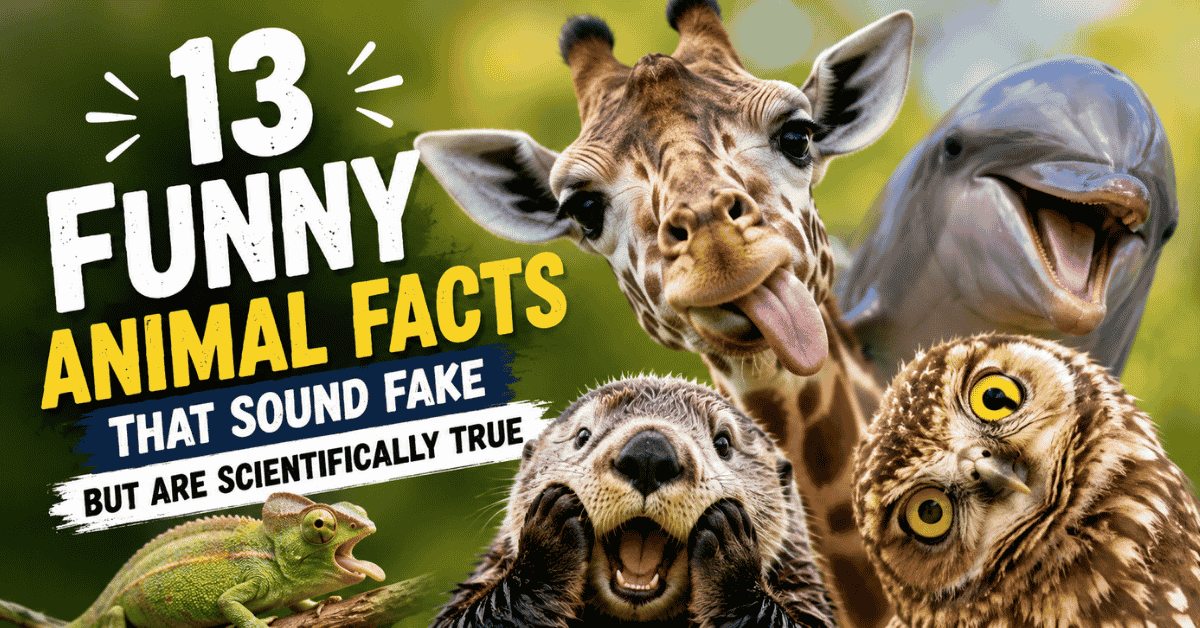
Quick answer: These animal facts that sound fake are all real: rats make high-pitched “laughing” chirps when they are tickled, sea otters often hold paws while they rest on the water, wombats produce cube-shaped droppings, and some goats stiffen and topple over when startled because of an inherited muscle condition called myotonia congenita.
Animals are often portrayed as serious survivors of nature, constantly competing for food, territory, and survival. Yet the natural world is filled with behaviors so strange and amusing that they feel almost like comedy sketches written by evolution itself.
From birds that laugh like humans to animals that faint dramatically when startled, wildlife produces countless moments of accidental humor. These funny animal facts are not myths or exaggerated stories. They are genuine biological behaviors shaped by millions of years of evolution.
In this article, we explore hilarious animal trivia and amusing wildlife information that reveal how nature sometimes creates the most unexpected comedy. Each fact also explains the biological mechanism behind the behavior and why it helps animals survive in the wild.
Goats Sometimes Faint When They Get Scared
The Surprising Behavior
One of the most famous funny animal facts involves fainting goats, also called myotonic goats. When startled, these goats suddenly stiffen and collapse.
The scene often looks dramatic and comedic because the goat remains conscious while its muscles temporarily lock.
The Scientific Mechanism
The condition is caused by a genetic disorder called myotonia congenita. When the goat experiences sudden stress or excitement, its muscles cannot relax immediately after contracting.
As a result:
- the body becomes rigid
- the legs lock
- the animal briefly falls over
Within seconds the goat recovers and continues walking normally.
Why It Matters in Nature
While it appears humorous, the condition historically served a strange agricultural purpose. Farmers sometimes kept fainting goats with other livestock because predators would target the immobilized goat first, allowing the rest of the herd to escape.
Rats Laugh When They Are Tickled
A Hidden Form of Animal Humor
Among the most entertaining zoological facts is that rats produce laughter-like sounds when tickled.
However, humans cannot hear these sounds without special equipment.
The Mechanism Behind Rat Laughter
Researchers discovered that rats emit ultrasonic chirping noises around 50 kHz when they experience positive emotions such as play or tickling.
These sounds indicate:
- excitement
- playfulness
- social bonding
Scientists studying animal emotions use these chirps as evidence that rats experience joy-like states.
Why This Discovery Matters
This amusing wildlife information changed how scientists understand animal emotions. It suggests that mammals share deeper emotional systems than previously believed.
Sea Otters Hold Hands While Sleeping
The Adorable Behavior
Sea otters floating in groups often hold hands while sleeping so they do not drift away from each other.
This charming behavior is sometimes called forming a “raft.”
How the Behavior Works
Otters live in coastal waters where strong currents could separate sleeping animals. To prevent drifting apart, they:
- wrap themselves in kelp
- hold paws with nearby otters
- float together in groups
Why It Matters
This simple behavior improves survival because staying together protects otters from predators and keeps the group cohesive.
Among chuckle-worthy animal curiosities, this one perfectly demonstrates how social cooperation can also look incredibly cute.
Wombats Produce Cube-Shaped Poop
A Truly Strange Biological Fact
One of the most comical creature fun facts is that wombats produce cube-shaped droppings.
Unlike most mammals, whose waste forms rounded shapes, wombat feces appear almost like small dice.
The Biological Explanation
Scientists discovered that the cube shape forms in the intestine rather than after the droppings leave the body.
Different regions of the intestine stretch and contract at varying rates, shaping the feces into cubes.
Why Evolution Produced This Shape
Cube-shaped droppings do not roll away easily. This helps wombats mark territory effectively by leaving scent markers on rocks and logs.
Crows Can Hold Funerals for Dead Birds
A Curious Social Ritual
Crows sometimes gather around a dead crow and produce loud calls in what appears to be a funeral gathering.
The Scientific Purpose
Rather than mourning, the birds are actually conducting a danger investigation.
When a crow dies, nearby birds gather to:
- identify potential threats
- learn about predators in the area
- warn the flock
Why It Matters
This behavior demonstrates remarkable intelligence and communication among birds.
It also provides entertaining zoological facts showing how animal societies can resemble human communities in surprising ways.
Dolphins Give Each Other Names
The Discovery
Dolphins use unique signature whistles to identify each other.
Each dolphin develops a specific whistle pattern that functions like a name.
The Mechanism
When dolphins communicate, they repeat these whistles to call specific individuals within the group.
This allows complex social coordination within dolphin pods.
Why It Matters
This is one of the most fascinating humorous critter details because it reveals that dolphins maintain complex social networks similar to human communication systems.
Penguins Propose with Pebbles
A Romantic Wildlife Behavior
Male penguins often present smooth pebbles to female penguins during courtship.
If the female accepts the pebble, the pair may form a long-term bond.
Why Penguins Use Pebbles
Penguins build nests using stones to keep eggs elevated above melting ice and water.
Pebbles therefore become a valuable resource during breeding.
Evolutionary Advantage
By selecting a mate that can gather quality stones, female penguins increase the chances of successfully protecting their eggs.
Octopuses Can Escape Almost Any Container
The Problem-Solving Ability
Octopuses possess extraordinary intelligence and flexible bodies that allow them to escape tight spaces.
If their beak fits through an opening, the entire body can squeeze through.
Cognitive Skills
Octopuses can:
- solve puzzles
- open jars
- navigate mazes
- remember solutions
These entertaining zoological tidbits demonstrate how advanced invertebrate intelligence can be.
Sloths Can Take a Month to Digest Food
The Slowest Digestion in Nature
Sloths move slowly, but their digestive systems are even slower.
Food can take up to 30 days to fully digest.
The Reason Behind It
Sloths eat leaves that are difficult to break down. Their digestive systems rely on specialized bacteria that slowly ferment plant material.
Why It Works
Slow digestion allows sloths to extract maximum nutrients from a low-energy diet.
Parrots Can Understand Words and Concepts
More Than Simple Mimicry
Some parrots do more than repeat sounds. They can actually understand word meanings.
Famous Example
A famous African Grey parrot named Alex demonstrated the ability to:
- identify colors
- recognize shapes
- count objects
Why It Matters
This discovery showed that advanced cognitive abilities are not limited to mammals.
Among side-splitting beastly revelations, intelligent parrots often produce unexpected comedic moments by using words in the correct context.
Elephants Are Afraid of Bees
The Unexpected Fear
Despite their enormous size, elephants often panic when they hear buzzing bees.
The Reason
Bees can sting sensitive areas such as:
- inside the trunk
- around the eyes
- behind the ears
Even a small swarm can cause significant discomfort.
Survival Implication
Farmers in Africa sometimes place beehives along fences to prevent elephants from damaging crops.
Flamingos Are Pink Because of Their Diet
The Color Mystery
Flamingos are not born pink. Baby flamingos are gray.
How They Turn Pink
Their color comes from carotenoid pigments found in algae and shrimp.
These pigments accumulate in feathers over time.
Biological Advantage
Bright coloration may help signal health and attract mates.
Cats Have a Built-In Righting Reflex
The Famous Cat Landing Trick
Cats often land on their feet when falling.
The Mechanism
Cats possess an advanced righting reflex that allows them to rotate their bodies mid-air using flexible spines and a highly developed vestibular system.
Why It Matters
This reflex dramatically reduces injury risk during falls.
It also connects with your existing article:
Authority Source
For additional scientific references about animal behavior:
Smithsonian National Zoo – Animal Behavior Research
https://nationalzoo.si.edu
Why animal facts that sound fake are worth knowing
Nature is full of unexpected humor. Many behaviors that appear strange or amusing actually reveal deeper biological mechanisms that help animals survive and adapt to their environments.
From fainting goats and laughing rats to dolphins with names and cube-shaped wombat droppings, these funny animal facts highlight how evolution often produces solutions that are both fascinating and entertaining.
Understanding these behaviors not only provides amusing wildlife information but also deepens our appreciation for the complexity of life on Earth.