
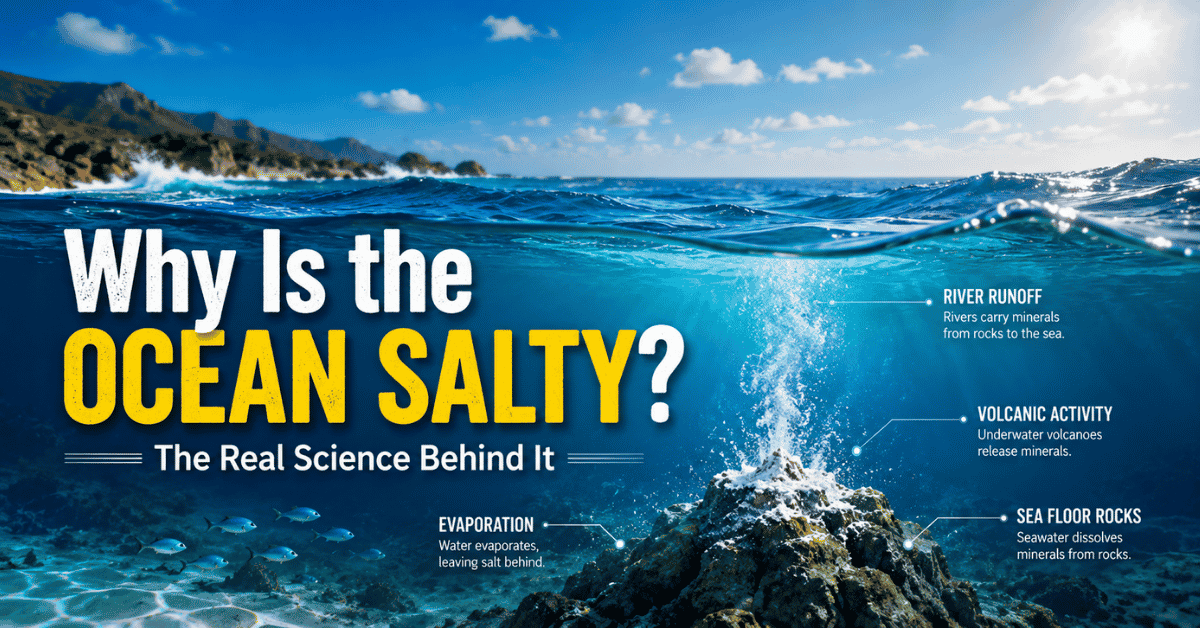
Quick answer: Why is the ocean salty? Because rain slowly dissolves minerals from rocks on land, and rivers carry those dissolved salts to the sea. Hydrothermal vents on the seafloor add more. When seawater evaporates, the water leaves but the salt stays behind, so it has built up over millions of years. On average, seawater is about 3.5% salt.
Every river on Earth flows into the ocean. The Amazon, the Mississippi, the Nile, the Ganges. They all carry fresh water. Yet the ocean stays salty. It has been salty for billions of years and shows no sign of diluting.
That contradiction is the right place to start. If fresh water pours in constantly, why does the salt stay?
The ocean is salty because dissolved mineral salts flow into it from two main sources: land runoff and seafloor vents. Water evaporates from the ocean surface and returns to land as rain, but the salts have no way out. They stay behind and accumulate. After roughly four billion years of this process, ocean water now contains about 3.5% dissolved salt by weight.
Understanding this also explains why some parts of the ocean are saltier than others, why rivers are not salty, why the Dead Sea is ten times saltier than the ocean, and why the strange creatures living in the deepest parts of the ocean have evolved in a chemically complex environment that has stayed remarkably stable for millions of years.
What Is Actually Dissolved in Seawater?
When most people think of ocean salt, they picture table salt. That is accurate but incomplete. Ocean water contains a mixture of dissolved mineral salts, not just sodium chloride.
USGS data shows the main ions dissolved in seawater:
- Chloride (Cl): 55% of dissolved ions
- Sodium (Na): 31% of dissolved ions
- Sulfate (SO4): 8%
- Magnesium (Mg): 4%
- Calcium, potassium, and others: remaining 2%
Sodium and chloride together make up over 90% of all dissolved material in seawater. One liter of ocean water contains about 35 grams of dissolved salts. That is roughly one heaped tablespoon per liter.
If you extracted all the salt from every ocean on Earth and spread it evenly across the land surface, it would form a layer over 500 feet thick. That is roughly the height of a 40-story building, covering every continent, desert, and mountain range on the planet.
Why Is the Ocean Salty? Source One: Salt From Rocks on Land
Rainwater is not pure water. Carbon dioxide from the atmosphere dissolves into falling rain and forms a weak carbonic acid. This slightly acidic rain lands on rocks, reacts with their mineral surfaces, and slowly breaks them apart.
That breakdown process releases mineral ions. Sodium, chloride, calcium, magnesium, potassium. The ions dissolve into the water and travel with it downhill into streams and rivers.
The Natural History Museum in London explains that this is why rivers carry a trace amount of dissolved minerals, even though they taste fresh. The concentration of minerals in river water is far too low to taste. But all those rivers, carrying all those dissolved minerals, pour approximately four billion tons of dissolved salts into the ocean every year.
The ocean receives those salts continuously. Water evaporates from the ocean surface under solar heat and returns to the atmosphere as pure water vapor. The salts cannot evaporate with it. They stay behind in the ocean water while the fresh water leaves. The cycle repeats endlessly. That is the core mechanism: salts arrive, water leaves, salts accumulate. Repeat for four billion years.
Source Two: Salt From the Seafloor
Land runoff is not the only source of ocean salt. NOAA’s ocean science resource identifies a second major source: hydrothermal vents on the seafloor.
Ocean water seeps into cracks in the seafloor near tectonic plate boundaries. Magma from below heats that water to extreme temperatures. The heat drives intense chemical reactions between the water and the surrounding rock.
During those reactions, the water loses oxygen, magnesium, and sulfate. It picks up iron, zinc, copper, and other metals from the rock. Then it shoots back up through hydrothermal vents as superheated, mineral-rich fluid and mixes back into the surrounding ocean.
Underwater volcanic eruptions add another layer. When volcanoes erupt on the seafloor, they release minerals and gases directly into the water. Salt domes, which are vast ancient salt deposits buried beneath the seafloor, also contribute dissolved salts as they slowly interact with surrounding water over geological time.
The seafloor is not a passive floor. It is an active chemical exchange system that has been adding minerals to ocean water for as long as the ocean has existed.
Why Rivers Are Not Salty
Rivers carry dissolved minerals toward the ocean continuously. So why do rivers taste fresh?
Three things prevent rivers from becoming salty.
Constant dilution. Rainfall and snowmelt constantly add fresh water to rivers. The incoming fresh water dilutes the dissolved mineral content before it can accumulate to a noticeable level.
Water flows through. Rivers have an exit. The water moves continuously from source to sea. Salts never stay long enough in any one place to build up.
The concentration is genuinely tiny. River water contains roughly 0.01% dissolved salts, compared to 3.5% in the ocean. That is 350 times less concentrated, well below the taste threshold.
The ocean has no exit. Water evaporates from it, but the salts stay. That is the fundamental difference between a river and an ocean when it comes to salt accumulation.
Why the Ocean Is Not Getting Saltier Over Time
If salts flow in constantly and do not leave, the ocean should be getting saltier every year. It is not. Ocean salinity has been broadly stable for hundreds of millions of years. That requires an explanation.
University of Wisconsin oceanographer Galen McKinley explains that the inputs and outputs of salt have reached a rough equilibrium. Several removal processes balance the incoming supply.
Marine organisms absorb ions. Shellfish, corals, and marine animals extract calcium, carbonate, and other ions from seawater to build shells and skeletons. When those organisms die and sink, their shells carry those minerals to the seafloor, permanently removing them from circulation.
Salt deposits form on the seafloor. Under certain geological conditions, seawater evaporates in isolated basins and leaves behind thick salt deposits. These evaporite deposits lock salt away from the ocean for millions of years.
Hydrothermal vents absorb as well as release. The same vent systems that add iron and other metals also remove magnesium and sulfate from seawater during the heating process. The seafloor both gives and takes.
The result is a system in dynamic equilibrium. Salts arrive from rivers and vents. Salts leave through organisms, sediment, and geological processes. The balance keeps ocean salinity stable across geological time.
Why Some Parts of the Ocean Are Saltier Than Others
Ocean salinity is not uniform. It varies significantly by region, driven by the balance between evaporation and precipitation at each location.
The Atlantic Ocean is the saltiest of the five major oceans. High evaporation rates relative to rainfall, particularly in the subtropical regions, concentrate the salt. The Pacific Ocean has lower average salinity because it receives more rainfall and has more freshwater river input relative to its surface area.
The saltiest open ocean regions on Earth sit at mid-latitudes in the subtropics, where high temperatures drive intense evaporation and rainfall is scarce. The least salty regions are near the equator, where heavy rainfall constantly dilutes surface water, and near the poles, where melting sea ice adds fresh water.
The Mediterranean Sea is saltier than the Atlantic because it is surrounded by land, receives limited river input, and experiences very high evaporation in its warm, dry climate. It is essentially borrowing saltier water from the Atlantic through the Strait of Gibraltar while losing fresh water to the atmosphere faster than rainfall replaces it.
The Dead Sea: What Happens When Saltwater Has Nowhere to Go
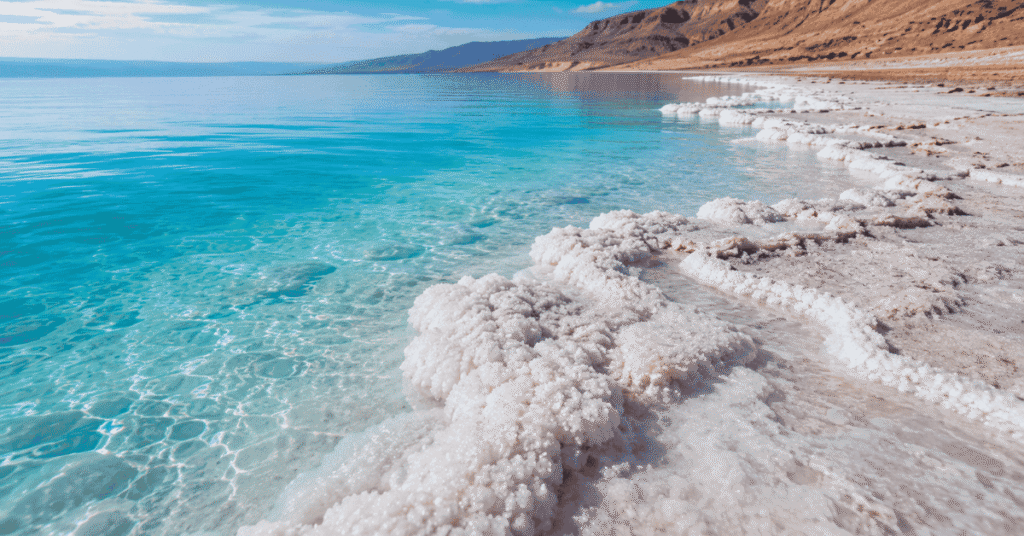
The Dead Sea sits in a desert valley between Jordan, Israel, and Palestine. It has no outlet. Water flows in from the Jordan River and from rainfall. Nothing flows out.
According to Live Science’s analysis of the Dead Sea, the intense desert heat evaporates water from the surface rapidly, leaving all dissolved salts behind. With no drainage channel to carry those salts away, they build up. The Dead Sea’s salinity sits at around 34%, compared to the ocean’s 3.5%. That makes it roughly ten times saltier than the average ocean.
The salt concentration is so high that no fish, plants, or most microorganisms can survive in it. The water is so dense that a human body floats effortlessly on the surface without any swimming effort at all.
The Great Salt Lake in Utah operates on the same principle. It sits in a closed basin with no outlet to the ocean. Rivers flow in, water evaporates, salts accumulate. The Great Salt Lake is currently between three and eight times saltier than ocean water depending on season and water levels.
Both lakes demonstrate in miniature what the ocean does at planetary scale. Remove the outlet, and salt concentrations rise over time. The same chemistry of isolated saltwater environments connects to the extreme conditions found in hydrothermal vent ecosystems on the ocean floor, where life has adapted to survive in water chemistry that would kill most surface organisms.
Frequently Asked Questions
Why does seawater taste bitter and not just salty?
Ocean water contains magnesium sulfate in addition to sodium chloride. Magnesium sulfate has a distinctly bitter taste. The combination of salty sodium chloride and bitter magnesium compounds produces the characteristic unpleasant taste of seawater.
Could the ocean ever run out of salt?
No. The geological processes that add salt to the ocean operate continuously and will continue for as long as Earth has active tectonics and a water cycle. The system is self-regulating. Even if input rates changed, the equilibrium mechanisms would adjust. The Woods Hole Oceanographic Institution notes that the ocean’s salt content reflects billions of years of accumulated input balanced against slow geological removal processes.
Why can some fish drink salt water but humans cannot?
Marine fish have evolved specialized gill cells that actively pump excess salt out of their bodies. Sharks excrete salt through rectal glands. Seabirds have salt glands near their eyes. Humans have no equivalent mechanism. Our kidneys can only produce urine slightly saltier than seawater, which means we cannot excrete the salt load fast enough to avoid net water loss. This adaptation gap is one of the striking examples covered in our article on the strange biology of animals that live in extreme ocean environments.
Is the ocean getting less salty because of climate change?
Melting polar ice caps add large volumes of fresh water to the ocean, which is measurably reducing salinity in the North Atlantic and Southern Ocean. NOAA’s current ocean monitoring data shows that freshwater from melting ice is diluting surface salinity in polar regions, which is affecting ocean circulation patterns including the Atlantic Meridional Overturning Circulation.
What would happen if the ocean suddenly became fresh water?
The ecological collapse would be immediate and total. Every marine organism adapted to saline water would die. Buoyancy changes would affect circulation patterns. The water cycle that regulates rainfall on land would shift significantly. The chemistry that supports marine food chains from plankton upward depends entirely on the specific ion mix that seawater provides. Salinity is not incidental to ocean life. It is the foundation that ocean biology, from the smallest microorganism to the largest whale, has evolved around over hundreds of millions of years.
The One-Paragraph Answer
Rain dissolves minerals from rocks on land and carries them downhill into rivers. Rivers deliver those dissolved salts to the ocean continuously. Heat from the sun evaporates water from the ocean surface and returns it to the atmosphere as fresh water vapor. The salts cannot evaporate and stay behind. Hydrothermal vents on the seafloor add more mineral material through geological activity. Marine organisms, seafloor sediments, and chemical reactions remove salts at a roughly equal rate, keeping salinity stable. After four billion years of this process, the ocean holds approximately 50 quadrillion tons of dissolved salts. That is why every ocean on Earth tastes salty, why it has always been salty, and why it will remain salty for as long as Earth has oceans.
Related articles
- Why does ice float?
- Mysteries of the deep sea
- Why is the sky blue?
- What would happen if ice didn’t float?
Sources
- U.S. Geological Survey: USGS data
- Natural History Museum in London
- NOAA's ocean science resource
- University of Wisconsin oceanographer Galen McKinley
- Live Science's analysis of the Dead Sea
- Woods Hole Oceanographic Institution