
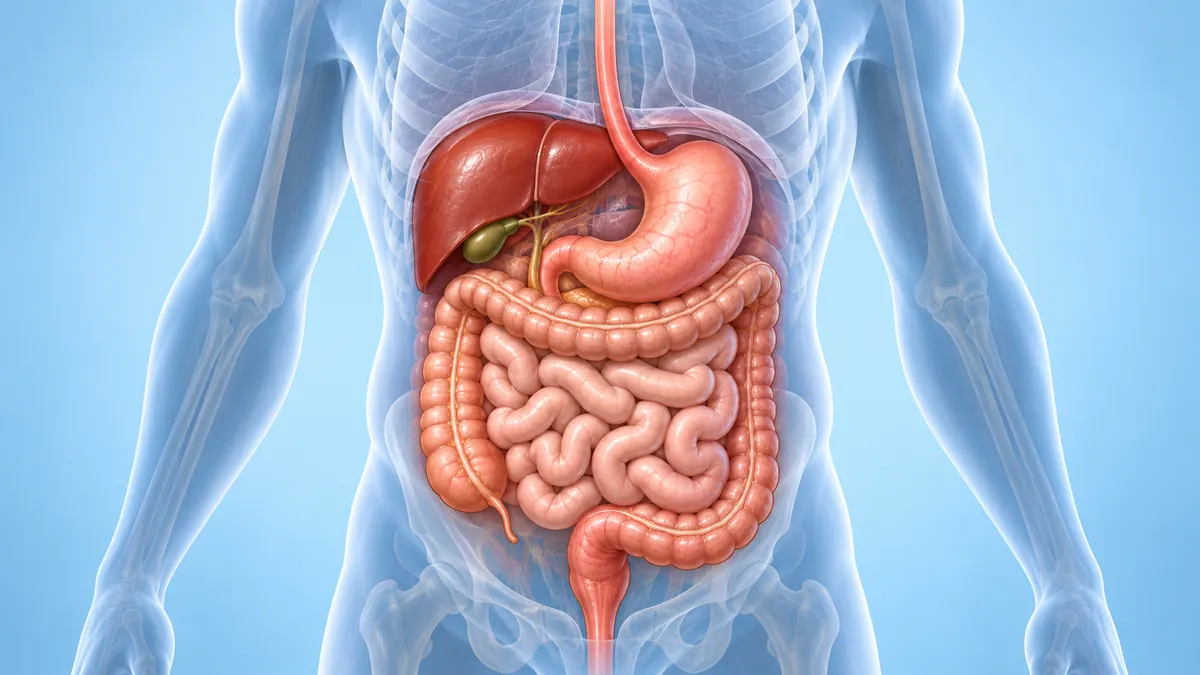
Quick answer: The digestive system is a tube about 9 meters long from mouth to anus, plus helper organs such as the liver and pancreas. It breaks food into nutrients your body can absorb. Some surprising facts about the digestive system: your gut has its own network of hundreds of millions of neurons (often called the “second brain”), it makes about 90% of the body’s serotonin, it hosts around 38 trillion bacteria, and food is pushed along by muscle waves that work even upside down.
You probably think about your digestive system only when something goes wrong. Yet every day it quietly turns meals into fuel, defends you against germs and talks constantly with your brain. Here is how digestion works and 20 amazing facts about the organs that make it happen.
What are the parts of the digestive system?
| Organ | What it does | Key fact |
|---|---|---|
| Mouth | Chews food and mixes it with saliva | Starch digestion starts here |
| Esophagus | Moves food to the stomach | About 25 cm long |
| Stomach | Churns food with acid and enzymes | Holds about 1 to 1.5 liters comfortably |
| Small intestine | Digests food and absorbs most nutrients | About 6 to 7 m long |
| Large intestine | Absorbs water and stores waste | Home to most of your gut bacteria |
| Liver | Makes bile and processes nutrients | Largest internal organ |
| Pancreas | Releases digestive enzymes and insulin | Neutralizes stomach acid |
| Gallbladder | Stores and releases bile | You can live without it |
How does digestion work, step by step?
- Mouth: Teeth break food into small pieces, and saliva starts digesting starch.
- Esophagus: Muscle waves push the food down to the stomach in a few seconds.
- Stomach: Acid and enzymes break down proteins and turn food into a thick liquid called chyme over about 2 to 4 hours.
- Small intestine: Bile and pancreatic enzymes finish digestion, and nutrients are absorbed into the blood.
- Large intestine: Water is absorbed, bacteria ferment fiber, and waste is formed.
- Exit: Waste leaves the body. The whole journey usually takes about 1 to 3 days.
20 amazing facts about the digestive system
Facts about saliva and the mouth
- You make about 0.5 to 1.5 liters of saliva a day. It moistens food, starts digestion and helps protect your teeth.
- Digestion starts before you eat. Just seeing or smelling food can trigger saliva and stomach juices.
- Saliva contains an enzyme that breaks down starch. That’s why bread starts to taste slightly sweet if you chew it for a long time.
Facts about the stomach
- Stomach acid is very strong. It has a pH of about 1.5 to 3.5, acidic enough to break down tough proteins and kill many germs.
- The stomach protects itself with mucus. A thick mucus layer and constantly renewed lining cells stop it from digesting itself.
- Your stomach can stretch. It holds about 1 to 1.5 liters comfortably and can stretch to several liters after a very large meal.
- Stomach rumbling has a name. The gurgling noise is called borborygmi, caused by gas and fluid moving through the gut.
Facts about the intestines
- Food moves by peristalsis. Waves of muscle contraction squeeze food along the gut, which is why astronauts can swallow and digest in zero gravity, and why you could swallow while upside down.
- The small intestine’s surface area is about 30 square meters. That’s roughly half a badminton court, thanks to folds and finger-like villi. Older claims of “a tennis court” were overestimates.
- Your intestinal lining renews itself every few days. Cells on the surface of the small intestine are replaced roughly every 3 to 5 days.
- The large intestine is shorter but wider. It’s about 1.5 m long, much shorter than the small intestine, but wider.

Facts about enzymes and helper organs
- Enzymes do the real chemical work. Amylase breaks down carbohydrates, proteases break down proteins and lipases break down fats.
- The liver has hundreds of jobs. Besides making bile, it stores energy, processes nutrients and breaks down toxins.
- The liver can regrow. It can regenerate to its full size after part of it is removed, which makes living liver donation possible.
- Bile isn’t an enzyme. It works like dish soap, breaking fat into tiny droplets so enzymes can reach it.

Facts about the gut-brain connection and gut bacteria
- Your gut has its own nervous system. The enteric nervous system contains around 200 to 600 million neurons and can run digestion largely on its own.
- Most of your serotonin is made in the gut. About 90% of the body’s serotonin is produced by cells in the gut lining, where it helps control gut movement.
- The gut and brain talk constantly. The vagus nerve carries signals both ways, which is one reason stress can cause “butterflies” or an upset stomach.
- You carry about 38 trillion bacteria. Most live in the large intestine, where they help digest fiber, make some vitamins and train the immune system.
- Exercise helps digestion. Regular physical activity can speed up the movement of food through the gut and is linked to a more diverse gut microbiome.
How to keep your digestive system healthy
- Eat plenty of fiber from vegetables, fruit, beans and whole grains.
- Drink enough water to help fiber work.
- Stay physically active.
- Eat slowly and chew well.
- See a doctor about lasting changes in bowel habits, pain, or blood in stool.
Frequently asked questions
How long is the digestive system?
The digestive tract from mouth to anus is about 9 meters (30 feet) long in an adult, with the small intestine making up most of that length.
How long does it take to digest food?
Food usually spends about 2 to 4 hours in the stomach and passes through the whole tract in about 1 to 3 days, depending on the person and the meal.
Why is the gut called the second brain?
Because it has its own large network of neurons, the enteric nervous system, which can control digestion independently and communicates with the brain.
What is the main organ of digestion?
The small intestine does most of the digestion and absorbs most nutrients, helped by the pancreas, liver and gallbladder.
Can you live without a stomach?
Yes. People who have their stomach removed can live normal lives by eating smaller, more frequent meals, though they need careful nutritional care.
Related articles
- 30 random facts about the human body
- 40 interesting facts about humans
- How many bones are in the human body?
- 20 mind-blowing science facts
Sources
- National Institute of Diabetes and Digestive and Kidney Diseases: “Your Digestive System & How It Works”. niddk.nih.gov
- Helander, H. F. & Fändriks, L. (2014). “Surface area of the digestive tract, revisited.” Scandinavian Journal of Gastroenterology.
- Sender, R., Fuchs, S. & Milo, R. (2016). “Revised estimates for the number of human and bacteria cells in the body.” PLoS Biology. doi:10.1371/journal.pbio.1002533
- Furness, J. B. (2012). “The enteric nervous system and neurogastroenterology.” Nature Reviews Gastroenterology & Hepatology.
- Yano, J. M. et al. (2015). “Indigenous bacteria from the gut microbiota regulate host serotonin biosynthesis.” Cell.