
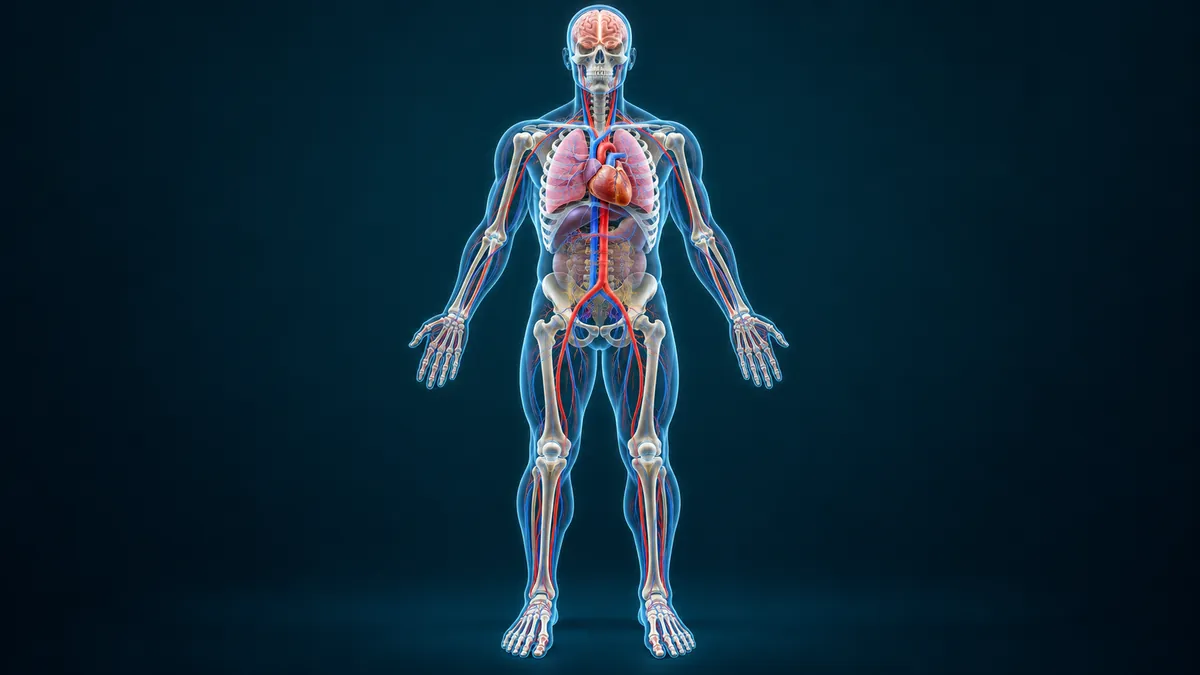
Quick answer: Some of the most surprising random facts about the human body: your brain uses about 20% of your energy while making up only about 2% of your weight. More than half your bones are in your hands and feet. Your heart beats about 100,000 times a day. And you are about 1 cm taller in the morning than at night. Below are 30 random, true facts about the human body, grouped by body system.
Your body runs thousands of processes every second without you noticing. Some of them are so strange they sound made up. Every fact on this page is based on mainstream medical and scientific sources, listed at the end.
Random facts about the human body: bones and muscles
- Adults have 206 bones, but babies are born with around 270 to 300. Many of a baby’s bones and cartilage pieces fuse as they grow. How many bones are in the human body?
- More than half of your bones are in your hands and feet. Each hand has 27 bones and each foot has 26, for 106 of your 206 bones. Which body part has the most bones?
- Your smallest bone is about the size of a grain of rice. The stapes in your middle ear is roughly 3 millimeters long.
- One bone is not connected to any other bone. The U-shaped hyoid bone in your throat is held in place only by muscles and ligaments. It supports your tongue and helps you swallow.
- Your skeleton is constantly rebuilding itself. Old bone is broken down and replaced with new bone throughout life. In adults, the skeleton is almost entirely renewed about every 10 years.
- The word “muscle” means “little mouse”. It comes from the Latin musculus, possibly because a flexing muscle looks like a mouse moving under the skin.
- Your smallest muscle is in your ear. The stapedius, only about a millimeter long, steadies the stapes bone and helps protect your hearing from loud sounds.
Facts about your brain and nerves
- Your brain is an energy hog. It makes up about 2% of your body weight but uses about 20% of the energy your body burns at rest.
- You have about 86 billion neurons. That is the current best estimate for the number of nerve cells in the adult human brain.
- Your brain cannot feel pain. Brain tissue has no pain receptors. That is why surgeons can operate on some patients while they are awake.
- Nerve signals can travel faster than a race car. The fastest nerve fibers carry signals at up to about 120 meters per second, around 430 km/h (270 mph).
- Your brain is very busy while you dream. During REM sleep, when most vivid dreams happen, brain activity looks similar to when you are awake. Why do we dream?
- Yawning may help cool your brain. One leading theory says a yawn’s deep breath and jaw stretch increase blood flow that helps regulate brain temperature. Why do we yawn?
Facts about your heart and blood
- Your heart beats about 100,000 times a day. Over a long life, that adds up to around 2.5 to 3 billion beats.
- Your blood makes a full lap of your body about once a minute. At rest, the heart pumps about 5 liters of blood per minute, roughly the total amount of blood in an adult.
- Your blood vessels could circle the Earth. Estimates put the total length of blood vessels in an adult at around 60,000 miles (about 100,000 km), most of it tiny capillaries.
- Red blood cells live for about 120 days. Your bone marrow replaces them constantly, making millions of new ones every second.
- AB-negative is the rarest of the eight common blood types. In the United States, fewer than 1 in 100 people have it.
Facts about your skin, hair and nails
- Your skin is your largest organ. It covers roughly 1.5 to 2 square meters in an adult.
- You shed tens of thousands of skin cells every minute. Your outer skin layer is replaced continuously, roughly every month.
- Fingernails grow about twice as fast as toenails. Fingernails grow about 3.5 millimeters per month; toenails grow much more slowly.
- Wrinkly fingers in water are controlled by your nerves. The wrinkling does not happen if the nerves to the finger are damaged, and one study found wrinkled fingers grip wet objects better.
- Your body gives off light. A 2009 study using ultra-sensitive cameras showed that the human body emits visible light, about 1,000 times weaker than our eyes can detect.
Facts about your senses
- Your cornea gets oxygen from the air. The clear front of the eye has no blood vessels, so it absorbs oxygen directly from the air and the tear film.
- Each eye has a blind spot. Where the optic nerve leaves the eye there are no light-sensing cells, but your brain fills in the gap so you never notice it.
- Your nose can tell apart a huge number of smells. A 2014 study estimated humans can distinguish over a trillion odors. Other scientists dispute the exact number, but it is far more than the 10,000 once claimed.
Facts about your gut and organs
- Your small intestine is about 6 meters (20 feet) long. Its folds and tiny finger-like villi give it a huge surface area for absorbing food. More digestive system facts
- Your stomach lining renews itself every few days. This constant renewal helps protect it from its own strong acid.
- Your left lung is smaller than your right. It has two lobes instead of three, leaving room for your heart.
- Your liver can regrow. After part of a healthy liver is removed, the remaining tissue can grow back to nearly full size within weeks to months. That is what makes living-donor liver transplants possible.
Bonus facts
- You are taller in the morning. The discs in your spine compress slightly during the day, so most people are about 1 cm shorter by evening.
- Tooth enamel is the hardest substance in your body.
- Your belly button is a tiny ecosystem. A 2012 study of 60 volunteers found an average of about 67 types of bacteria per navel.
Human body facts at a glance
| Fact | Number |
|---|---|
| Bones in an adult | 206 |
| Bones in a newborn (approx.) | 270–300 |
| Neurons in the brain (approx.) | 86 billion |
| Share of resting energy used by the brain | About 20% |
| Heartbeats per day | About 100,000 |
| Blood pumped per minute at rest | About 5 liters |
| Lifespan of a red blood cell | About 120 days |
| Length of the small intestine | About 6 m (20 ft) |
Looking for facts about how humans think and behave? Read 40 interesting facts about humans.
Frequently asked questions
What are some fun facts about the human body for kids?
Kids usually love these: babies have more bones than adults, you are taller in the morning than at night, your brain cannot feel pain, and more than half your bones are in your hands and feet.
What is the strongest muscle in the human body?
It depends on how you measure strength. The masseter (jaw muscle) can bite with the greatest force for its size, the gluteus maximus is the largest muscle, and the heart does the most continuous work.
What is the largest organ in the human body?
The skin is the largest organ overall. The liver is the largest internal organ.
Is it true we only use 10% of our brain?
No. Brain scans show that we use virtually all of our brain, just not every region at the same moment.
Sources
- MedlinePlus (U.S. National Library of Medicine): How the Body Works
- Azevedo, F. A. C. et al. (2009). “Equal numbers of neuronal and nonneuronal cells make the human brain an isometrically scaled-up primate brain.” Journal of Comparative Neurology.
- Kobayashi, M., Kikuchi, D. & Okamura, H. (2009). “Imaging of ultraweak spontaneous photon emission from human body displaying diurnal rhythm.” PLoS ONE.
- Bushdid, C. et al. (2014). “Humans can discriminate more than 1 trillion olfactory stimuli.” Science.
- Kareklas, K., Nettle, D. & Smulders, T. V. (2013). “Water-induced finger wrinkles improve handling of wet objects.” Biology Letters.
- Hulcr, J. et al. (2012). “A jungle in there: bacteria in belly buttons are highly diverse, but predictable.” PLoS ONE.
- OpenStax, Anatomy and Physiology 2e (bones, blood, heart and digestive system chapters).