
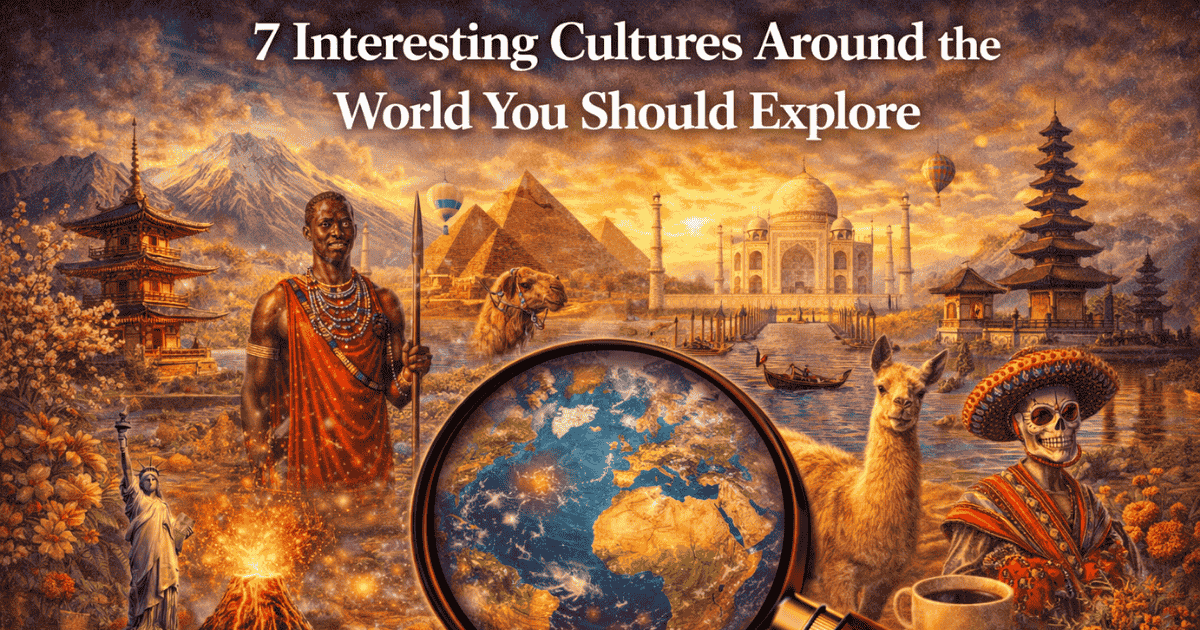
Quick answer: Seven interesting cultures around the world are the Maasai of East Africa, the Sámi of northern Europe, the Māori of New Zealand, the Inuit of the Arctic, the Bedouin of the Middle East and North Africa, the Quechua of the Andes, and Japan. Each has its own language, traditions and relationship with its land. Many of these traditions are still practiced today alongside modern life.
There are thousands of distinct cultures in the world and around 7,000 living languages. This list highlights seven, not as “exotic” curiosities, but as living communities whose traditions have lasted for centuries. For facts about humanity as a whole, see 40 interesting facts about humans.
1. The Maasai (Kenya and Tanzania)
The Maasai are a semi-nomadic people known for raising cattle, which are central to their wealth, diet and social life. Their red shúkà cloths and beadwork are instantly recognizable. In the adumu, young men take turns jumping high from a standing position while others sing. Many Maasai today combine herding with farming, tourism and city work.
2. The Sámi (Norway, Sweden, Finland and Russia)
The Sámi are the Indigenous people of the far north of Europe, a region they call Sápmi. Reindeer herding is an important part of their culture and economy, though today only a minority of Sámi herd reindeer. Their traditional singing, the joik, is a personal song that evokes a person, animal or place rather than describing it.
3. The Māori (New Zealand)
The Māori are the Indigenous Polynesian people of New Zealand, who arrived by canoe roughly 700 to 800 years ago. The haka, a ceremonial dance, is performed at welcomes, funerals and sports events. Tā moko is a traditional form of tattooing that carries information about a person’s ancestry. Te reo Māori became an official language of New Zealand in 1987.
4. The Inuit (Arctic Canada, Greenland and Alaska)
The Inuit developed ways of life suited to one of the coldest places on Earth, including kayaks, dog sleds and igloos used as temporary winter shelters. Inuksuit, human-made stone landmarks, help with navigation. Katajjaq, or Inuit throat singing, is traditionally a friendly contest between two women.
5. The Bedouin (Middle East and North Africa)
Bedouin communities traditionally lived as desert herders, moving with camels, goats and sheep. Their culture places great importance on hospitality: guests are welcomed with Arabic coffee and dates. Arabic coffee, a symbol of generosity, is recognized by UNESCO as part of the world’s intangible cultural heritage.
6. The Quechua (Andes of South America)
Quechua peoples live mainly in Peru, Bolivia and Ecuador, and their language family is spoken by millions, making it one of the most widely spoken Indigenous languages in the Americas. Andean weaving uses patterns passed down for generations. The Inti Raymi festival in Cusco celebrates the Sun at the winter solstice, a tradition from the Inca Empire.
7. Japan
Japanese culture blends ancient traditions with modern technology. The tea ceremony (chanoyu) is a carefully choreographed ritual of preparing and serving matcha. Omotenashi describes a deep tradition of attentive hospitality. Seasonal events, such as cherry blossom viewing (hanami) each spring, remain hugely popular.
Cultures at a glance
| Culture | Region | Well-known tradition |
|---|---|---|
| Maasai | Kenya and Tanzania | Adumu jumping dance, cattle herding |
| Sámi | Northern Norway, Sweden, Finland, Russia | Joik singing, reindeer herding |
| Māori | New Zealand | Haka, tā moko |
| Inuit | Arctic Canada, Greenland, Alaska | Throat singing, inuksuit |
| Bedouin | Middle East and North Africa | Hospitality and Arabic coffee |
| Quechua | Andes (Peru, Bolivia, Ecuador) | Weaving, Inti Raymi |
| Japanese | Japan | Tea ceremony, hanami |
How to learn about interesting cultures around the world respectfully
- Learn from people of that culture: their books, films, museums and guides.
- Ask before photographing people or sacred sites.
- Remember that every culture is diverse and changing. Traditions sit alongside modern jobs, phones and cities.
- Learn a few words of the local language. It is almost always appreciated.
Frequently asked questions
How many cultures are there in the world?
There is no exact count, because cultures overlap and change, but there are thousands. One rough guide is language: about 7,000 languages are spoken today.
What is the oldest living culture?
Aboriginal and Torres Strait Islander peoples of Australia are often described as the world’s oldest continuous cultures, with a history in Australia of at least 50,000 years.
What is the haka?
A traditional Māori ceremonial dance with chanting, stamping and strong facial expressions, performed to welcome guests, honor people and mark important occasions.
Related articles
- 40 interesting facts about humans
- 5 hidden wonders of the world
- 10 mysteries of ancient civilizations
- Interesting facts about North America
Sources
- UNESCO Intangible Cultural Heritage lists (including “Arabic coffee, a symbol of generosity”).
- Sámediggi (the Sámi Parliament of Norway): information on Sámi culture and reindeer husbandry.
- Te Ara, the Encyclopedia of New Zealand: haka, tā moko and te reo Māori.
- Inuit Tapiriit Kanatami: Inuit culture and throat singing.
- Ethnologue: Languages of the World.
- UNESCO Intangible Cultural Heritage