
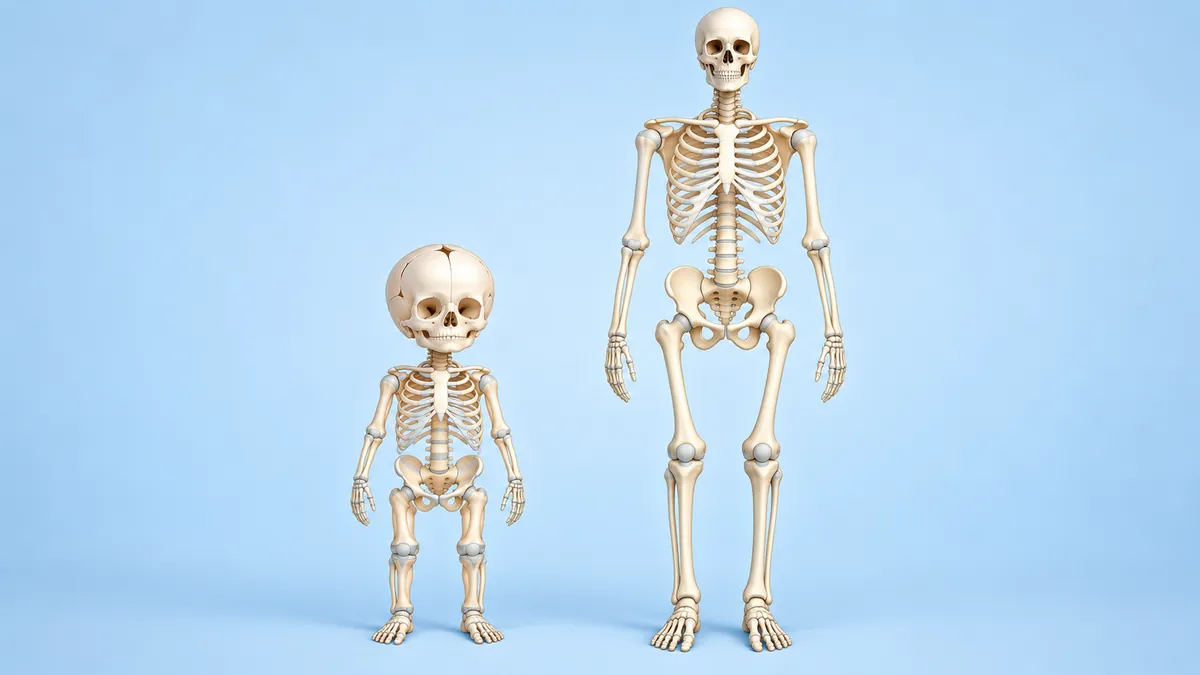
Short answer: How many bones are babies born with? Roughly 270 to 300, many of them still partly made of cartilage. As a child grows, many of these pieces fuse together, so an adult ends up with about 206 bones. Most of the fusing happens during childhood and the teenage years and is finished by the mid-20s.
It sounds like a riddle: how can a baby have more bones than an adult? The answer is that a newborn’s skeleton is designed for two jobs, squeezing through the birth canal and growing fast. Separate, flexible pieces do both jobs better than big, solid bones.
Key facts at a glance
- Newborns: about 270–300 bones and bony pieces (the exact number depends on how you count cartilage centers).
- Adults: usually 206 bones.
- The skull’s soft spots (fontanelles) close between about 2 months and 2 years of age.
- Growth plates in long bones close from the early teens to the mid-20s.
- Some of the last bones to finish fusing are the sacrum and the clavicle (collarbone).
How many bones are babies born with, and why so many?
A baby’s skeleton starts out largely as cartilage, a firm but flexible tissue. Bone forms in stages from many separate starting points called ossification centers. Early in life, many of these centers are separate pieces. Over time, bone spreads through the cartilage, and neighboring pieces join into single bones.
This has two big advantages:
- Safe birth: the skull plates can overlap slightly so the head fits through the birth canal.
- Fast growth: cartilage growth plates at the ends of long bones let the arms and legs lengthen quickly during childhood.
Where the fusing happens
1. The skull
A newborn’s skull is made of several plates separated by flexible seams (sutures) and soft spots (fontanelles). The small fontanelle at the back usually closes within the first few months. The larger one on top usually closes between about 12 and 24 months. The seams themselves keep fusing slowly into adulthood.
2. The spine: sacrum and coccyx
At the base of the spine, five separate vertebrae gradually fuse into one triangular bone, the sacrum. This fusion starts in the teenage years and is usually complete by the mid-20s, sometimes later. Below it, three to five small segments fuse to form the coccyx (tailbone).
3. The hip bones
Each hip bone begins as three separate bones: the ilium, ischium and pubis. They meet in the hip socket and fuse into a single bone during the teenage years.
4. Long bones and growth plates
Bones such as the femur and humerus have a shaft and separate ends, joined by cartilage growth plates. When growth stops, the plates turn to bone and the pieces become one. This is why doctors can estimate a young person’s age from an X-ray of the hand or wrist.
How many bones at each age?
| Stage | What is happening |
|---|---|
| Newborn | About 270–300 bones and cartilage pieces; open fontanelles |
| 0–2 years | Fontanelles close; bones harden quickly |
| Childhood | Growth plates are active; bones lengthen |
| Teenage years | Hip bones fuse; many growth plates begin closing |
| Early to mid-20s | Last growth plates, sacrum and clavicle finish fusing: about 206 bones |
Does everyone end up with exactly 206 bones?
No. 206 is the standard count, but real skeletons vary. Some people have an extra rib (a cervical rib), extra small bones in the hands or feet (sesamoid or accessory bones), or small extra bones in the skull’s seams (Wormian bones). Others have bones that stay unfused. A few bones more or fewer is completely normal.
Frequently asked questions
How many bones are we born with?
About 270 to 300. Many are small pieces of bone and cartilage that later fuse into larger bones.
Why do adults have fewer bones than babies?
Because separate pieces fuse together as we grow. For example, five vertebrae fuse into the sacrum and three bones fuse into each hip bone.
When do bones stop fusing?
Most fusion is complete by the late teens, but some bones, such as the sacrum and clavicle, finish fusing in the early to mid-20s.
Are babies’ bones soft?
They are more flexible than adult bones because they contain more cartilage, which is one reason young children’s bones tend to bend or crack (greenstick fractures) rather than snap.
How many bones does an adult have?
Usually 206. See the full breakdown in how many bones are in the human body and which part of the body has the most bones.
Sources
- OpenStax, Anatomy and Physiology 2e, chapter 6: “Bone Formation and Development”.
- Encyclopaedia Britannica, “Human skeleton” and “Fontanelle”.
- MedlinePlus (U.S. National Library of Medicine), “Fontanelles – bulging” and “Skull of a newborn”.
- Encyclopaedia Britannica: Human skeleton
- Cleveland Clinic: How many bones does a baby have?