

Quick answer: Curiosity is the desire to learn or know something new. Psychologists describe it as a motivational state that starts when you notice a gap between what you know and what you want to know. Curiosity activates the brain’s reward system, which is why satisfying it feels good and why people remember information better when they are curious.
What is curiosity? Curiosity is the natural human desire to seek knowledge and understand the unknown. It begins the moment the mind recognizes a gap between what it knows and what it wants to know, creating an internal urge to explore and discover. This drive is not accidental or limited to education or intelligence; curiosity is a fundamental psychological force that shapes how humans think, learn, explore, and evolve. It influences how the mind processes information, how the brain responds to novelty, and why people are drawn to mysteries, facts, and unanswered questions.
Across history, curiosity has driven exploration, scientific discovery, philosophical inquiry, and cultural progress. It explains why humans question nature, study the brain, investigate space, and search for meaning beyond immediate survival. When curiosity is examined through psychology, neuroscience, learning science, and real-world behavior, it reveals a deep connection between knowledge-seeking, cognitive development, and human growth.
Understanding what curiosity is helps explain why humans are naturally motivated to explore, learn, and seek new knowledge throughout life. Curiosity shapes attention, motivation, and memory, influencing how people interact with ideas, environments, and challenges. This article explores curiosity in depth, moving from the inner workings of the human mind to the broader forces that drive discovery in science, nature, and the universe.
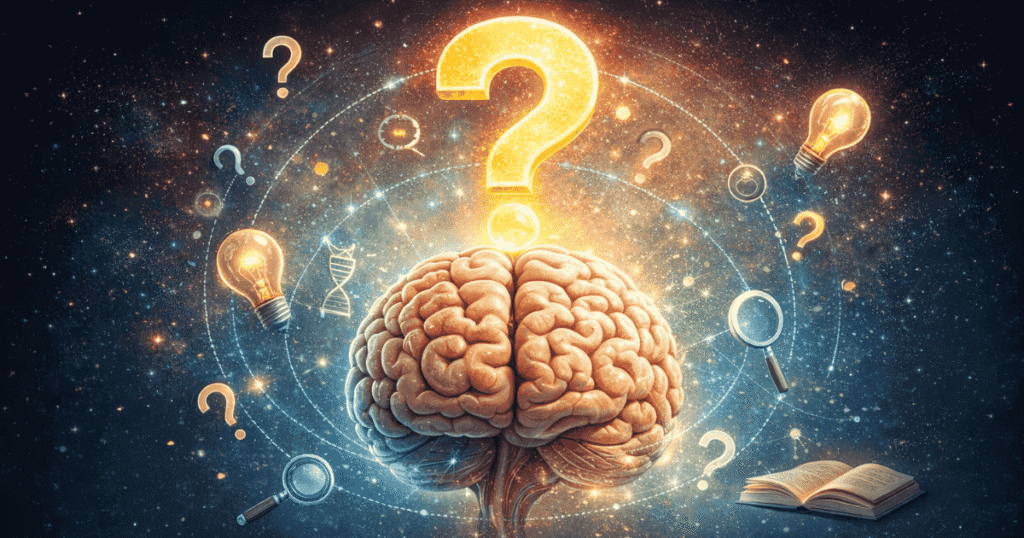
What Is Curiosity and Why Does It Matter?
What is curiosity? Curiosity is the natural human desire to acquire new knowledge, explore unfamiliar situations, and understand how things work. It emerges when the mind detects a gap between existing understanding and potential understanding. This gap—often described in psychology as the information gap—creates mental tension that motivates exploration, questioning, and learning.
Unlike behaviors driven by fear, obligation, or external rewards, curiosity is internally motivated. People seek answers not because they are required to, but because the process of learning itself feels rewarding. This internal reward system explains why curiosity can sustain attention, focus, and engagement for long periods without external incentives.
Curiosity operates on multiple levels. It may be triggered by a surprising fact, an unanswered question, a strange observation, or a complex problem. Sometimes curiosity appears quietly as a subtle interest; at other times, it becomes an intense drive to understand something deeply. In all cases, curiosity acts as a bridge between ignorance and knowledge, helping explain why humans are curious and naturally driven to learn and discover.
Curiosity in Human Psychology
Curiosity, from a psychological perspective, is closely connected to attention, emotion, and cognition. When people encounter uncertainty or incomplete information, the brain does not remain passive. Instead, it becomes motivated to seek a resolution. This response is deeply rooted in how humans process information, which is why curiosity is studied in psychology as a fundamental cognitive and motivational mechanism.
Psychological research shows that curiosity significantly increases mental engagement. When curiosity is present, individuals become more attentive, more persistent, and more willing to invest effort. This explains why curiosity enhances learning and problem-solving. Rather than passively receiving information, curious minds actively search for meaning, patterns, and connections, leading to deeper understanding and stronger memory formation.
From a psychological standpoint, what is curiosity can be understood as the mind’s response to gaps in knowledge. These gaps create cognitive tension that motivates exploration and inquiry. This process helps explain why curiosity drives learning and why information discovered through curiosity is often remembered more effectively.
Curiosity is also associated with personality traits such as openness to experience and cognitive flexibility. Individuals with high levels of curiosity tend to explore new ideas, challenge assumptions, and adapt more easily to change. This psychological openness supports creativity, emotional intelligence, and resilience across different life situations.
Importantly, curiosity is not limited to childhood. Although children often express curiosity more openly, adults retain the same underlying psychological mechanisms. The difference lies in whether curiosity is encouraged or suppressed by environment, education, and social expectations. Understanding curiosity through psychology reveals how intrinsic motivation continues to shape learning and behavior throughout life.
The Information Gap and the Drive to Know
One of the most influential explanations of curiosity is known as the information gap. This concept suggests that curiosity arises when people become aware that they are missing information they want or need. When this gap is detected, the brain experiences a mild form of cognitive discomfort—similar to hunger or thirst—which naturally motivates action and exploration.
The information gap explains why certain experiences feel especially compelling:
- Cliffhangers capture and hold attention
- Puzzles are difficult to ignore
- Mysteries linger in the mind
- Surprising facts trigger immediate interest
Curiosity becomes strongest when the mind believes the missing information is within reach. If something feels completely impossible to understand, curiosity fades. However, when the brain senses that an answer is achievable, curiosity intensifies. This balance between challenge and accessibility plays a critical role in learning, discovery, and sustained engagement.
Curiosity in the Brain
At the neurological level, curiosity shows that the brain treats learning as a reward. When curiosity is activated, the brain releases dopamine, a neurotransmitter associated with motivation, pleasure, and anticipation. Importantly, dopamine is released not only when an answer is discovered, but also during the process of searching for information. This explains why curiosity itself feels engaging and rewarding.
This anticipation effect helps curiosity sustain attention over time. Brain imaging studies show increased activity in regions involved in memory formation, decision-making, and focus when individuals are curious. The hippocampus, which plays a central role in memory, becomes more active, making new information easier to encode, store, and retrieve.
Curiosity effectively primes the brain for learning by placing it in an optimal cognitive state. Attention becomes sharper, distractions are reduced, and the brain is more receptive to new information. As a result, knowledge acquired through curiosity is often remembered longer than information learned through pressure, repetition, or external obligation.
The connection between Curiosity and the brain explains why curiosity improves focus, motivation, and information retention. By activating neural systems linked to learning and reward, curiosity strengthens cognitive engagement and supports deeper understanding rather than surface-level memorization.
Curiosity also plays an important role in motivation, influencing goal-setting, persistence, and learning behavior. When curiosity drives exploration, effort feels voluntary rather than forced, allowing learning to continue even in challenging or complex situations.
Curiosity, Memory, and Attention
Curiosity has a direct and measurable impact on memory. When people are curious, the brain encodes information more deeply rather than processing it superficially. This deeper encoding strengthens long-term memory formation and improves the ability to recall information later.
Curiosity also stabilizes attention. Instead of fluctuating or drifting, attention remains focused on the object of interest for longer periods. While curiosity and interest are closely related, they influence learning and attention in different ways. Curiosity actively drives exploration and questioning, which supports sustained focus and deeper cognitive engagement rather than surface-level familiarity.
These effects help explain why curiosity is so important in education, research, and skill development. Learning driven by curiosity consistently produces stronger cognitive outcomes than learning driven purely by obligation, repetition, or external pressure. By enhancing both memory retention and attentional control, curiosity supports more effective and meaningful learning.
Curiosity and Learning in Early Life
Human curiosity is most visible during early childhood. Children naturally ask questions, explore their surroundings, and experiment with cause and effect. This instinctive curiosity plays a crucial role in early learning by driving exploration, discovery, and active engagement with the environment. Through curiosity, children learn not by memorization but by interaction and experience.
During early life, curiosity helps the brain build foundational knowledge. Each question asked and answered strengthens neural connections, supporting language development, reasoning, and problem-solving skills. When curiosity is encouraged, learning feels natural and enjoyable rather than forced. This curiosity-driven learning creates strong cognitive foundations that support memory, understanding, and intellectual growth.
However, when curiosity is discouraged through rigid rules, fear of mistakes, or overly restrictive environments, learning often becomes passive. The brain shifts from exploration to compliance, reducing engagement, creativity, and motivation. This psychological shift can persist into adulthood if curiosity is consistently suppressed, affecting how individuals approach learning and problem-solving later in life.
Curiosity as a Lifelong Learning Force
Curiosity does not disappear with age; it evolves. In adulthood, curiosity often shifts toward deeper understanding, personal growth, and meaning. Curious adults are more likely to explore complex ideas, develop new skills, and remain mentally active throughout life. This ongoing desire to learn supports intellectual engagement well beyond formal education.
Lifelong curiosity is strongly associated with several positive cognitive outcomes:
- Better cognitive health
- Greater adaptability to change
- Higher creativity
- Stronger problem-solving abilities
Research suggests that curiosity supports cognitive longevity by keeping the brain engaged and flexible. Continuous mental exploration strengthens neural pathways, helping preserve memory, reasoning, and learning capacity over time. By encouraging sustained inquiry, curiosity remains a powerful force for learning across the entire lifespan.
Curiosity and Human Behavior
Curiosity strongly influences human behavior by shaping how people respond to challenges, interact with others, and navigate uncertainty. Curious individuals are more likely to explore unfamiliar situations, ask questions, and consider alternative perspectives rather than relying on fixed assumptions.
From a behavioral standpoint, curiosity reduces rigid and automatic thinking. Instead of reacting impulsively, curious people tend to pause, observe, and seek understanding. This openness supports more thoughtful decision-making, better emotional regulation, and adaptive responses in complex situations.
Curiosity also plays an important role in social behavior. It encourages empathy by motivating individuals to understand others’ thoughts, experiences, and motivations. This form of social curiosity strengthens communication, deepens relationships, and promotes cooperative interaction.
The Emotional Side of Curiosity
Curiosity is not purely cognitive; it also has a strong emotional dimension. Feelings such as anticipation, excitement, and satisfaction often accompany the search for knowledge. These emotions reinforce curiosity-driven behavior, making exploration feel rewarding rather than mentally exhausting.
At the same time, curiosity helps people tolerate uncertainty. Instead of fearing the unknown, curious individuals approach unfamiliar situations with interest and openness. This emotional resilience allows exploration to continue even when outcomes are unclear or information is incomplete, supporting learning and psychological flexibility.
Curiosity as a Source of Motivation
Curiosity plays a central role in motivation by driving learning even when no immediate reward is present. Unlike external motivation—which relies on pressure, deadlines, or incentives—curiosity-driven motivation comes from within. It naturally pulls attention toward questions, ideas, and challenges that feel meaningful and engaging.
When curiosity is active, effort feels voluntary rather than forced. People willingly invest time in exploring topics, practicing skills, and solving problems because the process itself is satisfying. This is why curiosity often leads to deeper understanding and mastery than motivation based purely on obligation.
Curiosity-driven motivation also supports resilience. When obstacles arise, curious individuals are more likely to view difficulties as problems to explore rather than failures to avoid. This mindset reduces frustration, increases persistence, and allows learning and growth to continue even under challenge.
Curiosity and the Development of Intelligence
Curiosity plays a central role in the development of intelligence by shaping how actively people seek knowledge. Intelligence is not only about what someone knows, but about how deeply and consistently they explore new ideas. Curious minds expand their understanding by asking better questions and engaging with unfamiliar concepts.
Psychological research suggests that curiosity supports intellectual growth by encouraging:
- Exploration of complex concepts
- Integration of diverse information
- Flexible thinking
- Continuous learning
Over time, curiosity compounds knowledge. Each new question builds on existing understanding, creating a richer and more connected mental framework. This process supports both analytical intelligence and creative intelligence.
Curiosity also reduces the fear of being wrong. Instead of avoiding mistakes, curious individuals treat errors as opportunities to refine understanding. This openness accelerates intellectual development and supports innovation.
Curiosity, Creativity, and Innovation
Creativity begins with curiosity. Every creative idea starts with a question such as “What if?” Curiosity pushes the mind beyond familiar patterns, encouraging novel connections between ideas and perspectives.
Curious thinkers explore alternatives, experiment with possibilities, and imagine outcomes that do not yet exist. This exploratory mindset fuels innovation across fields including science, art, technology, and problem-solving.
Curiosity also supports divergent thinking—the ability to generate multiple solutions rather than a single correct answer. This flexibility allows creative insights to emerge where rigid thinking would fail.
Innovation thrives in environments where curiosity is encouraged. When questioning is welcomed and exploration is valued, new ideas flourish. When curiosity is suppressed, creativity declines.
Curiosity and Personal Growth
Curiosity plays an important role in personal growth by shaping identity and self-development. Curious individuals are more likely to reflect on experiences, seek self-knowledge, and remain open to change.
Personal growth driven by curiosity often involves:
- Exploring beliefs and values
- Learning from diverse perspectives
- Developing emotional awareness
- Expanding skills and interests
Curiosity supports self-improvement by transforming challenges into learning opportunities. Rather than resisting change, curious people engage with uncertainty as a pathway to growth. This mindset supports adaptability in a rapidly changing world where continuous learning is essential.
Curiosity in Science and Discovery
Science exists because of curiosity. Every scientific field begins with questions about how reality works. Curiosity drives observation, experimentation, and the search for explanations beyond surface appearances. Without curiosity, scientific inquiry would lack direction and purpose.
Scientific curiosity has led to discoveries that reshaped human understanding, including:
- The laws of motion
- The structure of DNA
- The nature of electricity
- The expansion of the universe
Curiosity pushes scientists to test assumptions, refine theories, and explore the unknown. It keeps science from stagnating by encouraging continuous questioning and investigation. Many scientific breakthroughs occur unexpectedly, when curious minds notice anomalies and choose to investigate them rather than ignore them.
Curiosity and the Scientific Method
The scientific method reflects curiosity in action. Observation leads to questions, questions lead to hypotheses, and hypotheses lead to experimentation. Each step is guided by the desire to understand how and why phenomena occur.
Curiosity ensures that science remains dynamic rather than static. As old questions are answered, new ones emerge, creating an ongoing cycle of discovery. This process expands knowledge while continuously revealing new mysteries.
Scientific curiosity also encourages skepticism and critical thinking. Instead of accepting claims at face value, curious minds seek evidence, identify patterns, and look for explanations supported by data and observation.
Curiosity, Facts, and Knowledge
Facts satisfy curiosity by providing clear answers, but curiosity rarely ends with a single fact. Instead, facts often deepen curiosity by raising new questions and encouraging further exploration.
Curiosity-driven facts tend to:
- Challenge assumptions
- Expand understanding
- Reveal hidden patterns
- Connect ideas across disciplines
This explains why people are drawn to surprising, unusual, or counterintuitive facts. Such information disrupts expectations and stimulates deeper thinking. Facts become truly meaningful when curiosity connects them into a broader framework of understanding.
Curiosity and the Appeal of Surprising Information
The human brain responds strongly to novelty. When information contradicts expectations, curiosity intensifies. This response heightens attention and strengthens memory, making surprising information especially impactful and memorable.
Curiosity thrives on:
- Unexpected discoveries
- Rare phenomena
- Counterintuitive truths
- Unusual patterns
This explains the widespread fascination with amazing and unusual facts. Such information engages curiosity by expanding mental boundaries, challenging assumptions, and revealing the complexity of reality.
Curiosity, Exploration, and Risk
Exploration always involves uncertainty. Curiosity motivates individuals to move beyond comfort zones and explore unfamiliar territory—mentally, socially, and physically. This drive toward exploration has played a critical role in learning and adaptation throughout human history.
While curiosity can involve risk, it also supports growth and understanding. Exploration allows individuals to gather information, test limits, and adjust strategies. The balance between curiosity and caution has shaped human survival, innovation, and progress.
Healthy curiosity is guided by reflection rather than impulse. It seeks understanding while remaining aware of potential consequences, allowing exploration to be both productive and responsible.
Curiosity and Decision-Making
Curiosity influences how decisions are made by encouraging information-seeking and open evaluation. Curious decision-makers are more likely to gather evidence, consider multiple options, and question underlying assumptions, leading to more informed choices.
Instead of relying on habit or cognitive bias, curiosity promotes exploration of possibilities and flexible thinking. It supports adaptive responses in complex or uncertain situations by encouraging learning rather than avoidance.
Curiosity also helps individuals acknowledge uncertainty instead of ignoring it. This awareness improves judgment, problem-solving, and long-term decision quality.
Curiosity as a Social Force
Curiosity extends beyond individual learning into social interaction. Social curiosity motivates people to understand others’ perspectives, experiences, and emotions, fostering deeper interpersonal awareness.
This form of curiosity supports:
- Empathy
- Effective communication
- Cultural understanding
- Cooperation
By seeking to understand rather than judge, curiosity strengthens social bonds, improves collaboration, and helps reduce misunderstanding and conflict.
Curiosity and Cultural Progress
Cultural advancement depends heavily on curiosity. Societies that encourage questioning, exploration, and learning are more likely to innovate, adapt, and grow over time. Curiosity drives people to examine traditions, explore new ideas, and expand collective understanding.
Curiosity has shaped many aspects of human culture, including:
- Philosophical inquiry
- Artistic expression
- Technological advancement
- Scientific revolutions
When curiosity is restricted, cultural growth slows, and stagnation follows. When curiosity is encouraged, societies evolve by refining existing knowledge and embracing new possibilities.
Curiosity as a Catalyst for Change
Change often begins with curiosity. Questioning existing systems, beliefs, and practices opens pathways to improvement and progress. Curiosity drives reform by revealing alternatives to the status quo and encouraging experimentation with new approaches.
In this sense, curiosity acts as both a stabilizing and a transformative force. It preserves valuable traditions and knowledge while also challenging outdated ideas, allowing cultures to evolve without losing their foundations.
Curiosity and the Natural World
Curiosity about nature reveals how deeply humans are connected to the living world around them. Throughout history, people have observed plants, animals, landscapes, and natural phenomena with a sense of wonder. This curiosity led to early understanding of seasons, weather patterns, medicinal plants, and animal behavior.
Nature continuously invites questions. Why do animals migrate? How do ecosystems maintain balance? Why do certain environments support diverse life while others remain barren? Such questions naturally arise when humans engage attentively with the natural world.
Curiosity about nature has shaped scientific disciplines such as biology, ecology, geology, and environmental science. Each observation becomes an entry point to deeper understanding, highlighting the interconnectedness of life on Earth. This curiosity also encourages respect for natural systems, supporting conservation and sustainable interaction with the environment.
Curiosity and Animals: Learning Beyond Instinct
Animals display curiosity in ways that go beyond basic survival instincts. Many species explore new objects, investigate unfamiliar environments, and experiment with problem-solving strategies. These behaviors show that curiosity plays an important role in learning and adaptation across species.
Curious animals tend to learn faster, adapt more effectively to changing environments, and develop flexible behaviors. For example, primates use tools, birds solve complex puzzles, and marine mammals explore novel objects. These behaviors demonstrate how curiosity supports intelligence and survival in the natural world.
Human curiosity about animal behavior has expanded understanding of cognition, communication, and social structures across species. Studying animals not only reveals how curiosity functions biologically but also offers insight into the evolutionary foundations of human intelligence.
Curiosity Through Evolution
From an evolutionary perspective, curiosity explains why exploration became advantageous for survival. Early humans who explored their surroundings gained access to new resources, safer habitats, and more effective strategies for living. This exploratory behavior provided clear survival benefits.
Although exploration involved risk, curiosity-driven learning allowed humans to adapt more successfully than reliance on instinct alone. Over generations, curiosity became embedded in human cognition as a trait that enhanced survival, problem-solving, and adaptability.
Evolutionary curiosity continues to support adaptability. Species that explore, learn, and experiment are better equipped to respond to environmental change. This principle applies not only to biological evolution but also to cultural and technological development.
Curiosity and the Natural Patterns of Life
Nature operates through patterns—cycles, rhythms, and systems that repeat across different scales. Curiosity motivates humans to observe and interpret these patterns, from the movement of stars to the growth of plants and ecosystems.
Recognizing patterns satisfies curiosity by transforming complexity into understanding. This pattern-seeking behavior supports scientific discovery, artistic expression, and philosophical insight. Curiosity encourages people to look beyond surface appearances and search for underlying principles that shape reality.
Curiosity Through History
History has been shaped by curiosity. Human civilizations advanced by questioning existing knowledge, exploring new territories, and experimenting with ideas. Curiosity fueled exploration, trade, innovation, and cultural exchange across societies.
Historical curiosity contributed to major developments such as:
- The creation of writing systems
- Advances in mathematics and astronomy
- Exploration of new continents
- Philosophical and scientific revolutions
Through curiosity, civilizations learned from one another, adapted technologies, and expanded knowledge beyond local boundaries. Without curiosity, history would stagnate rather than progress.
Curiosity and the Rise of Knowledge Systems
Libraries, universities, and research institutions exist because curiosity demanded organized ways to preserve and expand knowledge. Written records allowed learning to extend across generations, transforming individual discovery into shared understanding.
Curiosity encouraged systematic inquiry, documentation, and debate. This intellectual drive laid the foundation for modern science, philosophy, and education, enabling knowledge to grow cumulatively over time.
Curiosity, Mysteries, and the Unknown
Mysteries capture attention because they represent unanswered questions. Curiosity intensifies when information is incomplete or ambiguous, drawing focus toward puzzles, anomalies, and unexplained phenomena.
Historical mysteries, archaeological discoveries, and unresolved questions continue to stimulate curiosity. Rather than discouraging inquiry, uncertainty strengthens the desire to understand. Mysteries act as catalysts for research, exploration, and imagination.
Curiosity transforms uncertainty from discomfort into an invitation to explore.
Curiosity and the Appeal of Hidden Knowledge
Hidden knowledge has long fascinated humans. From ancient myths to secret codes, curiosity pulls attention toward information that feels concealed or forbidden. This attraction reflects the mind’s drive to uncover what lies beneath the surface.
Curiosity about hidden knowledge has contributed to discoveries in archaeology, cryptography, and science. When people sense that there is more than what is immediately visible, curiosity motivates deeper investigation.
Curiosity and Space Exploration
The universe represents one of the greatest frontiers of curiosity. Humans have always looked to the sky and wondered about stars, planets, and the origins of existence. Curiosity about the cosmos has driven astronomical observation and space exploration.
Questions about how the universe began, whether life exists beyond Earth, and what lies beyond observable space continue to inspire scientific inquiry. Each answer reveals new questions, sustaining curiosity across generations.
Exploration of space expands human perspective, highlighting both the scale of the universe and humanity’s place within it.
Curiosity and the Expansion of Human Perspective
Exploring the universe challenges assumptions about time, scale, and reality. Curiosity fosters humility by revealing how much remains unknown, encouraging intellectual openness and respect for evidence.
Curiosity-driven space exploration has also fueled technological innovation, advancing communication systems, navigation, and scientific instruments that benefit life on Earth.
Curiosity and Unusual Facts
Unusual facts attract curiosity because they disrupt expectations. When information contradicts assumptions, curiosity intensifies, encouraging deeper investigation and learning.
Strange or surprising facts often serve as entry points to broader understanding. They spark questions that lead to scientific explanations, historical insights, or natural principles.
Curiosity thrives on surprise, using the unexpected as a gateway to knowledge.
Curiosity and the Human Fascination With the Unknown
Humans are drawn to the unknown not despite uncertainty, but because of it. Curiosity reframes uncertainty as opportunity rather than threat, supporting exploration, creativity, and resilience.
The unknown becomes meaningful when curiosity transforms fear into inquiry. This transformation lies at the core of discovery, innovation, and human progress.
Curiosity as a Bridge Between Knowledge and Wonder
Curiosity bridges rational understanding and emotional wonder. It allows humans to appreciate beauty, complexity, and mystery while still seeking explanation and understanding. This balance supports both scientific reasoning and imaginative thinking, helping people explore the world with insight as well as awe.
Curiosity does not eliminate wonder; it deepens it. Each answer uncovers new layers of complexity, sustaining an ongoing cycle of questioning, learning, and discovery rather than bringing curiosity to an end.
Curiosity in the Modern World
Curiosity plays an increasingly important role in the modern world, where information is more accessible than ever. The digital age provides instant answers, but it also creates new challenges. With overwhelming amounts of content available, curiosity determines whether people engage thoughtfully with knowledge or become passive consumers of information.
Modern curiosity involves asking better questions, verifying sources, and seeking understanding beyond headlines. It values depth over speed and meaning over noise. Curious minds explore context, evidence, and implications instead of stopping at surface-level information.
In a world shaped by rapid technological change, curiosity supports adaptability. People who remain curious are more likely to learn new skills, understand emerging technologies, and adjust to evolving environments. Curiosity keeps the mind flexible amid constant transformation.
Curiosity and Critical Thinking
Curiosity plays a central role in critical thinking by strengthening judgment and reasoning. Curious individuals question assumptions, analyze arguments, and evaluate evidence rather than accepting claims automatically.
Critical thinking begins with curiosity. Without the desire to understand, there is no reason to question. Curiosity motivates inquiry, while critical thinking provides the tools to assess information accurately and logically.
Together, curiosity and critical thinking are essential for navigating complex issues, making informed decisions, and resisting misinformation. Curious thinkers rely less on bias or habit and instead seek clarity through exploration and evidence-based reasoning.
Curiosity and the Search for Meaning
Beyond facts and knowledge, curiosity shapes the human search for meaning. People are curious not only about how things work but also about why they matter. This deeper curiosity drives philosophical reflection, ethical inquiry, and personal introspection.
Curiosity encourages individuals to explore purpose, values, and identity. It supports self-understanding by motivating reflection on experiences, beliefs, and aspirations. Through curiosity, people examine their place in the world and their relationships with others.
This inward exploration complements outward discovery, creating a balanced understanding of both the self and the surrounding environment.
Curiosity and Creativity in the Digital Age
The digital age amplifies both curiosity and distraction. Endless content competes for attention, but curiosity determines how attention is directed. Creative exploration flourishes when curiosity guides engagement rather than impulsive consumption.
Curiosity-driven creativity involves experimenting with ideas, combining perspectives, and exploring possibilities beyond conventional boundaries. While digital tools expand creative potential, curiosity provides the direction that turns tools into meaningful expression.
Creative curiosity fuels innovation across fields such as art, design, technology, and education. It transforms passive consumption into active creation.
Curiosity as a Tool for Problem Solving
Problem solving begins with curiosity about why a problem exists and how it might be resolved. Curious problem solvers explore multiple approaches, test assumptions, and adapt strategies as new information emerges.
Curiosity allows individuals to view problems as challenges rather than obstacles. This perspective reduces fear of failure and encourages experimentation. Each attempt becomes a source of learning rather than a judgment of ability.
This curiosity-driven approach supports resilience, adaptability, and continuous improvement, especially in complex or uncertain situations.
Curiosity and Emotional Intelligence
Curiosity plays an important role in emotional intelligence by encouraging inquiry into emotions. Curious individuals explore their own emotional responses as well as those of others. This form of emotional curiosity supports empathy, self-awareness, and effective communication.
By asking questions about feelings rather than suppressing them, people gain insight into motivations, reactions, and emotional patterns. This understanding strengthens relationships and helps reduce misunderstanding and conflict.
Emotional curiosity encourages listening, openness, and compassion. It transforms emotional experiences into opportunities for learning and personal growth rather than sources of confusion or discomfort.
Curiosity and Ethical Exploration
Curiosity drives exploration, but ethical awareness determines how that exploration is carried out. Healthy curiosity respects boundaries, values responsibility, and considers consequences before acting.
Ethical curiosity seeks understanding without causing harm. It balances the desire to know with respect for other people, the environment, and societal norms. This balance ensures that curiosity contributes positively to knowledge, innovation, and progress.
When guided by ethics, curiosity becomes a constructive force that advances understanding while preserving trust and responsibility.
Curiosity and Balance in Daily Life
Although curiosity is powerful, balance is essential. Excessive curiosity without focus can lead to distraction, while suppressed curiosity can result in stagnation. Healthy curiosity maintains direction while remaining open to discovery.
Balanced curiosity involves intentional exploration. It prioritizes meaningful inquiry over endless consumption of information. This approach supports mental clarity, productivity, and overall well-being.
By choosing what to explore thoughtfully, curiosity enriches daily life rather than overwhelming it.
Curiosity as a Lifelong Companion
Curiosity evolves throughout life. In youth, it appears as exploration and experimentation. In adulthood, it becomes reflection, mastery, and deeper understanding. Later in life, curiosity supports wisdom by encouraging continued engagement with ideas, learning, and experience.
Lifelong curiosity sustains mental vitality and emotional engagement. It keeps learning active and meaningful across every stage of life.
Curiosity does not fade naturally; it fades when neglected. When nurtured, it remains a constant source of growth, fulfillment, and intellectual engagement.
Curiosity as the Foundation of Human Progress
Across psychology, neuroscience, learning, nature, history, science, and the universe, one truth remains consistent: curiosity is the foundation of human progress. Every discovery, innovation, and cultural advancement begins with a question.
Curiosity transforms uncertainty into understanding and wonder into knowledge. It connects the human mind to the broader world, linking inner reflection with external exploration. Through curiosity, humans expand their understanding of themselves, their environment, and the cosmos. At its core, what is curiosity if not the force that turns uncertainty into discovery and learning?
Final Reflection
Curiosity is not a single idea but an ongoing process. It shapes how humans think, learn, adapt, and grow. It fuels exploration of the mind, the natural world, history, and the universe, strengthening creativity, intelligence, empathy, and resilience.
Curiosity does not demand immediate answers. It invites exploration, patience, and openness. By embracing curiosity, people remain connected to learning and discovery throughout life.
This article serves as a complete guide to curiosity—its nature, influence, and lasting significance in human experience.
FAQ
What is curiosity in simple words?
Curiosity is the natural desire to learn, explore, and understand something new. It happens when we notice a gap in our knowledge and feel motivated to close it. Curiosity drives discovery, learning, and problem-solving across all stages of life.
For a deeper psychological breakdown, see What Is Curiosity in Psychology?, Types, and Real-Life Examples.What are the main types of curiosity?
Researchers commonly identify several types of curiosity, including:
Epistemic curiosity (desire for knowledge)
Perceptual curiosity (interest in new sensory experiences)
Diversive curiosity (seeking novelty or stimulation)
Specific curiosity (wanting a precise answer)
Each type plays a role in learning and exploration.Why is curiosity important for learning?
Curiosity activates the brain’s reward system, increasing motivation and attention. When we are curious, the brain becomes more receptive to new information, which improves memory retention and understanding. Curiosity enhances both academic learning and real-world problem-solving.
You can explore the neuroscience behind this in Curiosity and the Brain: What Happens When You Feel Curious?Is curiosity a personality trait?
Yes, curiosity is considered a personality trait closely linked to openness to experience. However, it is also a cognitive process influenced by environment, education, and culture. Some people naturally show higher levels of intellectual curiosity, while others develop it through experience.
What causes curiosity in the brain?
Curiosity is triggered when the brain detects an information gap—a difference between what we know and what we want to know. This gap creates cognitive tension that motivates learning. Dopamine plays a key role in reinforcing this behavior.
To understand the evolutionary side of this process, read Why Are Humans Curious? The Psychology, Brain, and Evolution Behind Curiosity.How is curiosity different from interest?
Curiosity is usually short-term and focused on resolving uncertainty, while interest develops over time and reflects deeper engagement. Curiosity often starts the learning process, and sustained interest keeps it going.
See the full comparison in Curiosity vs Interest: What’s the Difference in Psychology?Can curiosity be developed or increased?
Yes. Curiosity can be strengthened by:
Asking open-ended questions
Exploring unfamiliar topics
Challenging assumptions
Engaging in lifelong learning
Neuroplasticity allows the brain to adapt and grow, meaning curiosity is not fixed.Is curiosity unique to humans?
Curiosity is not exclusive to humans. Many animals display exploratory behavior. However, human curiosity is more advanced because it includes abstract thinking, scientific inquiry, and philosophical questioning.
Does curiosity decline with age?
Curiosity may decrease when routines become rigid or when exposure to novelty decreases. However, research shows that adults can maintain strong intellectual curiosity through learning, creativity, and new experiences.
Is curiosity good or bad?
Curiosity is generally positive because it promotes growth, creativity, and innovation. However, excessive or risky curiosity can sometimes lead to poor decisions. Balanced curiosity encourages exploration while maintaining critical thinking.
How does curiosity relate to motivation?
Curiosity is a powerful intrinsic motivator. It encourages exploration without external rewards. When curiosity is activated, dopamine increases, making learning and discovery feel rewarding.
Why is curiosity considered the foundation of discovery?
Curiosity is the starting point of scientific research, innovation, and personal growth. Every major discovery begins with a question. Without curiosity, exploration and progress would stagnate.
Related articles
- Curiosity vs interest: what’s the difference?
- Why are humans curious?
- Curiosity and the brain
- Curiosity and learning
- Curiosity and motivation
Sources
- Encyclopaedia Britannica: Psychological research
- U.S. National Library of Medicine (PMC): memory formation, decision-making
- American Psychological Association: Research suggests that curiosity supports
- Kidd, C. & Hayden, B. Y. (2015). “The psychology and neuroscience of curiosity.” Neuron. doi:10.1016/j.neuron.2015.09.010
- Loewenstein, G. (1994). “The psychology of curiosity: A review and reinterpretation.” Psychological Bulletin. doi:10.1037/0033-2909.116.1.75