
Quick answer: No one knows for certain, but the leading scientific theory is that yawning helps cool the brain: the deep breath and wide jaw stretch increase blood flow to the head. Yawning also seems to help the body switch between states, such as from sleepy to alert, and it is contagious, possibly because of social bonding.
Why do we yawn? You have done it thousands of times. You yawn when you are tired. You yawn when you are bored. You yawn when you see someone else do it. You may have yawned just now reading that sentence.
Despite being one of the most universal human behaviors, one shared with almost every vertebrate animal on Earth, scientists still do not have a complete answer to why yawning exists. What they do know is surprising. The common explanations, that yawning delivers extra oxygen or expels excess carbon dioxide, were tested and largely disproven. The real picture is more interesting.
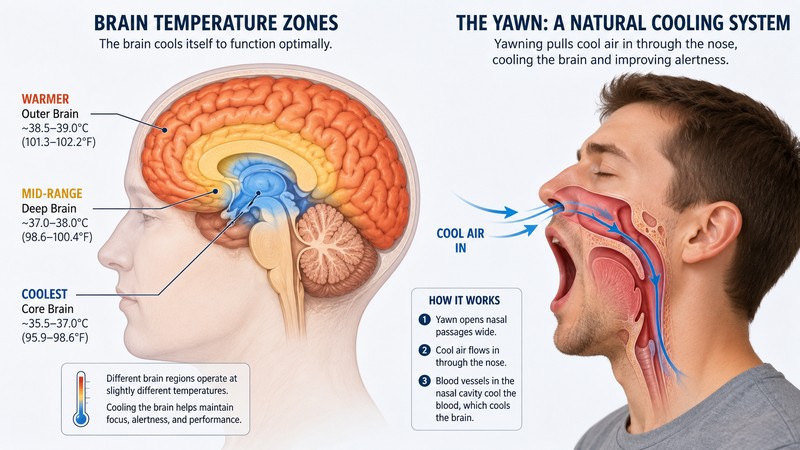
Why do we yawn? The most supported scientific explanation is that yawning regulates brain temperature. When your brain heats up, a yawn floods your nasal and oral cavities with cooler air through blood vessels directly connected to the brain, cooling it down rapidly. Yawning also occurs during transitions between behavioral states, particularly the shift from low activity to high activity or from wakefulness to sleep, when the brain needs a rapid recalibration.
That mechanism sits at the center of several competing theories, none of which has been conclusively proven. The honest answer is that yawning is one of the oldest and most universal behaviors in the animal kingdom, and science is still working out exactly why it happens. What follows is everything currently known, including some findings that overturn what most people think they understand about yawning.
Why Do We Yawn: The Leading Theories
Theory 1: Brain cooling
The brain cooling theory is currently the most supported explanation for why we yawn. Proposed and tested extensively by evolutionary biologist Andrew Gallup of Johns Hopkins University, it argues that yawning serves a thermoregulatory function.
The human brain uses approximately 40% of your body’s total metabolic energy despite representing only 2% of body weight. That metabolic activity generates significant heat. Brain temperature fluctuates constantly, rising during periods of sustained cognitive effort, drowsiness, and the transitions between sleep and wakefulness.
When you yawn, you inhale a large volume of air that makes direct contact with your nasal passages and oral cavity. These surfaces are lined with blood vessels that connect directly to the brain’s circulatory system. The cooler incoming air lowers blood temperature in those vessels, which then carries that cooled blood to the brain.
Research documented by the American Association for the Advancement of Science shows that in animal studies, yawns were reliably triggered by brain temperature increases of just 0.11 degrees Celsius. After the yawn, brain temperature dropped measurably. Gallup’s team also found that people yawn significantly more in warmer ambient temperatures up to a threshold, after which yawning decreases again because the incoming air is too warm to cool the blood vessels effectively.
This explains why yawning increases when you are tired. A fatigued brain runs at slightly higher temperatures. It explains why you yawn in the morning when transitioning from sleep to wakefulness, a state change that involves significant brain temperature shifts. It also explains why yawning decreases in very hot weather: above a certain ambient temperature, inhaling warm air provides no cooling benefit.
Theory 2: Behavioral state transitions
Before the brain cooling theory gained traction, the dominant explanation focused on state transitions. Pioneer researcher Dr. Robert Provine found that yawning is strongly associated with the moment of change between behavioral states: from wakefulness to sleep, from sleep to wakefulness, and from boredom to alertness.
Dr. Christian Agudelo of the University of Miami Miller School of Medicine describes yawning as occurring in anticipation of a change in activity level. Your brain registers that a shift is coming and yawning may prepare it for that shift. You yawn before standing up from a long period of sitting. You yawn when a boring meeting suddenly demands your attention. You yawn when the alarm wakes you from deep sleep.
This theory and the brain cooling theory are not mutually exclusive. State transitions involve temperature changes. Waking from sleep requires the brain to rapidly increase metabolic activity and heat output. Yawning at that moment could serve both the thermoregulatory and the arousal function simultaneously.
Theory 3: The oxygen theory : and why it was debunked
The oxygen theory is the one most people learn in school. It holds that yawning delivers a surge of oxygen to the bloodstream and expels excess carbon dioxide when your breathing has become shallow during periods of drowsiness.
It is intuitive. It fits the observation that people yawn when tired. But it does not hold up to testing.
Studies that altered the oxygen and carbon dioxide levels in subjects’ breathing gas found no consistent effect on yawning frequency. People breathing pure oxygen did not yawn less. People breathing elevated carbon dioxide did not yawn more. The Library of Congress science reference notes that the oxygen and carbon dioxide levels in blood do not change after a yawn in ways consistent with the exchange theory. Additionally, marine mammals yawn while fully submerged underwater, where no respiratory gas exchange is occurring at all. Fetuses yawn in the womb before their lungs ever inflate. Neither group has any possible respiratory benefit from yawning.
Why You Cannot Stop a Yawn Once It Starts
Try to stop a yawn after it has begun. You will find it nearly impossible. You can suppress the obvious jaw drop with effort, but the underlying muscular contraction and the sensation continue regardless.
University of Nottingham researchers publishing in Current Biology found that the human propensity for yawning, including the inability to suppress it once initiated, is triggered by primitive reflexes in the primary motor cortex, the region of the brain responsible for voluntary movement. Crucially, these reflexes operate below the level of conscious control.
The same research found that the urge to yawn and the urge to perform a yawn once triggered both involve this motor cortex activation. When participants were told to resist yawning, the motor cortex activation actually increased rather than decreased. Attempting to suppress a yawn strengthens the neural signal driving it.
This is why yawning feels unstoppable. It is not a voluntary action that you are failing to control. It is an automatic reflex generated at a neural level that bypasses the conscious decision-making systems in your prefrontal cortex. The same mechanism operates with sneezing and the knee-jerk reflex.
Why Yawning Is Contagious: The Empathy Connection
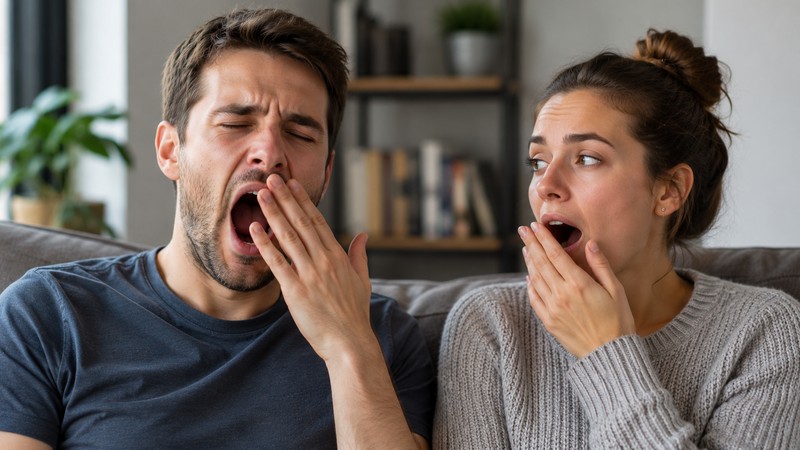
Contagious yawning is one of the most studied aspects of yawning science, and the findings connect to some of the deepest research in social neuroscience.
Approximately 60 to 70 percent of people yawn after seeing, hearing, or reading about someone else yawning. You do not need to see a full yawn. Audio of a yawn is sufficient. Reading about yawning is sufficient. Even a photograph of a yawning person is enough to trigger the response in most people. The brain does not require a complete sensory input to activate the contagion pathway.
fMRI research published in PubMed shows that when you observe someone else yawning, specific regions of your brain activate: the superior temporal sulcus, which processes social cues like facial expressions and eye contact. This activation occurs in the social perception areas of the brain, not the imitation areas. Contagious yawning is not a conscious choice to copy someone. It is an automatic social reflex.
The empathy gradient: you catch yawns from people you love
One of the most consistent findings in contagious yawning research is that yawn contagion follows an empathy gradient. You are far more likely to catch a yawn from a close family member than from a stranger, and the response happens faster when the source is someone you know well.
Research documented in Psychology Today found that this familiarity bias is driven by the same neural systems that underlie social bonding and empathy. When you observe someone you care about yawn, your superior temporal sulcus activates more strongly and your motor cortex responds faster. The same effect appears across species. In a 2013 study, dogs yawned significantly more frequently when watching their owners yawn than when watching a stranger yawn.
This has led researchers to propose that contagious yawning evolved as a social cohesion mechanism. In group-living species, synchronized behavioral state changes keep the group aligned. If the leader of a social group yawns before rest, others following suggests it helped groups sleep, rest, and wake together, improving collective safety.
Why children under 5 do not catch contagious yawns
Young children yawn spontaneously from birth, but they do not respond to contagious yawning until around age 4 to 5. Infants and toddlers watching someone else yawn do not yawn in response.
This developmental boundary aligns precisely with the emergence of theory of mind, the cognitive ability to understand that other people have internal mental states separate from your own. Children develop theory of mind at around age 4. Below that age, they cannot attribute mental states to others, and they do not respond to the social-empathy signal that contagious yawning appears to transmit. The correlation between theory of mind development and the onset of yawn contagion susceptibility is one of the strongest pieces of evidence linking contagious yawning to empathy processing in the brain.
Why Fetuses Yawn in the Womb Before They Can Breathe
One of the most striking facts about yawning is that it begins before birth, in an environment where yawning for respiratory purposes makes no sense at all.
Fetuses begin yawning from approximately 11 weeks of gestation, visible on ultrasound scans. At this stage, the lungs are not developed enough to function. All oxygen delivery happens through the placenta. There is no air to breathe, no respiratory benefit possible from the yawning motion.
Research published in PLOS One by Durham University’s Nadja Reissland used 4D ultrasound to observe healthy fetuses between 24 and 36 weeks of gestation. The study confirmed that fetal yawning is a distinct behavior from ordinary mouth opening, with a longer open duration and a specific closing pattern. Yawning frequency was highest at 24 weeks and declined toward zero by 36 weeks.
Reissland proposed that fetal yawning is linked to brain maturation. The motor pattern of yawning may stimulate neural development in the motor cortex at a critical developmental window. By 36 weeks, when the relevant neural circuits have matured, the yawning behavior is no longer needed and stops.
A 2026 study published in PLOS One by researchers at the University of Ferrara found an additional angle. Fetuses that yawned more frequently during observation tended to be born at slightly lower birth weight, suggesting a possible link between yawning frequency and mild fetal stress. This opens the intriguing possibility that yawning frequency on ultrasound could one day serve as a non-invasive marker of fetal health.
Fetal yawning disproves the oxygen theory definitively. A fetus in the womb has no access to atmospheric air and receives all oxygen through the placenta. If yawning served a respiratory function, it could not exist before the lungs are operational. Its presence in fetuses points strongly toward a neurological or developmental function that operates independently of breathing.
How Brain Size Across Species Relates to Yawning
One of the more unexpected findings in yawning research comes from cross-species comparisons.
Evolutionary biologist Andrew Gallup, interviewed by the American Association for the Advancement of Science, conducted large-scale comparative studies measuring yawn duration across more than 100 mammalian and avian species. The finding was striking: even when controlling for body size, there is a strong positive relationship between how long an animal’s yawn lasts and how large and complex its brain is.
Humans have the longest yawns of any animal studied. Great apes have the next longest. Small-brained rodents have very brief yawns. The correlation holds across mammals and birds despite enormous variation in body size, metabolism, and behavior.
If yawning functioned primarily as a respiratory reflex, this correlation would be unexpected. Larger brains do not require proportionally more oxygen from a yawn. But if yawning functions as a brain temperature regulation mechanism, the correlation makes sense. Larger, more complex brains generate more heat per unit time, have more surface area of neural tissue to cool, and may benefit more from the thermoregulatory effect. The longer yawn duration in species with larger brains is consistent with greater cooling demand.
This cross-species evidence is considered some of the strongest indirect support for the brain cooling theory and connects yawning to the same questions about how the brain’s extraordinary complexity creates behaviors that are still not fully understood, even simple ones like yawning that every person performs dozens of times a day.
What Excessive Yawning Can Signal

Occasional yawning is normal and healthy. Excessive yawning, defined as yawning far more frequently than typical without obvious fatigue or boredom, can sometimes signal an underlying issue.
The most common cause of excessive yawning is sleep deprivation. A consistently tired brain runs at higher temperature and triggers the cooling reflex more frequently. Medications that affect the central nervous system, particularly certain antidepressants, are associated with increased yawning as a side effect.
Excessive yawning has also been documented in people with multiple sclerosis, epilepsy, and certain liver conditions. In some stroke cases, pathological yawning occurs in the days immediately following the event, thought to be related to disruption of the thermoregulatory circuits in the brainstem. Vasovagal syncope, the type of fainting triggered by blood draws or standing up too fast, is sometimes preceded by repeated yawning as the brain’s thermoregulatory system responds to the drop in blood pressure.
If you find yourself yawning excessively, far more than normal, without an obvious cause like fatigue or a warm room, it is worth discussing with a doctor. Most cases are benign, but excessive yawning as a persistent and unexplained symptom is worth evaluating.
Why Yawning and Stretching Happen Together
Most people have noticed that yawning and stretching often occur simultaneously. You wake up in the morning, yawn, and stretch your arms overhead at the same time. This combination has its own term: pandiculation.
Pandiculation appears across almost all vertebrate species and seems to serve a muscle activation and joint lubrication function during transitions from rest to movement. The stretch component activates muscle spindles and prepares the musculoskeletal system for activity after a period of stillness. The yawn component, on the brain cooling or behavioral state transition theory, prepares the brain for increased activity.
The two behaviors are so consistently paired that they may be triggered by the same underlying neural signal, a combined preparation for state change that operates on both the brain and the body simultaneously. In animals, pandiculation is most visible in cats and dogs waking from sleep. The exaggerated full-body stretch accompanied by a wide jaw yawn appears to serve the same preparation function in every species studied.
Frequently Asked Questions
Why do we yawn when we are tired?
A fatigued brain operates at slightly higher temperatures due to the metabolic work of sustained activity. Higher brain temperature triggers the yawning reflex more frequently as the brain attempts to cool itself. Yawning also occurs at the transition from wakefulness to sleep, a state change that involves significant shifts in brain activity and temperature.
Why do we yawn when we are bored?
Boredom involves a low-activity brain state. Yawning during boredom may reflect the same state transition mechanism that drives yawning during fatigue: the brain is shifting between arousal levels and yawning helps recalibrate. Some researchers also suggest that yawning during boredom increases alertness by briefly boosting cerebral blood flow and dropping brain temperature, providing a mild arousal effect.
Is contagious yawning a sign of empathy?
The correlation is real but imperfect. Susceptibility to contagious yawning does correlate with measures of empathy in psychological research, and the brain regions activated during contagious yawning overlap with empathy processing areas. Children with autism spectrum conditions show reduced susceptibility to contagious yawning compared to neurotypical children, consistent with differences in social empathy processing. However, contagious yawning is not a reliable individual test of empathy. Individual susceptibility varies widely even among highly empathic people.
Why do we yawn in the morning?
The transition from sleep to wakefulness involves a rapid shift in brain metabolic activity. As your brain switches from the low-activity sleep state to the high-activity waking state, it generates heat rapidly. Yawning helps cool the brain during this temperature spike. Morning yawning is also consistent with the state transition theory: the change from sleep to wakefulness is one of the most dramatic behavioral state transitions the brain undergoes, and yawning is reliably associated with state transitions. This connection to the brain’s morning activation also relates to why dreams happen during specific sleep states and what the brain is doing during them, since both yawning frequency and dream intensity peak during the transitions between sleep stages.
Does yawning mean you are not getting enough oxygen?
The evidence does not support this. Controlled studies altering oxygen and carbon dioxide levels in breathing gas showed no reliable effect on yawn frequency. People breathing pure oxygen did not yawn less. Marine mammals yawn while submerged. Fetuses yawn before their lungs ever function. If oxygen intake were the primary driver, none of these patterns would exist. The brain cooling and state transition theories are better supported by the available evidence.
Why do some people yawn more than others?
Individual yawning frequency varies based on sleep quality, ambient temperature, current activity level, and individual differences in brain thermoregulation. People with naturally higher resting brain temperatures may yawn more frequently. Susceptibility to contagious yawning also varies significantly. Research shows roughly 60 to 70 percent of people respond to contagious yawn triggers, with the remainder largely unaffected. The reasons for this variation are not fully understood.
The One-Paragraph Answer
We yawn because the brain triggers a reflex designed to lower its own temperature, recalibrate between behavioral states, and prepare for transitions between rest and activity. When your brain heats up, a yawn floods your nasal and oral cavities with cooler air that is carried by blood vessels directly to the brain’s circulatory system, briefly lowering brain temperature. The same reflex fires during transitions from sleep to wakefulness, from boredom to alertness, and from high activity to rest. Contagious yawning is driven by social empathy circuits in the brain that activate automatically when you observe someone else yawn, operating below conscious control. You cannot suppress a yawn once the primary motor cortex has initiated it. Fetuses yawn from 11 weeks in the womb with no air to breathe, suggesting yawning also serves a neural development function early in life. Despite being universal across all vertebrates and extraordinarily ancient as a behavior, yawning remains one of the few things every creature on Earth does that science has not yet fully explained.
Related articles
Sources
- Research documented by the American Association for the Advancement of Science
- The Library of Congress science reference
- ScienceDaily: University of Nottingham researchers publishing in Current Biology
- U.S. National Library of Medicine (PMC): fMRI research published in PubMed
- Research documented in Psychology Today
- Live Science: Research published in PLOS One by Durham University's Nadja Reissland