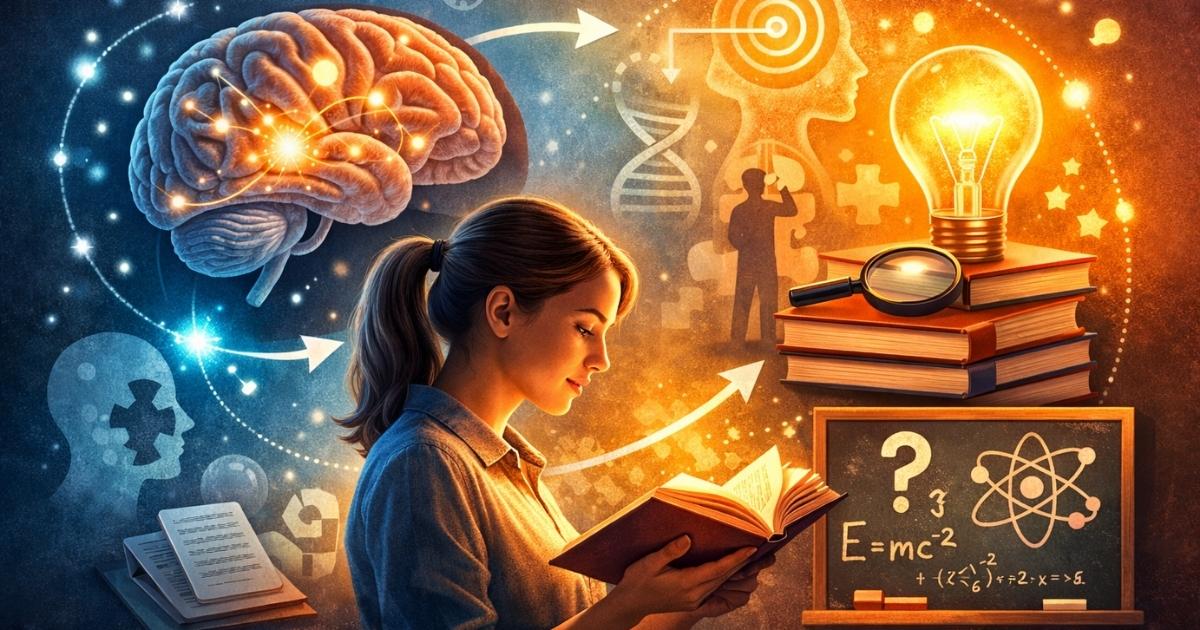
Curiosity and learning are deeply connected. When people feel curious, they become more engaged, attentive, and motivated to understand new ideas. This natural desire to explore information improves learning quality and strengthens memory retention over time.
Rather than passively absorbing information, curiosity-driven learners actively seek answers, ask questions, and explore ideas. This natural motivation significantly improves both learning quality and memory retention.
How Curiosity and Learning Work Together
Curiosity increases learning by activating attention and motivation systems in the brain. When curiosity is present, the brain becomes more receptive to new information.
Curious learners tend to:
- Focus more deeply on topics
- Explore subjects beyond surface-level understanding
- Engage actively with learning material
- Persist longer when solving problems
This is why curiosity-based learning often leads to deeper comprehension compared to rote memorization.
The Connection Between Curiosity and Memory
Memory formation is strongly influenced by curiosity. Research shows that curiosity activates brain regions associated with memory, particularly the hippocampus.
When curiosity is triggered:
- The brain prioritizes incoming information
- Dopamine release enhances memory encoding
- Information learned is retained for longer periods
This explains why people often remember facts they were curious about far better than information they were forced to memorize.
Curiosity as an Intrinsic Learning Motivator
Curiosity is an intrinsic motivator, meaning it comes from within rather than external rewards. Unlike grades or praise, curiosity-driven learning feels naturally satisfying.
This internal motivation encourages:
- Self-directed learning
- Lifelong intellectual growth
- Deeper engagement with complex ideas
Understanding this process is central to any curiosity explained framework that explores how curiosity shapes learning and human behavior.
Why Curiosity Leads to Better Long Term Learning
Learning driven by curiosity tends to last longer because it:
- Encourages deeper processing of information
- Builds stronger mental connections
- Makes learning enjoyable rather than stressful
Over time, curiosity helps learners develop critical thinking skills, adaptability, and a genuine love for learning.
Practical Examples of Curiosity Driven Learning
Curiosity-driven learning appears in many real-life situations:
- Students researching topics beyond exam requirements
- Professionals learning new skills out of interest
- Readers exploring subjects sparked by a single question
These examples show how curiosity naturally fuels meaningful learning experiences.
How Curiosity and Learning Affect Problem Solving Skills
Curiosity and learning play a major role in how people approach and solve problems. When individuals are curious, they are more willing to explore multiple solutions instead of settling for the first answer that appears. This open-minded approach allows the brain to consider different perspectives and possibilities.
Research suggests that curiosity increases cognitive flexibility, which helps learners adapt their thinking when faced with new or complex challenges. Curious learners are more likely to experiment, question assumptions, and persist even when problems become difficult.
In educational and professional settings, curiosity driven learning leads to better problem-solving outcomes because learners actively seek understanding rather than memorizing information. Over time, this strengthens analytical thinking, creativity, and decision-making skills.
By encouraging curiosity, learners can improve not only how much they learn, but also how effectively they apply knowledge in real world situations.
Final Thoughts
Curiosity is one of the most effective tools for improving learning and memory. By activating attention, motivation, and memory systems in the brain, curiosity transforms learning into an engaging and lasting process.
Encouraging curiosity rather than suppressing it can significantly enhance educational outcomes and lifelong learning potential.