
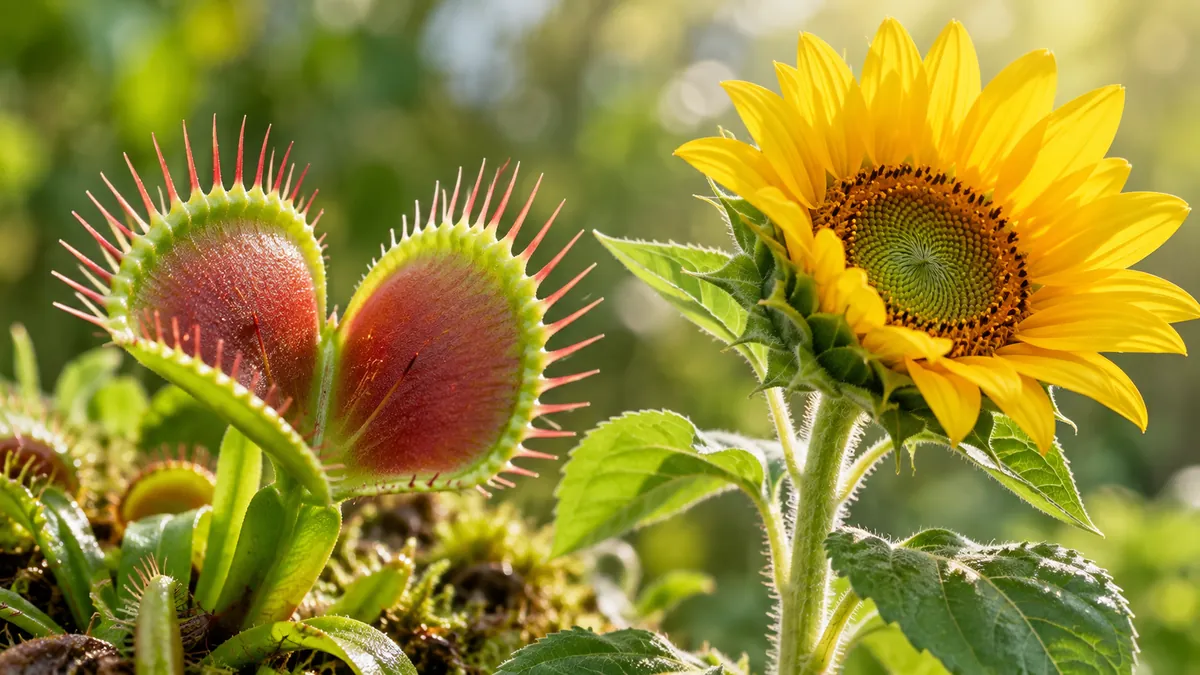
Quick answer: These facts about plants show they are far more active than they look. They release chemical warnings when attacked. Some make ultrasonic clicks when stressed. The Venus flytrap counts touches before it snaps shut. Some plants recognize their siblings. And a bristlecone pine in California is more than 4,800 years old. Here are 12 extraordinary plant facts, each backed by research.
Plants can’t run, bite or shout, but they sense light, touch, chemicals, gravity and even sound, and they respond in surprisingly clever ways.
How plants sense and communicate
- Plants warn each other. When caterpillars chew on a plant, it releases airborne chemicals called volatile organic compounds. Nearby plants detect them and boost their own defenses.
- Some plants recognize their siblings. In a 2007 study, sea rocket plants grown with siblings grew fewer competing roots than when grown next to unrelated plants.
- Stressed plants make sounds. A 2023 study recorded tomato and tobacco plants emitting ultrasonic clicks, too high for humans to hear, when they were short of water or had been cut.
- Flowers may “hear” bees. Beach evening primrose flowers produced sweeter nectar within minutes of hearing the buzz of a flying bee in experiments.

Plants that move and count
- The Venus flytrap counts. A trap closes only after its trigger hairs are touched twice within about 20 to 30 seconds, which avoids false alarms from raindrops. After about five touches, it starts producing digestive enzymes.
- The “sensitive plant” folds when touched. Mimosa pudica collapses its leaves within seconds by quickly moving water out of cells at the base of each leaflet.
- Young sunflowers follow the Sun. Growing sunflower heads track the Sun from east to west each day and swing back overnight. Mature flowers stop moving and face east.
- Plants have internal clocks. In 1729, French scientist Jean-Jacques d’Ortous de Mairan kept a mimosa plant in the dark and saw its leaves still open and close on a daily rhythm. We now know plants have circadian clocks, like animals.
Record-breaking facts about plants
- Some trees are over 4,800 years old. A Great Basin bristlecone pine in California known as Methuselah is one of the oldest known individual trees.
- The tallest known tree is taller than a 30-story building. A coast redwood nicknamed Hyperion measures about 116 m.
- Some bamboo grows almost a meter a day. Certain species can grow up to about 90 cm in 24 hours during their growth spurt.
- A strawberry’s “seeds” are actually fruits. Each little speck on a strawberry is an achene, a tiny fruit with a seed inside. The red flesh is a swollen part of the flower.

Why plants matter so much
Plants and algae produce the oxygen we breathe. Roughly half of Earth’s oxygen comes from tiny ocean plants called phytoplankton, and the rest mostly from land plants. Plants also form the base of almost every food chain on land. Read about why leaves change color in autumn.

Frequently asked questions
Can plants feel pain?
Plants sense damage and respond to it, but they have no brain or nerves, so most scientists do not think they feel pain the way animals do.
Do plants communicate?
Yes, in a chemical sense. Plants release airborne compounds and root signals that other plants and insects detect and respond to.
What is the oldest plant on Earth?
Among individual trees, Great Basin bristlecone pines are the oldest, at over 4,800 years. Some clonal colonies, such as the Pando aspen grove in Utah, are thought to be even older.
Related articles
- 10 secrets of the natural world science has revealed
- Why do leaves change color?
- How do bees make honey?
- 20 interesting geology facts
Sources
- Dudley, S. A. & File, A. L. (2007). “Kin recognition in an annual plant.” Biology Letters.
- Khait, I. et al. (2023). “Sounds emitted by plants under stress are airborne and informative.” Cell.
- Veits, M. et al. (2019). “Flowers respond to pollinator sound within minutes by increasing nectar sugar concentration.” Ecology Letters.
- Böhm, J. et al. (2016). “The Venus flytrap Dionaea muscipula counts prey-induced action potentials to induce sodium uptake.” Current Biology.
- Atamian, H. S. et al. (2016). “Circadian regulation of sunflower heliotropism, floral orientation, and pollinator visits.” Science.
- Khait et al. (2023), sounds emitted by stressed plants, Cell
- Böhm et al. (2016), the Venus flytrap counts, Current Biology