
Quick answer: Some of the most interesting geology facts: Earth is about 4.54 billion years old. The continents drift about as fast as your fingernails grow. The rock at the top of Mount Everest formed on an ancient seafloor. And Earth’s inner core is roughly as hot as the surface of the Sun. Here are 20 geology facts, each briefly explained.
Geology is the study of Earth: what it is made of, how it formed and how it keeps changing. Many geological processes are too slow to notice in a lifetime, yet they built every mountain, canyon and beach on the planet. To see some of the results, visit our list of 10 geological wonders of the world.
Facts about Earth’s age and structure
- Earth is about 4.54 billion years old. Scientists worked this out by radiometric dating of meteorites and the oldest Earth and Moon rocks.
- The oldest known pieces of Earth are about 4.4 billion years old. They are tiny zircon crystals found in the Jack Hills of Western Australia.
- The oldest known intact rocks are about 4 billion years old. The Acasta Gneiss in northern Canada is one of the oldest rock formations ever found.
- Earth’s inner core is roughly as hot as the surface of the Sun. It is estimated at around 5,200 °C, yet it stays solid because of the enormous pressure.
- Earth is not a perfect sphere. Its spin makes it bulge at the equator, so the diameter across the equator is about 43 km wider than from pole to pole.
- Oxygen is the most common element in Earth’s crust. It makes up about 46% of the crust by weight, mostly locked inside minerals, followed by silicon.
Facts about moving continents and mountains
- Continents move about as fast as fingernails grow. Tectonic plates typically move a few centimeters a year.
- The Atlantic Ocean is getting wider. North America and Europe are moving apart by about 2.5 cm a year.
- All the continents were once joined. They formed a supercontinent called Pangaea, which began breaking apart about 200 million years ago.
- The summit of Mount Everest is made of seafloor. Its top layers are marine limestone containing fossils of sea creatures, pushed up as India collided with Asia.
- Everest isn’t the tallest mountain from base to peak. Mauna Kea in Hawaii rises more than 10,000 m from the ocean floor, though most of it is underwater.
- Most ocean floor is geologically young. Because seafloor is constantly recycled at subduction zones, most of it is less than 200 million years old, far younger than many continental rocks.
Facts about volcanoes and earthquakes
- There are about 1,350 potentially active volcanoes on land. That is the U.S. Geological Survey’s count, not including the many volcanoes along mid-ocean ridges.
- Earth has around half a million detectable earthquakes a year. About 100,000 of them can be felt, and around 100 cause damage.
- Some rocks float. Pumice forms when frothy, gas-filled lava cools so quickly that it is full of bubbles, making it light enough to float on water.
- Diamonds come from deep inside Earth. Most form around 150 km or more below the surface and are carried up by rare, fast volcanic eruptions through pipes of kimberlite rock.
Interesting geology facts about rocks and minerals
- The largest natural crystals are over 10 meters long. Selenite crystals in the Cave of Crystals at Naica, Mexico, reach about 12 m.
- Chalk is made of tiny fossils. The White Cliffs of Dover formed from the microscopic shells of countless plankton that settled on an ancient seabed.
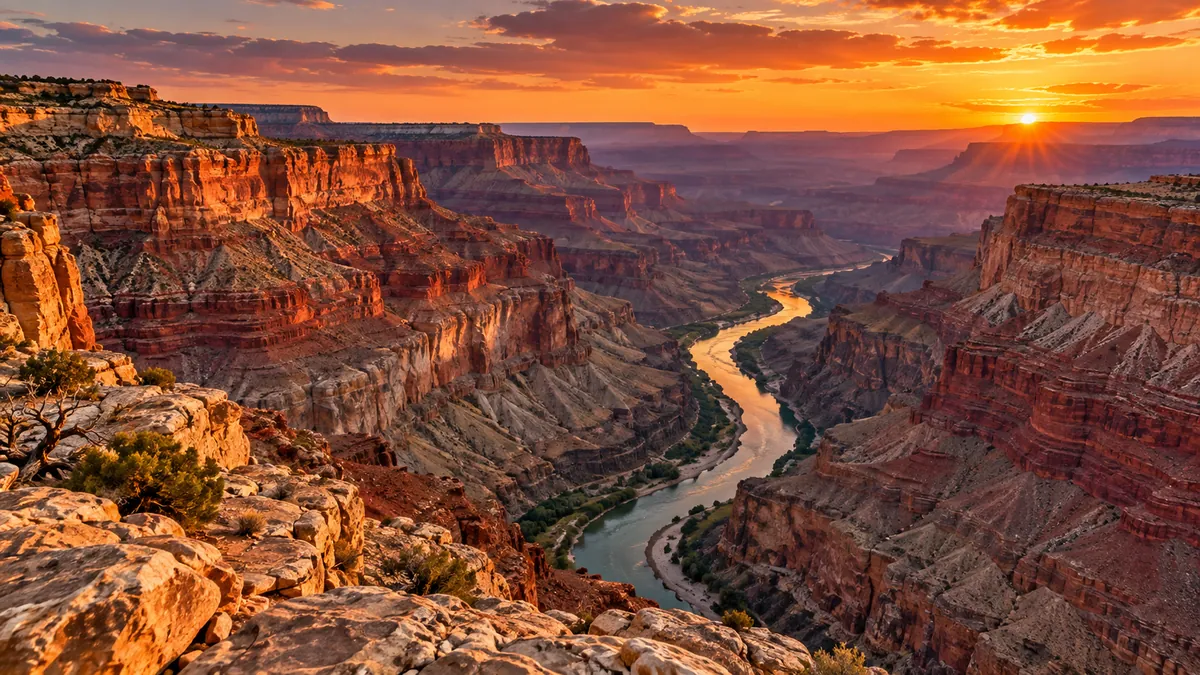
- The Grand Canyon exposes nearly 2 billion years of history. The oldest rocks at the bottom are about 1.7 to 1.8 billion years old.
- The deepest hole ever drilled goes 12 km down. The Kola Superdeep Borehole in Russia reached 12,262 m, still only a tiny fraction of the way to Earth’s center.
The rock cycle in one paragraph
Rocks are constantly recycled. Igneous rocks form when magma or lava cools. Wind, water and ice break them into sediment, which is buried and pressed into sedimentary rocks such as sandstone and limestone. Heat and pressure deep underground can transform any rock into metamorphic rock, such as marble or slate, and eventually it may melt back into magma and start the cycle again.
Frequently asked questions
What is geology?
Geology is the science of Earth: its rocks, minerals, landforms and the processes, such as plate tectonics, erosion and volcanism, that shape them over time.
What is the oldest rock on Earth?
The oldest known intact rocks, such as the Acasta Gneiss in Canada, are about 4 billion years old. Individual zircon crystals from Australia are even older, at about 4.4 billion years.
What are the three main types of rock?
Igneous, sedimentary and metamorphic rock.
Is Mount Everest still growing?
Yes. The collision between the Indian and Eurasian plates is still pushing the Himalayas upward by a few millimeters a year.
Related articles
- 10 geological wonders of the world you need to see
- 10 amazing natural phenomena on Earth
- Why is the ocean salty?
- 10 weird science facts that are surprisingly true
Sources
- U.S. Geological Survey (USGS): “Age of the Earth”, “Volcanoes” and “Earthquake Facts & Statistics”.
- Wilde, S. A. et al. (2001). “Evidence from detrital zircons for the existence of continental crust and oceans on the Earth 4.4 Gyr ago.” Nature.
- Bowring, S. A. & Williams, I. S. (1999). “Priscoan (4.00–4.03 Ga) orthogneisses from northwestern Canada.” Contributions to Mineralogy and Petrology.
- National Park Service: “Grand Canyon Geology”.
- Encyclopaedia Britannica: “Plate tectonics” and “Rock cycle”.
- Wilde et al. (2001), 4.4-billion-year-old zircons, Nature