
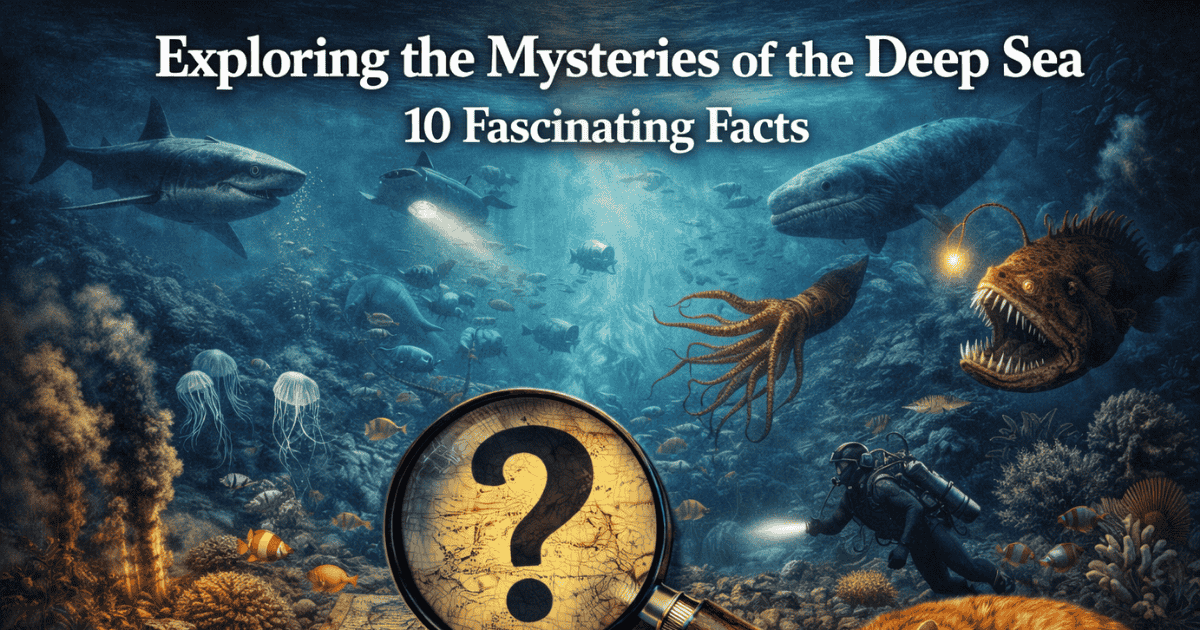
Quick answer: The deep sea usually means the ocean below about 200 meters, where sunlight fades out. It is the largest habitat on Earth, yet only about a quarter of the seafloor has been mapped in detail. At its deepest point, the Challenger Deep, the water is nearly 11 km deep and the pressure is more than 1,000 times what we feel at sea level. Most animals living in the open ocean can make their own light.
The ocean covers about 71% of Earth’s surface, with an average depth of around 3,700 meters. Most of that water is cold, dark and under enormous pressure, which makes the deep sea one of the hardest places on the planet to explore. Here are 15 facts about what scientists have found there, and what is still unknown.
How deep is the deep sea? The ocean’s zones
| Zone | Depth | What it’s like |
|---|---|---|
| Sunlight zone (epipelagic) | 0–200 m | Enough light for photosynthesis; most familiar sea life |
| Twilight zone (mesopelagic) | 200–1,000 m | Faint blue light; many animals migrate up each night |
| Midnight zone (bathypelagic) | 1,000–4,000 m | Total darkness except for bioluminescence; about 4 °C |
| Abyssal zone (abyssopelagic) | 4,000–6,000 m | Near-freezing water over vast muddy plains |
| Hadal zone | Below 6,000 m | Ocean trenches, including the deepest point on Earth |
15 facts about the deep sea
- The deepest known point is almost 11 km down. The Challenger Deep in the Mariana Trench is about 10,900 to 11,000 m deep. Mount Everest would fit inside with more than 2 km of water to spare.
- The pressure there could crush a car. At the bottom of the Challenger Deep, water pressure is over 1,000 times the pressure at sea level.
- Only about a quarter of the seafloor is mapped in detail. The international Seabed 2030 project reports that roughly 25% of the ocean floor has been mapped with modern sonar.
- Humans first reached the deepest point in 1960. Jacques Piccard and Don Walsh dived the Challenger Deep in the bathyscaphe Trieste. Filmmaker James Cameron made the first solo dive in 2012.
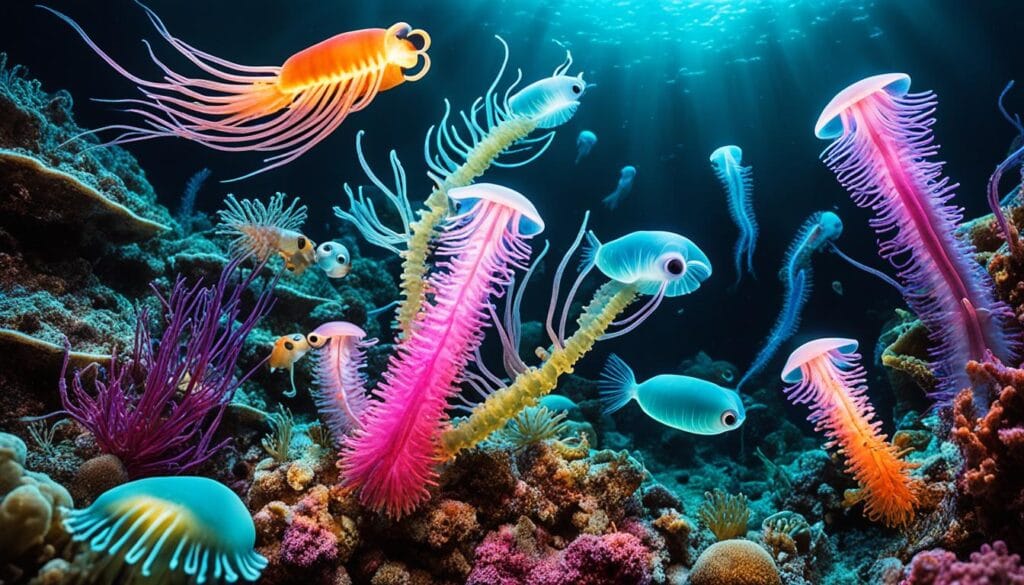
- Most open-ocean animals glow. A study of more than 350,000 animal sightings off California found that about three-quarters of the animals in the water column can produce light.
- Bioluminescence has many jobs. Animals use light to lure prey, find mates, and hide their silhouette from predators below by matching the faint light from above.
- Some ecosystems run without sunlight. At hydrothermal vents, first found in 1977 near the Galápagos Islands, bacteria make food from chemicals in the hot water. This process is called chemosynthesis.
- Giant tube worms live at those vents. They can grow about 2 m long and have no mouth or gut. Bacteria living inside them make their food.
- The deepest fish ever filmed was over 8,300 m down. In 2023, scientists recorded a snailfish at 8,336 m in a trench off Japan.
- The giant squid was first filmed alive in the deep in 2012. Before that, scientists knew it mainly from dead specimens and sucker scars on sperm whales.
- Some deep-sea animals are unusually large. Giant isopods, relatives of pill bugs, can grow up to around 40 to 50 cm long, an example of “deep-sea gigantism”.
- Anglerfish fish with a built-in light. The glowing lure on a female anglerfish’s head is lit by bacteria. In some species, the much smaller male fuses permanently to the female.
- Deep-sea food falls like snow. “Marine snow”, made of bits of dead plankton, waste and dust, drifts down from above and feeds much of the deep sea.
- A dead whale can feed life for decades. When a whale carcass sinks, a “whale fall” supports scavengers, worms and bacteria for years, sometimes decades.
- Greenland sharks may live for centuries. Radiocarbon dating of their eyes suggests some are around 250 to 400 years old, making them the longest-lived vertebrates known.
What are the biggest unsolved mysteries of the deep sea?
- How many species live there. Most deep-sea species are thought to be undescribed, and new ones are found on almost every expedition.
- What the unmapped seafloor holds. Detailed maps of the remaining three-quarters of the ocean floor could reveal unknown seamounts, canyons and vents.
- How deep-sea life will cope with change. Scientists are still learning how warming water, lower oxygen and proposed deep-sea mining could affect these slow-growing ecosystems.

How do scientists explore the deep sea?
Because humans cannot survive the pressure unprotected, most exploration uses remotely operated vehicles (ROVs), robots tethered to a ship by a cable, and autonomous underwater vehicles (AUVs) that swim pre-programmed routes. Crewed submersibles such as Alvin, which helped discover hydrothermal vents, still carry scientists to the seafloor. Ship-based sonar maps the shape of the ocean floor from above.
Frequently asked questions
How much of the deep sea has been explored?
Only a small part has been seen directly. About 25% of the seafloor has been mapped in detail, and a far smaller fraction has been visited or filmed.
Why is the deep sea so dark?
Seawater absorbs sunlight quickly. Below about 200 m there is too little light for photosynthesis, and below about 1,000 m there is effectively no sunlight at all.
What is the deepest part of the ocean?
The Challenger Deep, in the Mariana Trench in the western Pacific Ocean, at roughly 10,900 to 11,000 m deep.
How do animals survive the pressure?
Deep-sea animals have no air-filled spaces to crush, flexible bodies, and special molecules that stabilize their proteins under high pressure.
Related articles
- Bioluminescent bays: where and why the water glows
- Why is the ocean salty?
- 15 examples of migratory animals
- 10 lost cities that were rediscovered
Sources
- NOAA Ocean Exploration: “How deep is the ocean?” and “What is the deepest part of the ocean?”
- Martini, S. & Haddock, S. H. D. (2017). “Quantification of bioluminescence from the surface to the deep sea demonstrates its predominance as an ecological trait.” Scientific Reports.
- Nielsen, J. et al. (2016). “Eye lens radiocarbon reveals centuries of longevity in the Greenland shark.” Science.
- The Nippon Foundation–GEBCO Seabed 2030 Project: annual seafloor mapping updates.
- Woods Hole Oceanographic Institution: “Hydrothermal Vents”.
- Martini & Haddock (2017), bioluminescence in the deep sea, Scientific Reports
- Nielsen et al. (2016), Greenland shark longevity, Science