
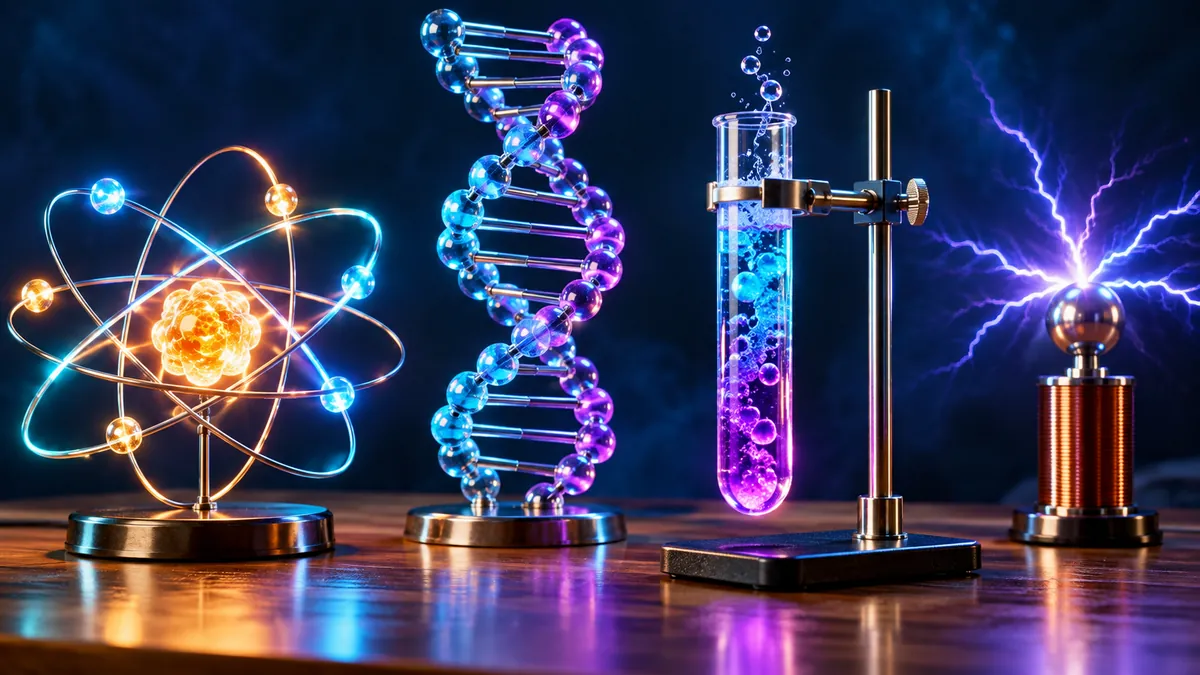
Quick answer: Some of the most mind-blowing science facts are that atoms are almost entirely empty space, time passes slightly faster at higher altitude, lightning is about five times hotter than the Sun’s surface, your body holds roughly as many bacterial cells as human cells, and the DNA in a single cell would stretch about 2 meters if unwound. Below are 20 science facts across physics, chemistry, biology and Earth science, each with the explanation behind it.
Science is full of discoveries that sound like they can’t possibly be true, until you see the evidence. These facts are grouped by subject so you can jump to what interests you. For even stranger examples, see our weird science facts.
Physics facts
- Atoms are about 99.9999999% empty space. If an atom’s nucleus were the size of a marble in the middle of a football stadium, its electrons would be buzzing around the outer stands. Solid objects feel solid because of electric forces between atoms, not because atoms are packed full.
- Time runs faster on a mountain than at sea level. Einstein’s general relativity says gravity slows time. In 2010, physicists measured the difference with atomic clocks just 33 cm apart in height.
- Your phone’s GPS depends on relativity. Clocks on GPS satellites run about 38 microseconds a day faster than clocks on the ground. Without correcting for this, positions would drift by several kilometers a day.
- Light can behave like a wave and a particle. In the double-slit experiment, even single electrons fired one at a time build up an interference pattern, as if each one passed through both slits.
- “Spooky action at a distance” is real. Entangled particles stay linked so that measuring one instantly tells you about the other, however far apart they are. Experiments proving this won the 2022 Nobel Prize in Physics.
- Sunlight is ancient by the time it leaves the Sun. Energy made in the Sun’s core bounces around for many thousands of years before reaching the surface, then takes just over 8 minutes to reach Earth.
Chemistry facts
- Water can boil and freeze at the same time. At its “triple point”, 0.01 °C and very low pressure, water exists as solid, liquid and gas together.
- Super-cold helium climbs walls. Cooled below about −271 °C, helium becomes a superfluid with zero viscosity and can creep up and over the sides of its container.
- Glass is not a slow-moving liquid. Old church windows are thicker at the bottom because of how they were made, not because glass flowed. Glass is an amorphous solid.
- Most of the human body is just a few elements. About 99% of your body’s mass is oxygen, carbon, hydrogen, nitrogen, calcium and phosphorus.
Biology facts
- You are about half bacteria. A 2016 estimate found the average person has about 38 trillion bacteria and about 30 trillion human cells, most of the bacteria in the gut (see facts about the digestive system).
- Each cell holds about 2 meters of DNA. It is coiled so tightly that it fits inside a nucleus far smaller than a pinhead.
- Your brain physically changes when you learn. A famous study of London taxi drivers found that part of their hippocampus, involved in spatial memory, was larger than in other people. This ability to rewire is called neuroplasticity.
- Life experiences can leave chemical marks on genes. People conceived during the Dutch famine of 1944 to 1945 showed differences in chemical tags on their DNA six decades later. This field is called epigenetics.
- Tardigrades have survived open space. In 2007, these tiny animals were exposed to the vacuum and radiation of space on a satellite, and some survived and reproduced.
- Your stomach lining protects itself from acid. Stomach acid has a pH of about 1.5 to 3.5, acidic enough to break down tough food and kill many germs, so the stomach coats itself in mucus and constantly replaces the cells of its lining.
Earth science facts
- Lightning is about five times hotter than the Sun’s surface. A bolt can heat the air around it to roughly 30,000 °C for a fraction of a second.
- Lightning strikes Earth about 40 to 50 times every second. That adds up to millions of flashes every day.
- Earth’s inner core is about as hot as the Sun’s surface. Experiments suggest it is around 5,000 to 6,000 °C, yet stays solid because of enormous pressure.
- Days are slowly getting longer. The Moon’s tides act like a brake on Earth’s spin, adding a couple of milliseconds to the length of a day each century. Some 400 million years ago, a year had over 400 days.
Science facts at a glance
| Subject | Fact | Key number |
|---|---|---|
| Physics | GPS clocks run fast | 38 microseconds per day |
| Physics | Atoms are mostly empty | About 99.9999999% empty |
| Chemistry | Water’s triple point | 0.01 °C |
| Biology | Bacteria in your body | About 38 trillion |
| Biology | DNA per cell | About 2 m |
| Earth | Lightning temperature | About 30,000 °C |
| Earth | Inner core temperature | About 5,000 to 6,000 °C |
Frequently asked questions
What is the most mind-blowing science fact?
Many people pick the fact that time passes at different speeds depending on gravity and motion. It sounds like science fiction, but GPS would not work without accounting for it.
Are we really made of mostly empty space?
In terms of volume, yes. Atoms are almost entirely empty, but electric forces between them make matter feel solid.
Is it true that the human body has more bacteria than cells?
The old claim of 10 bacteria for every human cell was an overestimate. Current estimates put the ratio closer to 1 to 1.
Why is science so surprising?
Our intuition evolved for everyday sizes and speeds. At very small, very large or very fast scales, nature behaves in ways our instincts don’t expect.
Related articles
- 10 weird science facts
- 15 mind-blowing facts about space
- Easy science experiments at home
- 40 interesting facts about humans
- All Science & Nature articles
Sources
- Chou, C. W. et al. (2010). “Optical clocks and relativity.” Science.
- Sender, R., Fuchs, S. & Milo, R. (2016). “Revised estimates for the number of human and bacteria cells in the body.” PLoS Biology. doi:10.1371/journal.pbio.1002533
- Maguire, E. A. et al. (2000). “Navigation-related structural change in the hippocampi of taxi drivers.” PNAS.
- Heijmans, B. T. et al. (2008). “Persistent epigenetic differences associated with prenatal exposure to famine in humans.” PNAS.
- Jönsson, K. I. et al. (2008). “Tardigrades survive exposure to space in low Earth orbit.” Current Biology.
- The Nobel Prize in Physics 2022, NobelPrize.org.