
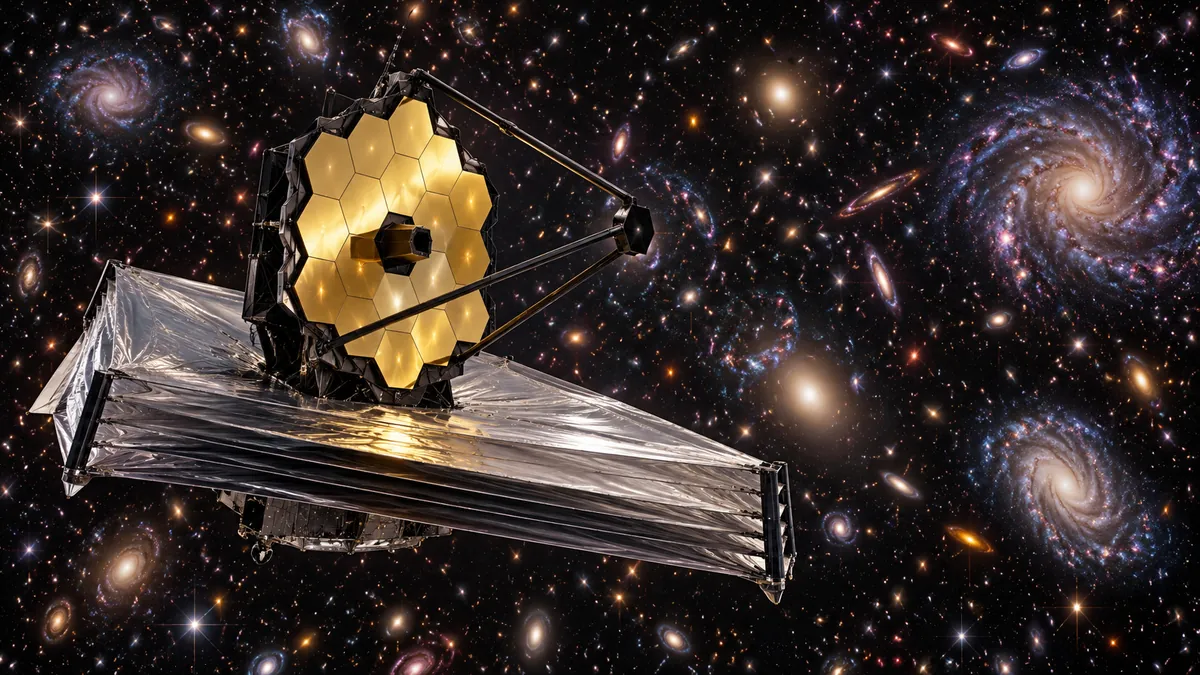
Quick answer: Some of the biggest space discoveries of all time are the expanding universe (1929), the Big Bang’s afterglow (1965), the first planet around a Sun-like star (1995), the accelerating expansion of the universe (1998), gravitational waves (2015) and the first image of a black hole (2019). Recent highlights include the James Webb Space Telescope’s view of galaxies from the universe’s first few hundred million years and asteroid samples rich in the building blocks of life.
A century ago, astronomers still debated whether the Milky Way was the entire universe. Since then, discovery after discovery has transformed our picture of the cosmos. Here are 14 space discoveries that changed what we know, listed in the order they happened.
The biggest space discoveries at a glance
| Year | Discovery | Why it matters |
|---|---|---|
| 1929 | The universe is expanding | Led to the Big Bang theory |
| 1965 | Cosmic microwave background | Direct evidence of the hot early universe |
| 1967 | Pulsars | Proved neutron stars exist |
| 1995 | Planet around a Sun-like star | Started the exoplanet era |
| 1998 | Accelerating expansion | Revealed dark energy |
| 2005 | Enceladus’s water plumes | Found an ocean world that could host life |
| 2013 | Ancient habitable lake on Mars | Mars once had conditions suitable for microbes |
| 2015 | Pluto’s active surface | Small worlds can be geologically alive |
| 2015 | Gravitational waves | A new way to observe the universe |
| 2017 | Neutron star collision | Showed where much of the gold comes from |
| 2017 | First interstellar object | Material from another star system passed through ours |
| 2019 | First black hole image | Confirmed predictions of general relativity |
| 2024 | Galaxies 300 million years after the Big Bang | Early galaxies formed faster than expected |
| 2025 | Life’s building blocks in asteroid Bennu | Ingredients for life were common in the early solar system |
1. The universe is expanding (1929)
Edwin Hubble showed that distant galaxies are moving away from us, and the farther they are, the faster they recede. Building on work by Georges Lemaître and others, this pointed to a universe that is growing, and therefore had a beginning.
2. The afterglow of the Big Bang (1965)
Arno Penzias and Robert Wilson found a faint microwave hiss coming from every direction. It turned out to be the cosmic microwave background, light released about 380,000 years after the Big Bang, and it won them the 1978 Nobel Prize.
3. Pulsars (1967)
Graduate student Jocelyn Bell Burnell noticed a radio signal pulsing every 1.3 seconds. It was a pulsar, a rapidly spinning neutron star: the collapsed core of a massive star, so dense that a teaspoon of it would weigh about a billion tonnes.
4. The first planet around a Sun-like star (1995)
Michel Mayor and Didier Queloz found 51 Pegasi b, a giant planet orbiting its star every 4.2 days. More than 6,000 exoplanets are now confirmed (see facts about exoplanets).

5. The universe’s expansion is speeding up (1998)
Two teams measuring distant supernovae expected to find the expansion slowing down. Instead it was accelerating. The unknown cause, called dark energy, makes up about 68% of the universe.
6. Water plumes on Enceladus (2005)
NASA’s Cassini spacecraft saw jets of water vapor and ice shooting from cracks near the south pole of Saturn’s small moon Enceladus. Later flybys showed they come from a global underground ocean containing salts and organic molecules.
7. An ancient lake on Mars (2013)
NASA’s Curiosity rover found that Gale Crater once held a long-lasting freshwater lake with all the chemical ingredients microbes would need. Mars was once far more Earth-like than it is today.
8. Pluto is geologically active (2015)
NASA’s New Horizons flyby revealed a heart-shaped plain of nitrogen ice called Sputnik Planitia, mountains of water ice and a surface young enough to suggest ongoing activity, on a world scientists expected to be a frozen, cratered ball.
9. Gravitational waves (2015)
On 14 September 2015, the LIGO detectors recorded ripples in spacetime from two black holes merging about 1.3 billion light-years away, confirming a prediction Einstein made a century earlier. Three of the project’s founders won the 2017 Nobel Prize.
10. A neutron star collision makes gold (2017)
In August 2017, gravitational-wave detectors and telescopes around the world caught the collision of two neutron stars. The explosion, called a kilonova, showed that such collisions produce heavy elements including gold and platinum.
11. Visitors from other star systems (2017 onward)
‘Oumuamua, discovered in 2017, was the first known object to pass through our solar system from interstellar space. Comet 2I/Borisov followed in 2019, and comet 3I/ATLAS was discovered in 2025.
12. The first image of a black hole (2019)
The Event Horizon Telescope linked radio dishes across Earth to photograph the shadow of the black hole M87*, 55 million light-years away. In 2022 it imaged Sagittarius A*, the black hole at the center of our galaxy (see what is a black hole?).
13. Galaxies from the dawn of time (2022 onward)
The James Webb Space Telescope has spotted galaxies that existed less than 300 million years after the Big Bang, along with surprisingly large early black holes. They are brighter and more numerous than many models predicted.
14. Building blocks of life in an asteroid (2025)
NASA’s OSIRIS-REx mission returned samples from asteroid Bennu in 2023. In 2025, scientists reported they contain many of the amino acids used by life on Earth and all five nucleobases found in DNA and RNA, plus salts that suggest Bennu’s parent body once had water.
What could be the next big space discovery?
- Signs of past or present life on Mars, Europa or Enceladus
- The identity of dark matter (see what is dark matter?)
- Whether a hidden Planet Nine exists
- Gases linked to life in the atmosphere of an exoplanet
Frequently asked questions
What is the most important space discovery ever?
Many astronomers would choose the expanding universe or the cosmic microwave background, because together they established the Big Bang model of how the universe began.
What has the James Webb Space Telescope discovered?
Webb has found some of the earliest known galaxies, surprisingly massive early black holes, and molecules such as water, carbon dioxide and methane in exoplanet atmospheres.
What was discovered in space recently?
Recent highlights include the third known interstellar object, 3I/ATLAS, and amino acids and DNA bases found in samples returned from asteroid Bennu.
Who discovered pulsars?
Jocelyn Bell Burnell, then a PhD student at Cambridge, discovered the first pulsar in 1967.
Related articles
Sources
- Abbott, B. P. et al. (2016). “Observation of gravitational waves from a binary black hole merger.” Physical Review Letters. doi:10.1103/PhysRevLett.116.061102
- Event Horizon Telescope Collaboration (2019). “First M87 Event Horizon Telescope results. I.” The Astrophysical Journal Letters. doi:10.3847/2041-8213/ab0ec7
- Mayor, M. & Queloz, D. (1995). “A Jupiter-mass companion to a solar-type star.” Nature. doi:10.1038/378355a0
- Glavin, D. P. et al. (2025). “Abundant ammonia and nitrogen-rich soluble organic matter in samples from asteroid (101955) Bennu.” Nature Astronomy.
- Grotzinger, J. P. et al. (2014). “A habitable fluvio-lacustrine environment at Yellowknife Bay, Gale Crater, Mars.” Science.
- NASA Science. science.nasa.gov