
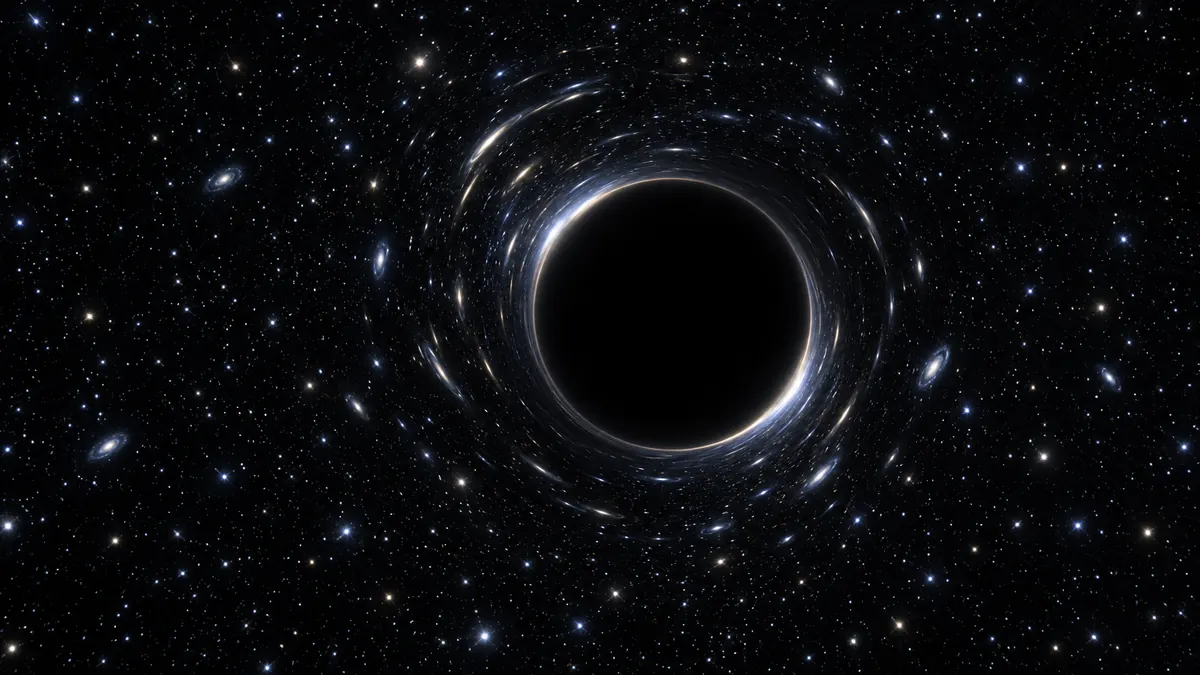
Quick answer: Rogue black holes are black holes that drift through space on their own, with no companion star and no surrounding gas, so they give off no light at all. They form when massive stars collapse and get kicked away, or when merging black holes recoil. Our galaxy may contain tens of millions of them. The first confirmed one, about 7 times the Sun’s mass and roughly 5,000 light-years away, was found in 2022 by watching it bend the light of a background star.
Most black holes we know about give themselves away by tugging on a partner star or heating up gas. A rogue black hole has none of that. It is a dark, heavy object silently roaming the galaxy. For years astronomers were sure they existed but couldn’t prove it. That changed with an observation that took six years of Hubble Space Telescope data. If you’re new to the topic, read what is a black hole first.
What makes a black hole “rogue”?
| Rogue black hole | Black hole in a binary | |
|---|---|---|
| Companion | None | Orbits a star |
| Light or X-rays | None | Often bright X-rays from stolen gas |
| How we find it | Gravitational microlensing | X-rays or the companion star’s wobble |
| Known examples | About 1 confirmed | A few dozen |
How do rogue black holes form?
- Supernova kicks: When a massive star collapses, the explosion can be lopsided, kicking the new black hole away at high speed and breaking up any binary system.
- Losing a partner: A black hole’s companion star can be pulled away by a passing star or destroyed.
- Merger recoil: When two black holes merge, uneven gravitational waves can kick the new black hole at hundreds or thousands of km/s (see what happens when two black holes collide).
- Born alone: If they exist, primordial black holes from the early universe would be rogue from the start.
How was the first rogue black hole found?
In 2011, two survey teams (OGLE and MOA) saw a distant star in the direction of the galaxy’s center brighten unusually for about 270 days. This is called gravitational microlensing: an unseen object passing in front of the star bent its light like a lens.
A team led by Kailash Sahu then used the Hubble Space Telescope for six years to measure how the star’s apparent position shifted by a tiny amount as its light was bent. From that, they calculated the lens’s mass: about 7 times the Sun, with no light of its own. In 2022 they announced it as the first confirmed isolated black hole, named OGLE-2011-BLG-0462, about 5,000 light-years away. Another team initially suggested it might be a neutron star, but later analyses supported the black hole interpretation.
How many rogue black holes are there?
Astronomers estimate the Milky Way holds around 100 million stellar-mass black holes, and many, probably most, are isolated. That suggests tens of millions of rogue black holes roaming our galaxy. Read more in how many black holes are in our galaxy.
Runaway supermassive black holes
Even giant black holes might go rogue. In 2023, astronomer Pieter van Dokkum and colleagues reported a long, straight streak of young stars about 200,000 light-years long, which they suggested could be the trail left by a supermassive black hole ejected from its galaxy, triggering star formation as it plowed through gas. It remains a candidate and is still debated.
Could a rogue black hole hit Earth?
The chance is extremely small. Space is vast, and even with millions of rogue black holes in the galaxy, the odds of one passing through the solar system in the next few billion years are tiny. If one ever came within a light-year or so, it would first disturb the distant comets of the Oort Cloud. A rogue black hole would have to come very close to the inner solar system to affect planetary orbits, and there’s no sign of any such object nearby.
How will we find more?
NASA’s Nancy Grace Roman Space Telescope will run a huge microlensing survey toward the galaxy’s center and is expected to find many more isolated black holes. Data from ESA’s Gaia mission and the Vera C. Rubin Observatory will also help.
Frequently asked questions
What is a rogue black hole?
A black hole that travels through space alone, without a companion star or surrounding gas, so it emits no light.
Has a rogue black hole been found?
Yes. OGLE-2011-BLG-0462, announced in 2022, is the first confirmed isolated stellar-mass black hole, found through microlensing.
How fast do rogue black holes move?
The first one found is moving at about 45 km per second relative to its surroundings, faster than nearby stars, consistent with a kick at birth.
Are rogue black holes dangerous?
Not in practice. None is known to be near the solar system, and the chance of a close encounter is extremely low.
How are rogue black holes different from rogue planets?
Both drift without a star, but a rogue planet is a planet ejected from its system, while a rogue black hole is the collapsed remnant of a massive star.
Related articles
- What is a black hole?
- How many black holes are in our galaxy?
- Names of famous black holes
- Primordial black holes
- Facts about exoplanets (including rogue planets)
Sources
- Sahu, K. C. et al. (2022). “An isolated stellar-mass black hole detected through astrometric microlensing.” The Astrophysical Journal.
- Lam, C. Y. et al. (2022). “An isolated mass-gap black hole or neutron star detected with astrometric microlensing.” The Astrophysical Journal Letters.
- van Dokkum, P. et al. (2023). “A candidate runaway supermassive black hole identified by shocks and star formation in its wake.” The Astrophysical Journal Letters.
- NASA: “Hubble determines mass of isolated black hole roaming our Milky Way galaxy” (2022). science.nasa.gov