
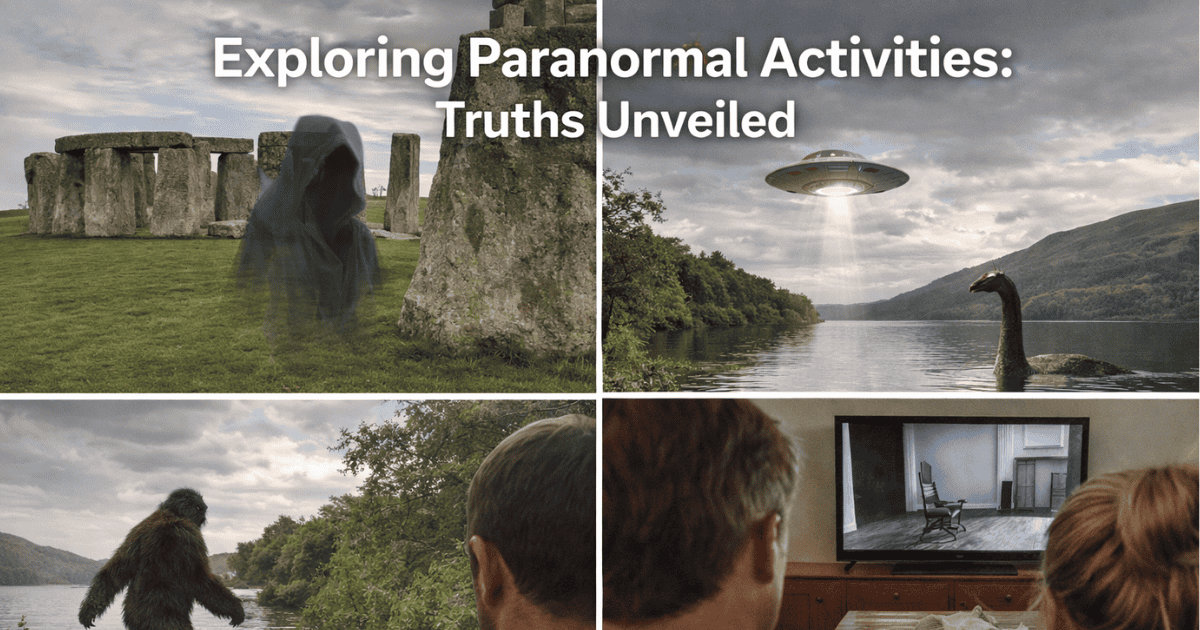
Quick answer: Paranormal activity refers to events that seem to go beyond normal scientific explanation, such as ghosts, hauntings, psychic powers and poltergeists. Surveys show many people believe in at least one paranormal idea, but no paranormal claim has been confirmed under controlled scientific testing. Researchers have found natural explanations for many experiences, including sleep paralysis, low-frequency sound (infrasound), carbon monoxide poisoning, the brain’s habit of seeing faces in random patterns, and ordinary memory errors.
Footsteps in an empty hallway, a cold spot in an old house, a shadow at the edge of your vision: experiences like these have been reported in every culture for thousands of years. This article takes them seriously. It looks at what people experience, what researchers have tested, and what science can and can’t explain about paranormal activity.
How common is belief in the paranormal?
Very common. A 2005 Gallup poll found that about three in four Americans held at least one paranormal belief, such as in haunted houses, telepathy, ghosts or astrology. A 2009 Pew Research Center survey found that around one in five US adults said they had seen or been in the presence of a ghost. Similar beliefs are widespread worldwide, though they take different forms in different cultures.
Types of paranormal activity
| Type | What people report | Common natural explanations |
|---|---|---|
| Ghosts and apparitions | Seeing figures, shadows or faces | Pareidolia, peripheral vision, sleep-related hallucinations |
| Hauntings | Noises, cold spots, feelings of being watched | Old buildings settling, drafts, infrasound, suggestion |
| Poltergeists | Objects moving, knocking sounds | Pipes, animals, vibration, deliberate hoaxes |
| Psychic abilities (ESP) | Telepathy, predicting the future | Coincidence, cold reading, selective memory |
| Mediums and spirit contact | Messages from the dead | Cold reading, the ideomotor effect (Ouija boards) |
| Night visitors | A presence pressing on the chest at night | Sleep paralysis |
What science says: 7 explanations for paranormal experiences
1. Sleep paralysis
During REM sleep, your body is naturally paralyzed so you don’t act out dreams (see why do we dream?). Sometimes people wake up while the paralysis continues and dream imagery spills into waking. They may see a figure in the room, feel pressure on their chest and be unable to move. Studies estimate that about 8% of people experience sleep paralysis at some point, and it likely explains many “night visitor” legends worldwide.
2. Infrasound
Infrasound is sound below about 20 Hz, too low for us to hear consciously. In 1998, engineer Vic Tandy investigated a “haunted” laboratory where people felt uneasy and saw gray shapes. He traced the problem to a new extractor fan producing a standing wave at about 19 Hz, close to the frequency at which the eyeball may vibrate. When the fan was adjusted, the “ghost” disappeared.
3. Carbon monoxide poisoning
In 1921, an eye doctor named William Wilmer published the case of a family whose “haunted house” experiences, including strange sounds, feelings of dread and apparitions, stopped after a faulty furnace leaking carbon monoxide was repaired. Low-level carbon monoxide exposure can cause headaches, confusion and hallucinations. If a home suddenly feels “haunted”, checking for a gas leak is a sensible first step.
4. Pareidolia
The human brain is wired to spot faces and patterns, even in random shapes. This helps us recognize people quickly, but it also means we see faces in clouds, wood grain and blurry photographs.
5. Expectation and suggestion
In experiments, people told a location is haunted tend to report more unusual experiences there than people who were told nothing. Expectation shapes what we notice and how we interpret it.
6. Memory and coincidence
We remember the dream that “came true” and forget the thousands that didn’t. Memories are also rebuilt every time we recall them, so stories can grow over time.
7. Hoaxes and camera artifacts
From the Fox sisters, whose 1840s “spirit rappings” launched Spiritualism (one sister later demonstrated how they cracked their toe joints to make the sounds), to modern “ghost orbs”, which are usually dust or water droplets lit by a camera flash, many famous cases have turned out to be tricks or photographic effects.
Has anyone proven paranormal powers?
No paranormal ability has been reliably demonstrated under controlled conditions. The James Randi Educational Foundation offered a prize of $1 million for proof of a paranormal power under agreed test conditions from 1964 until 2015. Many people applied; none succeeded. Some parapsychology studies, such as the Ganzfeld telepathy experiments, have reported small positive effects, but these have not been consistently replicated, and most scientists remain unconvinced.
Why do people believe in the paranormal?
- To make sense of strange experiences. When something frightening happens, a clear explanation, even a supernatural one, can feel better than uncertainty.
- Grief and connection. Feeling the presence of a loved one after their death is very common and can be comforting.
- Culture and stories. Folklore, religion, films and social media all shape what people expect to experience.
- Curiosity. Unexplained events create information gaps the brain wants to fill (see why are humans curious?).
How to investigate a “haunting” scientifically
- Check for a carbon monoxide leak and install a detector.
- Look for drafts, loose fittings, pipes, animals and vibrations from nearby traffic or machinery.
- Record when events happen; patterns often point to ordinary causes, such as heating cycles.
- Consider sleep: many experiences happen while falling asleep or waking up.
- Seek medical advice if experiences are frequent, distressing or come with other symptoms.
Frequently asked questions
Is paranormal activity real?
The experiences are real in the sense that people genuinely have them. But there is no scientific evidence that ghosts or psychic powers cause them, and many have well-understood natural explanations.
Why do I feel like someone is watching me?
The brain is highly sensitive to possible threats and faces, so it sometimes detects a “presence” that isn’t there, especially when you’re tired, anxious or alone in the dark.
What is the most common paranormal experience?
Sensing a presence, hearing unexplained noises and seeing shadowy figures are among the most frequently reported experiences.
Do EMF meters detect ghosts?
No. EMF meters detect electromagnetic fields from wiring and appliances. There is no evidence that ghosts produce them.
How do Ouija boards move?
Through the ideomotor effect: tiny, unconscious muscle movements by the people touching the pointer.
Related articles
- Strange occurrences around the world
- Mysterious places in the world
- Unsolved historical mysteries
- Why do we dream?
- Curiosity and the brain
Sources
- Moore, D. W. (2005). “Three in four Americans believe in paranormal.” Gallup News Service.
- Pew Research Center (2009). “Many Americans mix multiple faiths.”
- Sharpless, B. A. & Barber, J. P. (2011). “Lifetime prevalence rates of sleep paralysis: a systematic review.” Sleep Medicine Reviews.
- Tandy, V. & Lawrence, T. R. (1998). “The ghost in the machine.” Journal of the Society for Psychical Research.
- Wilmer, W. H. (1921). “Effects of carbon monoxid upon the eye.” American Journal of Ophthalmology.
- French, C. C. & Stone, A. (2014). Anomalistic Psychology: Exploring Paranormal Belief and Experience. Palgrave Macmillan.