
Quick answer: Some of the most surprising facts about space: a day on Venus is longer than its year; neutron stars can spin over 700 times a second; footprints on the Moon can last for millions of years; the Sun turns about 4 million tonnes of matter into energy every second; and the observable universe holds hundreds of billions to perhaps two trillion galaxies. Each fact below is explained with the science behind it.
Space is full of numbers too big to imagine and phenomena that seem to break common sense. These 15 facts about space are all backed by measurements from NASA, ESA and peer-reviewed research. For a younger audience, try our space facts for kids.
Facts about the universe
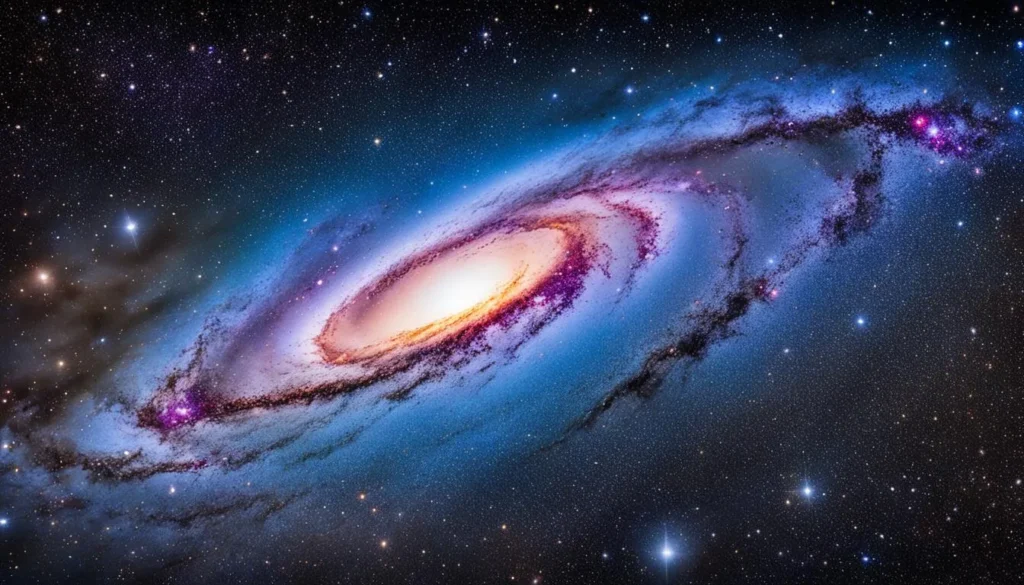
- The observable universe contains hundreds of billions of galaxies, possibly trillions. A 2016 study estimated about two trillion. Later measurements from NASA’s New Horizons spacecraft suggested the number may be lower, in the hundreds of billions. Either way, each galaxy can hold billions of stars.
- The observable universe is about 93 billion light-years across. That is wider than 13.8 billion years of light travel would suggest, because space itself has expanded while the light was on its way.
- Space isn’t completely empty. Even between galaxies there are a few atoms per cubic meter, plus radiation, magnetic fields and neutrinos. It is still emptier than any vacuum made on Earth.
- There’s no sound in space. Sound needs a medium such as air or water to travel through. In the near-vacuum of space, explosions are silent.
Facts about stars and black holes
- The Sun converts about 4 million tonnes of mass into energy every second. Nuclear fusion in its core turns hydrogen into helium, and the “missing” mass becomes the energy that lights the solar system. It has enough fuel for about another 5 billion years.
- Sunlight is about 8 minutes old when it reaches you. Light takes roughly 8 minutes and 20 seconds to cross the 150 million km between the Sun and Earth.
- Neutron stars can spin more than 700 times a second. The fastest known pulsar, PSR J1748-2446ad, rotates 716 times per second.
- Thousands of black holes may surround the center of our galaxy. In 2018, astronomers found a dozen black holes paired with stars within a few light-years of Sagittarius A*, suggesting around 10,000 may lurk there (see how many black holes are in our galaxy).
- Gamma-ray bursts are the most powerful explosions known. In a few seconds, a burst can release more energy than the Sun will produce in its entire lifetime.
Facts about our solar system
- A day on Venus is longer than its year. Venus takes about 243 Earth days to spin once, but only about 225 Earth days to orbit the Sun. It also spins backward compared to most planets.
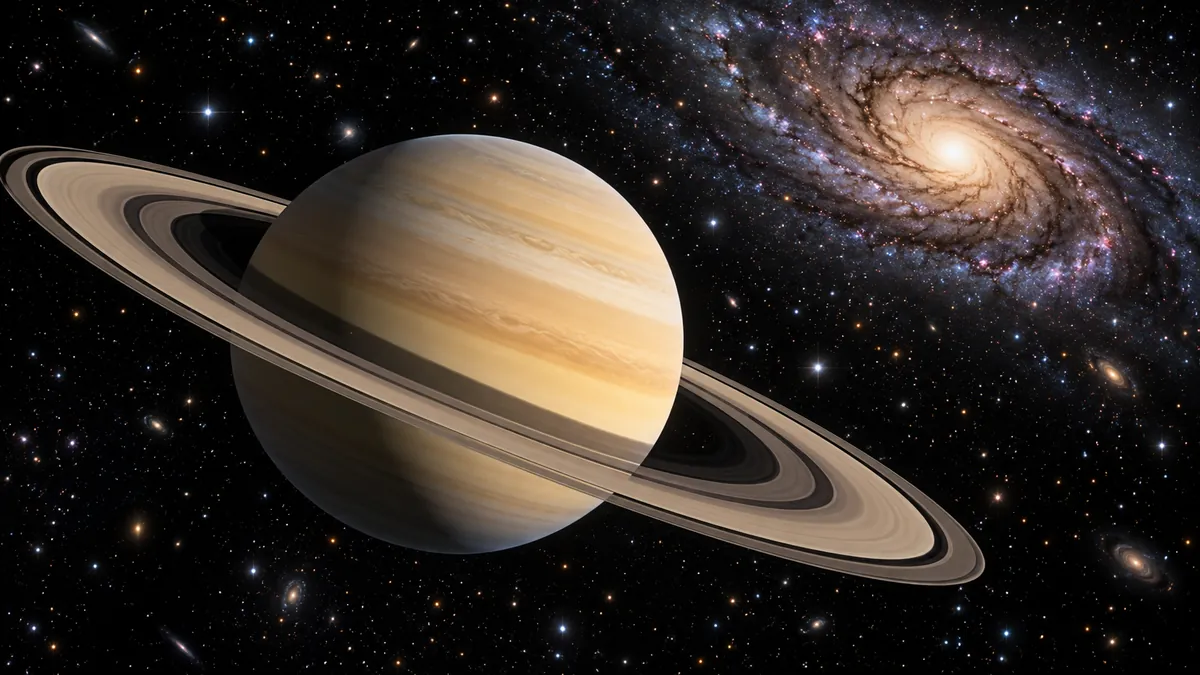
- Saturn is less dense than water. Its average density is about 0.7 grams per cubic centimeter, so in theory it would float in a big enough bathtub, though as a ball of gas it wouldn’t stay in one piece.
- Mars has the tallest volcano in the solar system. Olympus Mons rises about 22 km, roughly two and a half times the height of Mount Everest above sea level.
- Footprints on the Moon could last millions of years. With no wind or rain, the only things that slowly erase them are tiny meteorite impacts and solar radiation.
- The Moon is drifting away. Laser measurements show it moves about 3.8 cm farther from Earth every year, about as fast as your fingernails grow.
- The International Space Station circles Earth about 16 times a day. It travels at around 28,000 km/h, so astronauts on board see roughly 16 sunrises and sunsets every 24 hours.
Facts about space at a glance
| Fact | Number |
|---|---|
| Age of the universe | About 13.8 billion years |
| Diameter of the observable universe | About 93 billion light-years |
| Fastest known pulsar | 716 spins per second |
| Time for sunlight to reach Earth | About 8 min 20 s |
| Venus day vs year | 243 vs 225 Earth days |
| Height of Olympus Mons | About 22 km |
| Moon’s yearly drift | About 3.8 cm |
| ISS orbits per day | About 16 |
Frequently asked questions
What is the most interesting fact about space?
Many people find it surprising that a day on Venus lasts longer than a Venus year, or that the light we see from distant galaxies left them billions of years ago.
Is space really silent?
Yes, for human ears. Sound waves need matter to travel through, and space is nearly empty. Spacecraft instruments can, however, detect vibrations in plasma that scientists convert into sound.
How cold is space?
The background temperature of space is about 2.7 kelvin, or roughly −270 °C. Objects in sunlight, however, can get very hot.
How many stars are in the Milky Way?
Estimates range from about 100 billion to 400 billion stars.
Does space smell?
Astronauts returning from spacewalks have described a smell on their suits like seared steak, hot metal or gunpowder, probably from reactive oxygen atoms clinging to their gear.
Related articles
- Space facts for kids
- The biggest space discoveries
- What is a black hole?
- Why do stars twinkle?
- Unsolved mysteries of the universe
Sources
- Conselice, C. J. et al. (2016). “The evolution of galaxy number density at z < 8 and its implications.” The Astrophysical Journal.
- Lauer, T. R. et al. (2021). “New Horizons observations of the cosmic optical background.” The Astrophysical Journal.
- Hessels, J. W. T. et al. (2006). “A radio pulsar spinning at 716 Hz.” Science.
- Hailey, C. J. et al. (2018). “A density cusp of quiescent X-ray binaries in the central parsec of the Galaxy.” Nature.
- NASA Science: Solar System facts. science.nasa.gov