
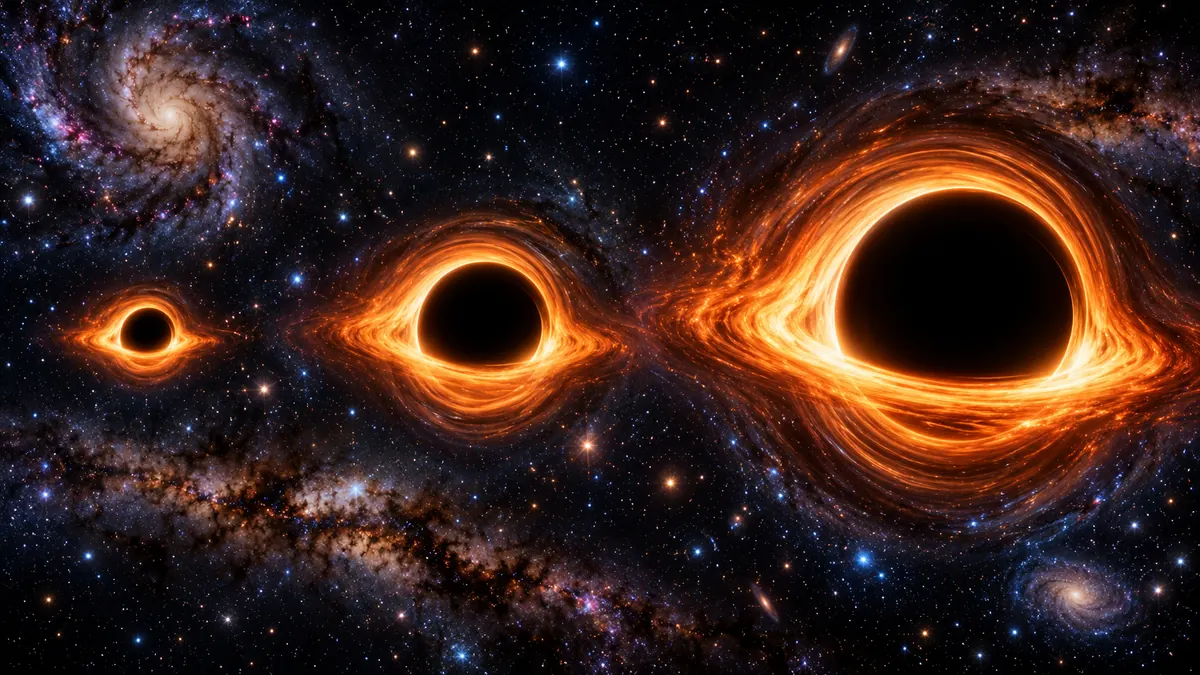
Quick answer: The most famous names of black holes include Sagittarius A* (the giant black hole at the center of our galaxy), M87* (the first black hole ever photographed), Cygnus X-1 (the first widely accepted black hole), TON 618 (one of the most massive known) and Gaia BH1 (the closest known to Earth). Most black hole names are catalog codes that describe where the object sits in the sky or which survey found it.
Black holes don’t get names like hurricanes. Most are labeled with a code that tells astronomers which constellation, catalog or telescope they belong to. Once you know the system, the names start to make sense. Here are 15 famous black holes and what each name means. New to the topic? Read what is a black hole first.
Famous black holes at a glance
| Name | Type | Mass (Sun = 1) | Distance from Earth | Famous for |
|---|---|---|---|---|
| Sagittarius A* | Supermassive | About 4 million | About 26,000 light-years | Center of the Milky Way |
| M87* (Pōwehi) | Supermassive | About 6.5 billion | About 55 million light-years | First black hole image (2019) |
| Cygnus X-1 | Stellar | About 21 | About 7,000 light-years | First widely accepted black hole |
| Gaia BH1 | Stellar | About 10 | About 1,560 light-years | Closest known black hole |
| Gaia BH3 | Stellar | About 33 | About 1,900 light-years | Most massive stellar black hole in our galaxy |
| TON 618 | Supermassive | Tens of billions (estimate) | Billions of light-years | One of the most massive known |
| GW150914 | Merger | 36 + 29, becoming 62 | About 1.3 billion light-years | First gravitational waves detected |
How are black holes named?
- Constellation + type + number: Cygnus X-1 means the first X-ray source found in the constellation Cygnus.
- Catalog codes: TON 618 is object 618 in a catalog made at the Tonantzintla Observatory in Mexico. M87 is object 87 in Charles Messier’s 18th-century catalog.
- The asterisk (*): Used for a compact radio source at a galaxy’s core, as in Sagittarius A* and M87*.
- Survey names: Gaia BH1 is the first black hole found using data from the European Space Agency’s Gaia satellite.
- Dates: Gravitational-wave events are named “GW” plus the date, so GW150914 was detected on 14 September 2015.
- Nicknames: A few get cultural names. M87* was given the Hawaiian name Pōwehi, meaning roughly “embellished dark source of unending creation”.
Supermassive black holes
1. Sagittarius A* (Sgr A*)
The black hole at the heart of the Milky Way, about 4 million times the Sun’s mass. Tracking stars orbiting it earned Reinhard Genzel and Andrea Ghez half of the 2020 Nobel Prize in Physics, and the Event Horizon Telescope released its first image in 2022.
2. M87* (Pōwehi)
In the giant galaxy Messier 87, this was the first black hole ever photographed, in images released in April 2019. It is about 1,500 times heavier than Sagittarius A* and launches a jet of particles thousands of light-years long.
3. TON 618
A quasar powered by one of the most massive black holes known, often quoted at around 40 to 66 billion Suns. Its light has traveled for about 10 billion years to reach us. Estimates for such distant objects are uncertain.
4. M31*
The central black hole of the Andromeda Galaxy, our nearest large neighbor, is estimated at roughly 100 million Suns, about 25 times heavier than our own.
5. UHZ1
Found in 2023 using NASA’s Chandra X-ray Observatory and the James Webb Space Telescope, this black hole existed only about 470 million years after the Big Bang, one of the earliest known.
Stellar-mass black holes in our galaxy
6. Cygnus X-1
Discovered as an X-ray source in 1964 and accepted as a black hole in the 1970s. It was the subject of a famous 1974 bet between Stephen Hawking and Kip Thorne; Hawking bet it was not a black hole and conceded in 1990.
7. Gaia BH1
Identified in 2022 from the wobble of a Sun-like star orbiting it, about 1,560 light-years away in the constellation Ophiuchus. It is the closest known black hole to Earth.
8. Gaia BH2
Found in 2023, about 3,800 light-years away, orbited by a red giant star.
9. Gaia BH3
Announced in 2024, about 33 times the Sun’s mass and around 1,900 light-years away, the heaviest stellar black hole known in the Milky Way.
10. V404 Cygni
A black hole about 9 times the Sun’s mass that flares dramatically when it pulls in material from its companion star. Its 2015 outburst was one of the brightest X-ray events seen.
11. A0620-00
Before the Gaia discoveries, this black hole about 3,000 light-years away in Monoceros was often listed among the closest known.
12. OGLE-2011-BLG-0462
The first isolated, “rogue” black hole confirmed by gravitational microlensing, announced in 2022 (see rogue black holes).
Black holes found by gravitational waves
13. GW150914
The first direct detection of gravitational waves: two black holes of about 36 and 29 Suns merging into one of about 62 (see what happens when two black holes collide).
14. GW190521
A merger that produced a black hole of about 140 solar masses, the first clear example of an “intermediate-mass” black hole.
15. HLX-1
Short for “Hyper-Luminous X-ray source 1”, this object near the galaxy ESO 243-49, about 290 million light-years away, is one of the best candidates for an intermediate-mass black hole, estimated at roughly 20,000 times the Sun’s mass.
Frequently asked questions
What is the name of the black hole in our galaxy?
Sagittarius A*, pronounced “Sagittarius A-star”, at the center of the Milky Way.
What is the biggest black hole ever found?
TON 618 and Phoenix A are among the candidates, with estimated masses in the tens of billions of Suns. These estimates are uncertain.
What is the closest black hole to Earth?
Gaia BH1, about 1,560 light-years away.
Why does Sagittarius A* have a star symbol?
The asterisk was added to show it is the compact, bright radio source within the larger radio region called Sagittarius A.
Do black holes have real names?
Mostly no. They usually carry catalog codes, though a few, like M87* (Pōwehi), have been given cultural names.
Related articles
- What is a black hole?
- How many black holes are in our galaxy?
- Rogue black holes
- Primordial black holes
- The biggest space discoveries
Sources
- Event Horizon Telescope Collaboration (2019). “First M87 Event Horizon Telescope results. I.” The Astrophysical Journal Letters. doi:10.3847/2041-8213/ab0ec7
- El-Badry, K. et al. (2023). “A Sun-like star orbiting a black hole.” Monthly Notices of the Royal Astronomical Society.
- Gaia Collaboration (2024). “Discovery of a dormant 33 solar-mass black hole in pre-release Gaia astrometry.” Astronomy & Astrophysics.
- Miller-Jones, J. C. A. et al. (2021). “Cygnus X-1 contains a 21-solar mass black hole.” Science.
- LIGO Scientific and Virgo Collaborations (2020). “GW190521: a binary black hole merger with a total mass of 150 solar masses.” Physical Review Letters.
- Bogdán, Á. et al. (2023). “Evidence for heavy-seed origin of early supermassive black holes from a z ≈ 10 X-ray quasar.” Nature Astronomy.