
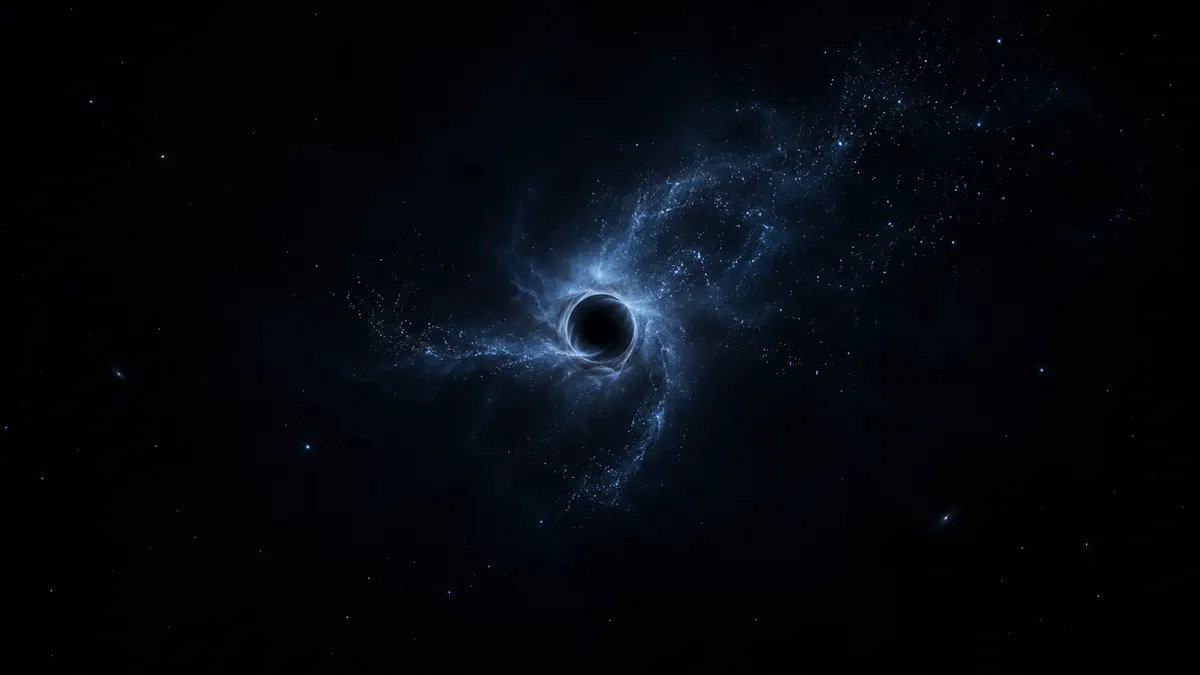
Quick answer: Do black holes die? According to Stephen Hawking’s 1974 prediction, yes, but incredibly slowly. Black holes leak a faint glow called Hawking radiation, lose mass and eventually evaporate, ending in a final burst of energy. A black hole with the Sun’s mass would take around 1067 years to disappear, far longer than the universe’s current age of 13.8 billion years. Hawking radiation has never been observed directly.
For a long time, black holes were thought to be forever: anything that falls in can never come out, so how could they ever shrink? In 1974, Stephen Hawking combined general relativity with quantum physics and reached a startling conclusion: black holes are not completely black. They glow very faintly, and that glow slowly drains them away. For a quick introduction, see what is a black hole?
What is Hawking radiation?
Quantum physics says that even “empty” space is full of tiny, fleeting energy fluctuations. Near a black hole’s event horizon, these effects mean the black hole emits a weak stream of particles and light, as if it had a temperature. This is Hawking radiation.
A popular simplified picture: pairs of “virtual” particles pop into existence near the horizon. Occasionally one falls in and the other escapes. The escaping particle carries energy away, and the black hole loses a matching amount of mass. Physicists stress this is only an analogy, but it captures the main idea: the black hole slowly loses mass.
How long does it take a black hole to die?
The key rule: smaller black holes are hotter and evaporate faster. Bigger ones are colder and last far longer.
| Black hole mass | Hawking temperature | Approximate lifetime |
|---|---|---|
| About a billion tonnes (a small mountain) | Over 100 billion degrees | About the age of the universe (13.8 billion years) |
| 1 Sun | About 60 billionths of a degree above absolute zero | About 1067 years |
| 4 million Suns (Sagittarius A*) | Even colder | About 1087 years |
| Tens of billions of Suns | Coldest of all | Up to about 10100 years |
Why aren’t black holes shrinking right now?
Because real black holes are colder than the universe around them. The cosmic microwave background, the afterglow of the Big Bang, has a temperature of about 2.7 kelvin. A stellar black hole’s Hawking temperature is billions of times colder than that. So today, black holes absorb more energy from the background radiation, and from gas, stars and dark matter, than they lose. They are still growing.
Only in the far future, when the universe has expanded and cooled far below their temperature, will black holes start to shrink overall.
What happens when a black hole dies?
- Slow shrinking: Over unimaginable times, the black hole loses mass through Hawking radiation.
- Speeding up: As it gets smaller, it gets hotter and evaporates faster.
- Final burst: In the last moments, it releases its remaining energy in a flash of high-energy radiation, including gamma rays.
- What’s left? Physicists don’t know. It may vanish completely, or leave a tiny remnant. What happens to the information about everything that fell in is one of physics’ biggest puzzles (see the black hole information paradox).
Has anyone seen a black hole die?
No. Stellar and supermassive black holes won’t evaporate for an almost unimaginable time. The only ones that could be dying now are tiny primordial black holes formed just after the Big Bang, with masses of around a billion tonnes. NASA’s Fermi Gamma-ray Space Telescope and other observatories have searched for their final flashes, but none has been found.
Can black holes be destroyed in other ways?
Not as far as we know. When two black holes collide, they don’t destroy each other; they merge into a bigger black hole, releasing some energy as gravitational waves (see what happens when two black holes collide). Nothing we know of can “blow up” a black hole.
The far future of the universe
If the universe keeps expanding, stars will eventually burn out. After roughly 1014 years, few new stars will form. Over far longer times, black holes will become the main objects left. Then, over 1067 to 10100 years, even they will evaporate, leaving a cold, dark universe filled with faint radiation. Scientists sometimes call this the “black hole era” followed by the “dark era”.
Frequently asked questions
Can a black hole disappear?
In theory, yes, through Hawking radiation. In practice, it would take far longer than the current age of the universe for any known black hole.
What is the lifespan of a black hole?
It depends on mass. A black hole with the Sun’s mass would last about 1067 years; supermassive ones up to about 10100 years.
Has Hawking radiation been proven?
Not directly. It is far too weak to detect from real black holes. Lab experiments with “analog black holes” made from sound waves in ultracold gases have produced effects that mimic it.
Do black holes get bigger or smaller?
Today they get bigger, because they absorb more energy and matter than they lose. In the very distant future, they will slowly shrink.
What happens to things inside a dying black hole?
Nobody knows. This question is at the heart of the black hole information paradox, which physicists are still trying to solve.
Related articles
- What is a black hole?
- The black hole information paradox
- Primordial black holes
- What happens when two black holes collide
- Unsolved mysteries of the universe
Sources
- Hawking, S. W. (1974). “Black hole explosions?” Nature. doi:10.1038/248030a0
- Hawking, S. W. (1975). “Particle creation by black holes.” Communications in Mathematical Physics.
- Page, D. N. (1976). “Particle emission rates from a black hole.” Physical Review D.
- Adams, F. C. & Laughlin, G. (1997). “A dying universe: the long-term fate and evolution of astrophysical objects.” Reviews of Modern Physics.
- Steinhauer, J. (2016). “Observation of quantum Hawking radiation and its entanglement in an analogue black hole.” Nature Physics.