
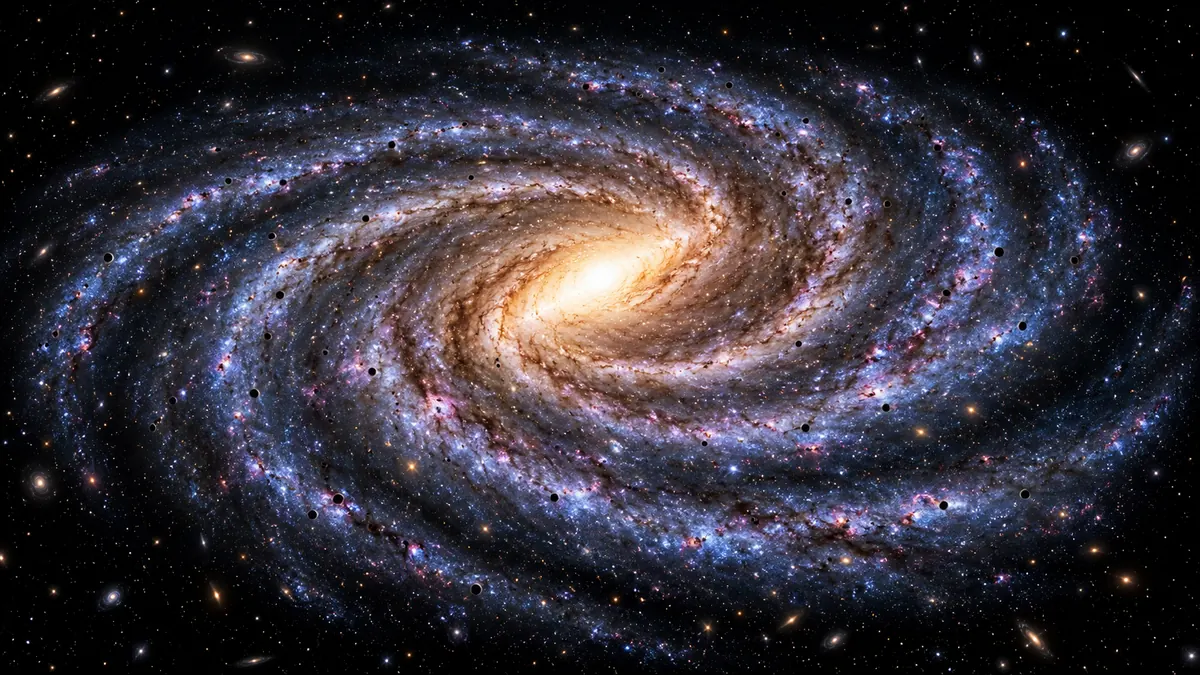
Quick answer: How many black holes in our galaxy? Astronomers estimate the Milky Way contains roughly 100 million stellar-mass black holes, plus one supermassive black hole, Sagittarius A*, at its center. But only a few dozen have actually been identified, because most black holes are dark, alone and almost impossible to see. The nearest known, Gaia BH1, is about 1,560 light-years away.
Black holes are the remains of the most massive stars, and the Milky Way has been making stars for more than 13 billion years. That means our galaxy should be full of black holes, even though we can only spot a tiny fraction of them. Here is how scientists estimate the number and what we have actually found. For background, see what is a black hole.
Black holes in the Milky Way at a glance
| Type | Estimated number | Confirmed so far |
|---|---|---|
| Supermassive | 1 (Sagittarius A*) | 1, imaged in 2022 |
| Stellar-mass | About 100 million (estimate) | A few dozen, mostly in binary systems |
| Isolated (“rogue”) stellar black holes | Most of the 100 million | About 1 confirmed by microlensing |
| Intermediate-mass | Unknown | Candidates only |
How do astronomers estimate 100 million?
- Count the stars. The Milky Way has roughly 100 to 400 billion stars.
- Work out how many were massive. Only stars born with roughly 20 or more times the Sun’s mass usually leave black holes, and they make up a small fraction of all stars.
- Add up galactic history. Massive stars live only a few million years, so many generations have already died and left black holes behind.
Combining these gives a figure around 100 million. Some estimates are higher or lower, so treat it as an order-of-magnitude number rather than an exact count.
Why have we found so few?
A black hole on its own gives off no light. We can usually only detect one in three ways:
- X-rays from a companion: When a black hole pulls gas off a nearby star, the gas heats up and glows in X-rays. Cygnus X-1 was found this way.
- A star’s wobble: If a visible star orbits an unseen heavy object, its motion reveals the black hole. The European Space Agency’s Gaia satellite found Gaia BH1, BH2 and BH3 this way.
- Microlensing: When a black hole passes in front of a distant star, its gravity briefly bends and brightens the star’s light. This revealed the first isolated black hole in 2022 (see rogue black holes).
Most black holes have no companion and aren’t passing in front of a star at the right moment, so they stay hidden.
The supermassive black hole at the center
At the heart of the Milky Way, about 26,000 light-years from us, sits Sagittarius A*, about 4 million times the Sun’s mass. Astronomers proved it was there by tracking stars whipping around an invisible point at thousands of kilometers per second, research that won the 2020 Nobel Prize in Physics. In 2022 the Event Horizon Telescope released its first image.
The region around it may also host a crowd of smaller black holes. In 2018, astronomers found a dozen black holes with companion stars within about 3 light-years of the center and estimated that around 10,000 may be packed into that small area.
The closest black holes to Earth
| Black hole | Distance | Mass (Sun = 1) |
|---|---|---|
| Gaia BH1 | About 1,560 light-years | About 10 |
| Gaia BH3 | About 1,900 light-years | About 33 |
| A0620-00 | About 3,000 light-years | About 6 to 7 |
| Gaia BH2 | About 3,800 light-years | About 9 |
Because millions of black holes are undiscovered, there are almost certainly closer ones we haven’t found yet. The true nearest black hole may be much closer than Gaia BH1. None is close enough to be a danger. See more in our list of famous black holes.
How many black holes are in the whole universe?
A 2022 study by Alex Sicilia and colleagues estimated about 40 quintillion (40 billion billion) stellar-mass black holes in the observable universe, making up about 1% of all ordinary matter.
Frequently asked questions
Is there a black hole in the Milky Way?
Yes, many. The biggest is Sagittarius A* at the center, and there are probably around 100 million smaller ones spread through the galaxy.
How many black holes have been discovered in the Milky Way?
Only a few dozen have been confirmed, mostly black holes with companion stars, plus a handful found by the Gaia satellite and one isolated black hole found by microlensing.
Will the Milky Way’s black hole swallow Earth?
No. Earth is about 26,000 light-years from Sagittarius A*, in a stable orbit around the galaxy’s center, just like the Sun.
Where is the nearest black hole?
The nearest confirmed one is Gaia BH1, about 1,560 light-years away in the constellation Ophiuchus.
Does every galaxy have a black hole?
Almost every large galaxy appears to have a supermassive black hole at its center, and all galaxies with massive stars should contain many stellar-mass black holes.
Related articles
- What is a black hole?
- Names of famous black holes
- Rogue black holes
- Primordial black holes
- 15 mind-blowing facts about space
Sources
- Hailey, C. J. et al. (2018). “A density cusp of quiescent X-ray binaries in the central parsec of the Galaxy.” Nature.
- Sicilia, A. et al. (2022). “The black hole mass function across cosmic time. I.” The Astrophysical Journal.
- Sahu, K. C. et al. (2022). “An isolated stellar-mass black hole detected through astrometric microlensing.” The Astrophysical Journal.
- El-Badry, K. et al. (2023). “A Sun-like star orbiting a black hole.” Monthly Notices of the Royal Astronomical Society.
- Event Horizon Telescope Collaboration (2022). “First Sagittarius A* Event Horizon Telescope results.” The Astrophysical Journal Letters.
- NASA Science: “Black Holes”. science.nasa.gov