
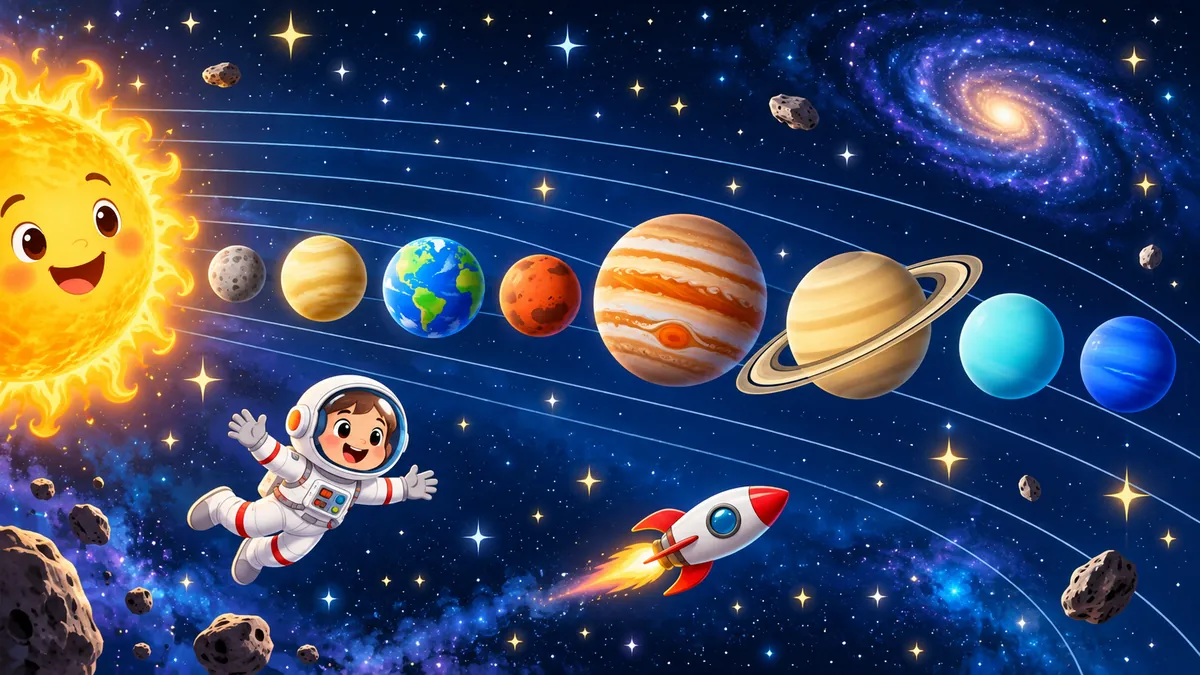
Quick answer: Here are some of the best space facts for kids: the Sun is a star so big that about 1.3 million Earths could fit inside it. A day on Venus lasts longer than its year. Saturn could float in a giant bathtub. And astronauts’ footprints on the Moon could last for millions of years. Keep reading for 25 fun, true facts about space.
Space is full of things that sound impossible but are true. These facts are written for kids, parents and teachers. Each one comes with a short explanation, so you can learn why it is true, not just what it is.
Facts about the Sun
- The Sun is a star. It looks bigger and brighter than other stars only because it is much closer to us.
- About 1.3 million Earths could fit inside the Sun. It is about 109 times wider than Earth.
- Sunlight takes about 8 minutes to reach us. The light you see from the Sun left it a little over 8 minutes ago.
- The Sun holds almost all the mass in our solar system, about 99.8% of it.

Space facts for kids about the planets
- Mercury is closest to the Sun, but Venus is the hottest planet. Venus’s thick clouds trap heat, making its surface about 465 °C, hot enough to melt lead.
- A day on Venus is longer than its year. Venus takes about 243 Earth days to spin once, but only about 225 Earth days to go around the Sun.
- Mars is red because of rust. Its soil is full of iron oxide, the same stuff as rust.
- Mars has the tallest volcano in the solar system. Olympus Mons is about 22 km high, around two and a half times the height of Mount Everest.
- Jupiter is the biggest planet. More than 1,300 Earths could fit inside it.
- Jupiter’s Great Red Spot is a giant storm that is wider than Earth and has been raging for hundreds of years.
- Saturn could float in water. It is made mostly of light gases, so it is less dense than water, though you would need an impossibly big bathtub.
- Uranus spins on its side. It is tipped over so far that it seems to roll around the Sun like a ball.
- Neptune has the fastest winds in the solar system, reaching around 2,000 km/h.
- Pluto is a dwarf planet. Astronomers reclassified it in 2006 because it shares its orbit with many other icy objects.
Facts about the Moon
- Footprints on the Moon could last for millions of years. The Moon has no wind or rain to wipe them away.
- You would weigh about one-sixth as much on the Moon. Its gravity is much weaker than Earth’s, so you could jump about six times higher.
- The Moon is slowly drifting away from Earth, by about 3.8 cm every year.
- Twelve people have walked on the Moon, all during NASA’s Apollo missions between 1969 and 1972.
Facts about astronauts and space travel
- Space is silent. Sound needs air to travel, and space is almost empty, so there is nothing to carry sound waves.
- Astronauts on the International Space Station see about 16 sunrises a day. The station circles Earth about every 90 minutes.
- Astronauts get a little taller in space. Without gravity pressing down, the spine stretches, so they can grow a few centimeters until they return to Earth.

Facts about stars, galaxies and the universe
- Our galaxy, the Milky Way, contains hundreds of billions of stars.
- The closest star after the Sun is about 4.2 light-years away. Its light takes over 4 years to reach us. It is called Proxima Centauri.
- Stars twinkle because of Earth’s air. Moving air bends starlight. Out in space, stars don’t twinkle. Why do stars twinkle?
- Black holes pull so hard that not even light can escape. That is why they look black. Black holes explained
Frequently asked questions
What is the most amazing fact about space for kids?
Many kids love that a day on Venus is longer than its year, and that Saturn is light enough to float in water.
What is the biggest thing in space?
Galaxies are among the biggest single objects. Some galaxies are millions of light-years across and contain trillions of stars.
How cold is space?
Empty space far from any star is about −270 °C, just a few degrees above the coldest possible temperature.
Can you breathe in space?
No. There is no air in space, which is why astronauts wear spacesuits with their own oxygen supply.
Related articles
- 15 mind-blowing space facts
- Why do stars twinkle?
- Why is the sky blue?
- 10 amazing facts about exoplanets
Sources
- NASA Science: “Solar System Exploration” planet and Sun fact sheets.
- NASA Space Place: kid-friendly explainers on the Sun, Moon and planets.
- NASA: “Astronauts in space grow taller” and International Space Station facts.
- International Astronomical Union: 2006 definition of a planet.
- NASA Space Place